Why a fallback channel exists at all
Why do you need a fallback channel for voice OTP and flash call verification?
A fallback channel ensures verification succeeds even when SMS delivery is delayed or blocked. SMSRoute’s no-KYC API supports voice OTP and flash calls as reliable alternatives, maintaining user access without identity checks. This multi-channel approach boosts completion rates and trust, making your verification flow resilient across 149 countries.
Even on good routes, SMS OTP fails for a small slice of users. Commonly 1-5% on direct US routes, higher on aggregated ones. At a million verifications that is tens of thousands of people stuck at your login screen. Voice OTP and flash call verification are the two channels that catch them. They work differently enough that knowing which to reach for matters. Neither replaces SMS; both exist to recover the deliveries SMS misses.
This is the same logic as every fallback in the modern stack. The universal-reach argument our passkeys and SNA pieces make applies one layer down, among the phone-based channels themselves.
The two mechanisms, compared
How do voice OTP and flash call verification compare as SMS fallbacks?
Voice OTP delivers a spoken code via call, ideal for users with hearing or device limitations. Flash calls provide a missed call with caller ID as verification, faster and cost-effective. Both integrate with SMSRoute’s API, offering automatic failover and real-time DLRs, ensuring seamless fallback without compromising security or user experience.
| Voice OTP | Flash call | |
|---|---|---|
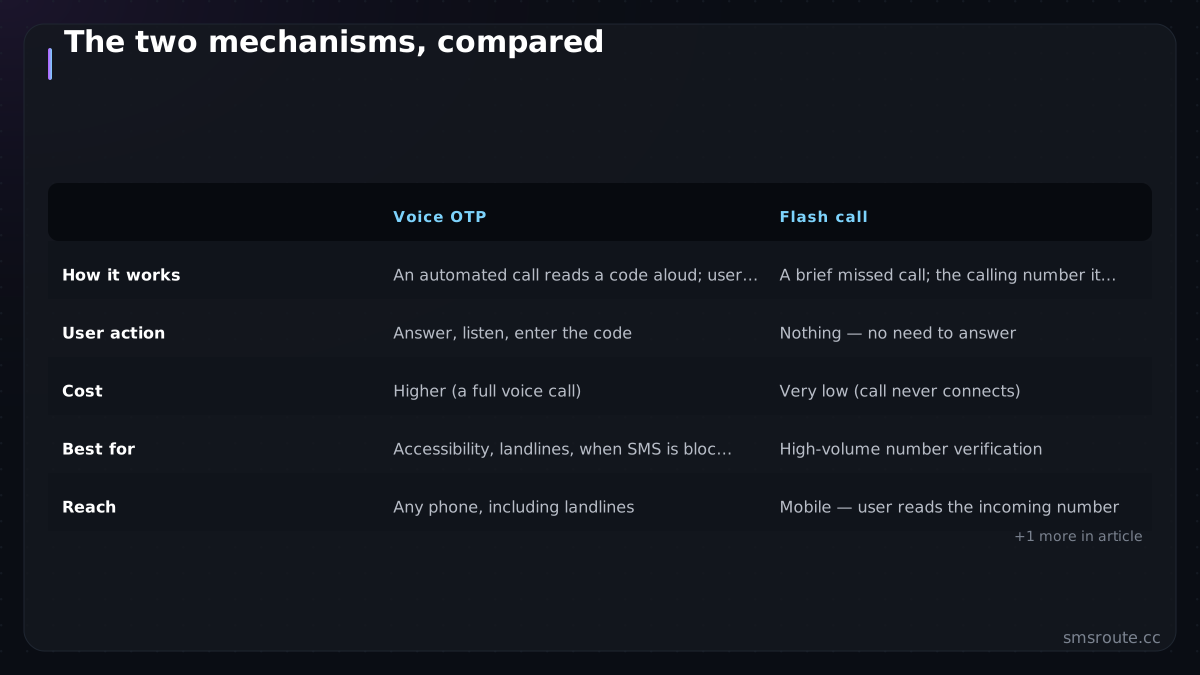
| How it works | An automated call reads a code aloud; user types it | A brief missed call; the calling number itself is the proof |
| User action | Answer, listen, enter the code | Nothing — no need to answer |
| Cost | Higher (a full voice call) | Very low (call never connects) |
| Best for | Accessibility, landlines, when SMS is blocked | High-volume number verification |
| Reach | Any phone, including landlines | Mobile — user reads the incoming number |
| Failure mode | User misses/ignores the call | Number withheld or app can't read call log |
Flash call is the quiet growth story here. A2P voice volume is projected to rise roughly 25x from 2022 to 2026, into the region of 128 billion calls. This happens precisely because a missed call verifies a number at a fraction of an SMS's cost. Voice OTP is the more universal but pricier option. It also serves accessibility and landline cases SMS and flash call cannot.
When to reach for each
When should you use voice OTP versus flash call verification?
Use voice OTP when users need a spoken code, such as for accessibility or when SMS is unreliable. Flash calls suit high-volume, low-cost scenarios where instant verification via missed call is acceptable. SMSRoute’s adaptive routing automatically selects the best fallback per destination, optimizing delivery and cost across 149 countries.
- SMS didn't deliver → voice OTP. The user is waiting, the SMS failed, and a call that reads the code works on any phone including landlines. The reliable catch-all fallback.
- High-volume number verification → flash call. When you are verifying that a number is real and reachable at scale, a missed call does it cheaply. Watch platform limits on reading the call log (Android restricts it, and the Play Store rules apply).
- Accessibility requirements → voice OTP. Visually-impaired users and those who cannot read a screen are served by a spoken code in a way no SMS is.
- Landline-heavy audiences → voice OTP. SMS and flash call assume a mobile; voice reaches the fixed line an older or business user actually answers.
Order by cost where you can: flash call is cheapest, SMS next, voice OTP the priciest. A cost-aware ladder tries the cheap channels first and escalates only on failure — but never at the expense of a user getting stuck, since a lost signup costs more than any message.
Fitting it into the flow
How do you integrate voice OTP and flash call fallbacks into your verification flow?
Integrate via SMSRoute’s REST API or SMPP, setting fallback logic to trigger voice OTP or flash call on SMS failure. Real-time DLR webhooks confirm delivery, while auto-refunds credit failed attempts. With crypto billing and no KYC, you can deploy in minutes, ensuring a smooth, compliant verification flow globally.
- Keep one code, one stateWhichever channel delivers, the code and its rate limits live in your backend — the channel-agnostic design from our OTP best-practices guide. Flash call is the exception: the 'code' is the caller number, so handle it as its own verification type.
- Time the fallbackNo SMS delivery confirmation in 15-30 seconds → escalate. Use the delivery receipts to trigger it rather than a blind timer where possible.
- Rate-limit every channel togetherPer-number caps must span SMS, voice, and flash call, or fraudsters use the multiplicity against you — the cross-channel version of the pumping defense.
- Measure recovery, not just deliveryThe metric that matters is end-to-end completion after fallback. Multichannel fallback recovers 90%+ of the initial SMS failures — track that you are actually getting it.
SMSRoute is a no-KYC SMS API with crypto billing (BTC, ETH, USDT, XMR, LTC, and SOL), focused on the SMS layer — the primary channel these voice methods back up. Voice OTP and flash call are typically a voice-API capability, so the honest architecture is SMS-first for reach and cost, with a voice provider layered for the fallback tier; keep the code, state, and rate limits unified in your backend across all of them. The multichannel fallback architecture guide wires the whole ladder together. SMSRoute's published route pages list delivery from $0.004/message (premium direct-carrier corridors up to $0.035) with sub-100ms median submission and ~98.6% delivered success (smsroute.cc route pages, 2026). For regulatory context on voice OTP and flash call, see the GSMA's guidelines on A2P messaging.
Related reading
FAQ
What is voice OTP?
What is flash call verification?
Should I use voice OTP or flash call?
Do voice OTP and flash call replace SMS?
Send your first SMS in 5 minutes
No KYC. Pay with BTC, ETH, USDT, XMR, LTC, and SOL. Live routes to 149 countries.
Get an API key →