
Two-way SMS lets your application send and receive messages through the same number — turning one-way alerts into conversations for support, keyword opt-ins, appointment confirmations, and user-driven flows. With smsroute, you get inbound numbers in 149 countries, real-time webhook delivery, and sub-100ms median latency. No KYC required. Pay with BTC, ETH, USDT, XMR, LTC, or SOL. This guide covers how two-way SMS works, how to set it up, the best use cases, and common pitfalls to avoid.
What Is Two-Way SMS and How Does It Work?
Two-way SMS is a messaging setup where your application both sends and receives messages through the same phone number. It works by assigning an inbound-capable number — a long code or short code — and forwarding every incoming text to your application via webhook in real time. The SMS protocol itself supports replies; the limitation is whether your sender type can receive them.
Alphanumeric sender IDs are send-only: effective for one-time passwords and marketing blasts but incapable of receiving replies. Long codes (standard phone numbers) and short codes (3–6 digits) both support full two-way SMS. Long codes work best for conversational volumes like customer support; short codes handle higher throughput and are common for keyword campaigns such as "Text JOIN to 12345."
Two-way SMS unlocks replies to confirmations, keyword opt-ins, support conversations, and surveys — use cases that purely outbound messaging cannot touch. Carriers expect two-way programs to comply with the TCPA and local equivalents, and smsroute handles compliance tooling as part of the platform.
How to Set Up Two-Way SMS in 4 Steps
Setting up two-way SMS with an API takes a few minutes. Here is the exact flow from provisioning to live traffic:
- Provision an inbound number — Get a long code or short code through your provider. Alphanumeric senders are send-only and will not work here.
- Point it at a webhook — When someone texts that number, the provider sends an HTTP POST to your webhook URL containing the sender number, message body, and timestamp. smsroute's inbound webhook payload mirrors the DLR delivery receipt pattern with a different schema for inbound messages.
- Route on content — Parse the body text and decide the action: a keyword match (YES, STOP, HELP), a reply to an open conversation, or free text for a human agent. Case- and punctuation-insensitive matching is critical — exactly as opt-out handling requires.
- Respond in thread — Reply from the same number so the conversation stays intact on the user's phone. Track conversation state keyed on their number with sensible timeouts, typically 24–72 hours.
Handle inbound webhooks the same way you handle DLRs: acknowledge with a fast 200, process asynchronously, and design for idempotency — providers can redeliver.
The same REST API and SMPP gateway you use for outbound sending also handles inbound webhook delivery. Set your webhook URL in the dashboard and start receiving messages immediately — no additional configuration required on the inbound side beyond pointing the number at your endpoint.
Best Use Cases for Two-Way SMS
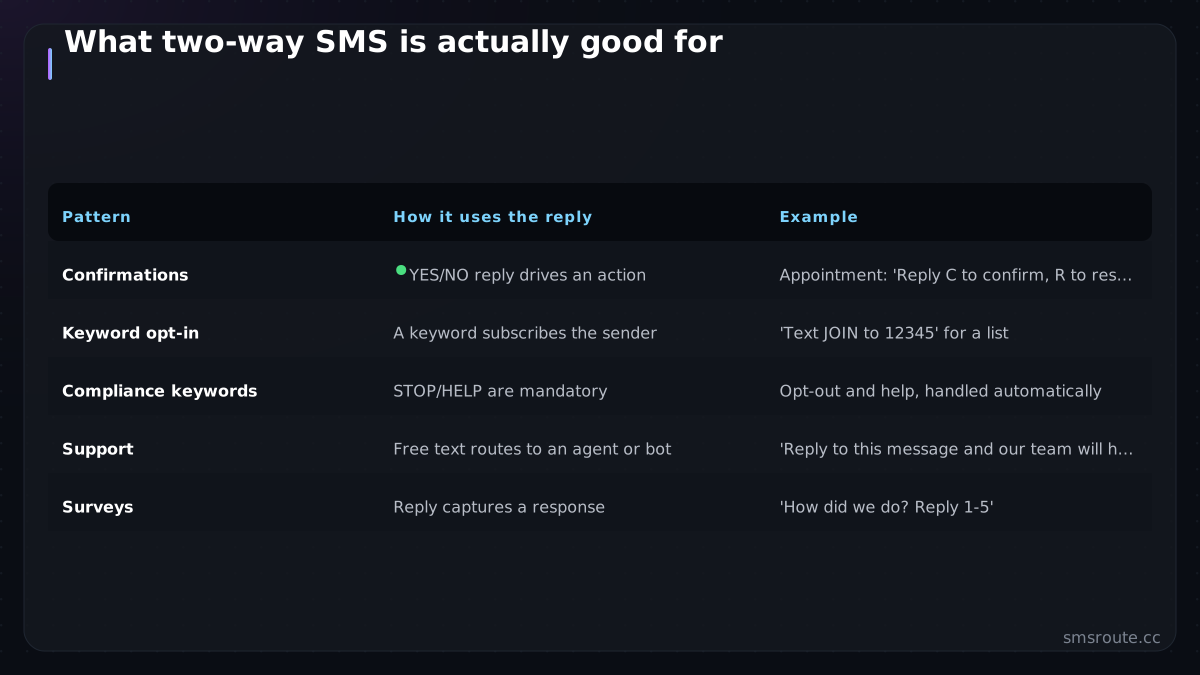
Two-way SMS excels wherever a reply does useful work — confirmations, keyword opt-ins, mandatory compliance keywords like STOP and HELP, support conversations routed to agents or bots, and surveys that capture responses without an app. Here is how each pattern maps to your application:
| Pattern | How It Uses the Reply | Example |
|---|---|---|
| Confirmations | YES/NO reply drives an action | "Reply C to confirm, R to reschedule" |
| Keyword opt-in | A keyword subscribes the sender | "Text JOIN to 12345" to join a list |
| Compliance keywords | STOP/HELP mandatory per carrier rules | Opt-out and help handled automatically |
| Support | Free text routes to agent or bot | "Reply to this message and our team will help" |
| Surveys | Reply captures a response | "How did we do? Reply 1–5" |
smsroute handles both directions from a single API. Send outbound via REST or SMPP; inbound arrives at your webhook with the same reliability as our delivery receipts. Coverage spans 149 countries with typical submission latency under 100ms and rates from $0.004 per message on direct-carrier corridors up to $0.035 for premium routes. Compare our pricing against other providers.
5 Rules for Building Reliable Two-Way SMS
Building reliable two-way SMS means accounting for number normalization, compliance keyword handling, conversation lifecycle management, and sender-type constraints. Follow these five rules:
- Normalize inbound numbers to E.164 format before matching conversations. The same person can text from +1-415-555-0100 and 14155550100 — without normalization they become two different users in your system. Our E.164 format guide covers the details.
- Always handle STOP and HELP — not optional on any two-way program. Carriers audit for these keywords, and missing them can result in fines or blocked routes. The compliance checklist covers everything you need.
- Set conversation timeouts — an open conversation should not route a reply sent three days later into a stale flow. Expire conversation state after a reasonable window, commonly 24–72 hours.
- Rate-limit inbound processing too — a flood of inbound messages, accidental or malicious, should not overwhelm your webhook handler. The same rate-limit patterns apply to both directions.
- Match sender type to use case — two-way requires a long code or short code, not an alphanumeric sender. Some countries mandate alphanumeric senders for specific traffic, so verify per destination before provisioning.
For a concrete walkthrough, start with the outbound SMS send example, add an inbound webhook, and route on content. That is a fully conversational SMS channel — and it reaches phones no app-based channel can. smsroute's published route pages show delivery from $0.004 per message with sub-100ms median submission and approximately 98.6% delivered success rate across our direct carrier connections.
Frequently Asked Questions
What is the best SMS gateway for two-way messaging?
How much does two-way SMS cost per message?
Can I use my existing phone number for two-way SMS?
What are STOP and HELP keywords in two-way SMS?
Do I need a short code or long code for two-way SMS?
Start sending two-way SMS in 5 minutes
No KYC. Pay with BTC, ETH, USDT, XMR, LTC, and SOL. Live routes to 149 countries. Sub-100ms latency. 98.6% delivery rate.
Get an API key →