The number type people overlook
Toll-free verification is lighter than short-code review but is not optional: unverified toll-free traffic is heavily throttled and filtered, so verification is the gate to actually delivering.
Where toll-free fits among the three
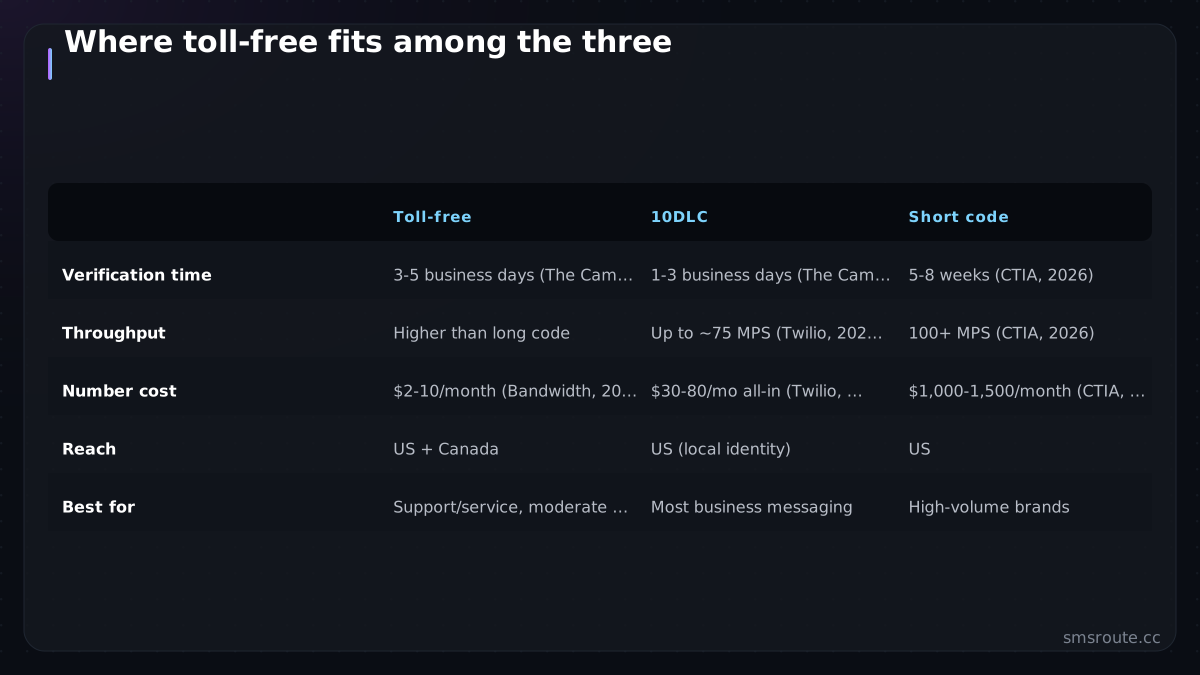
| Toll-free | 10DLC | Short code | |
|---|---|---|---|
| Verification time | 3-5 business days (The Campaign Registry, 2026) | 1-3 business days (The Campaign Registry, 2026) | 5-8 weeks (CTIA, 2026) |
| Throughput | Higher than long code | Up to ~75 MPS (Twilio, 2026) | 100+ MPS (CTIA, 2026) |
| Number cost | $2-10/month (Bandwidth, 2026) | $30-80/mo all-in (Twilio, 2026) | $1,000-1,500/month (CTIA, 2026) |
| Reach | US + Canada | US (local identity) | US |
| Best for | Support/service, moderate volume | Most business messaging | High-volume brands |
The full three-way trade-off is in our number-type decision guide. Toll-free's edge is specific: it's a faster, cheaper alternative to a short code. You get more throughput and US/Canada reach than a plain 10DLC long code gives. And you skip the short code's weeks of review and four-figure monthly cost.
How toll-free verification works
- Submit your use case and detailsBusiness info, the messaging use case, sample message content, opt-in details, and expected volume. Accuracy matters: mismatches cause rejections and delays.
- Provide opt-in evidenceHow recipients consent to your messages. This is the core of the review. A clear, documented opt-in flow is what gets approved.
- Wait for review (3-5 business days)Carriers assess the submission. Complete, honest applications clear faster; vague or non-compliant ones bounce back.
- Send at full throughput once verifiedVerification unlocks reliable delivery and higher rate limits. Until then, expect heavy throttling that makes the number impractical for real traffic.
The opt-in evidence is where applications succeed or fail. Carriers want to see that your recipients actually agreed to hear from you. The same consent discipline that keeps you compliant generally is what clears verification. Weak consent documentation is the top rejection reason. For example, a screenshot of a checked box on a signup form is strong evidence, while a vague mention of consent buried in terms of service is weak.
# Send an SMS
curl -X POST https://api.smsroute.cc/sms/send \
  -H "Authorization: Bearer YOUR_API_KEY" \
  -H "Content-Type: application/json" \
  -d '{"to": "+1234567890", "from": "YourBrand", "message": "Your verification code is 123456"}'
Choosing toll-free (or not)
- Choose toll-free for nationwide customer support and service messaging at moderate volume — two-way conversations, appointment and account notifications, help lines. The two-way capability plus fast verification fits support well.
- Choose 10DLC instead if you want local-number identity and your volume fits — it's cheaper and verifies slightly faster for most business messaging.
- Choose a short code only at genuinely high volume where throughput justifies the weeks of review and four-figure monthly cost.
- Don't skip verification on any of them — unverified traffic is throttled and filtered regardless of number type; the verification is the point.
SMSRoute is a no-KYC SMS API with crypto billing (BTC, ETH, USDT, XMR, LTC, and SOL), and one honest scoping note applies. Toll-free registration is a US domestic-route regime with its own verification — the same domestic-vs-international line we draw for 10DLC and India's DLT. For global OTP on international routes, the toll-free question doesn't arise. For US support and service messaging at moderate volume, toll-free is often the practical, fast, affordable answer. Verify it properly with solid opt-in evidence, and it delivers cleanly. SMSRoute's published route pages list delivery from $0.004/message (premium direct-carrier corridors up to $0.035) with sub-100ms median submission and ~98.6% delivered success (smsroute.cc route pages, 2026).
Related reading
FAQ
How long does toll-free SMS verification take?
Do I need to verify a toll-free number for SMS?
When should I use toll-free instead of 10DLC or a short code?
What's the most important part of toll-free verification?
Send your first SMS in 5 minutes
No KYC. Pay with BTC, ETH, USDT, XMR, LTC, and SOL. Live routes to 149 countries.
Get an API key →