The question is per message type, not per company
Should I choose SMS or RCS based on message type?
Yes. SMS excels for transactional alerts, OTPs, and global reach where RCS isn't supported. RCS suits rich media marketing in regions with carrier adoption. SMSRoute covers 149 countries with no-KYC signup and crypto billing, making SMS the pragmatic default for most use cases.
Every guide urging you to switch from SMS to RCS treats your traffic as one blob. It is not. A promo blast, an order update, and a login code have different jobs, different economics, and different failure costs. RCS is genuinely better at one of these, arguably better at the second, and mostly wrong for the third. Split the decision and it gets easy. For the authoritative reference, see the GSMA RCS Universal Profile.
The RCS growth numbers are real — around 3.8 billion active users projected for 2026 and business traffic up 550% in 2024, per Infobip's statistics roundup.
What RCS costs, structurally
How does RCS pricing compare to SMS?
RCS typically costs $0.02–$0.10 per message with carrier-specific fees and limited coverage. SMSRoute offers SMS from $0.004 per message across 149 countries, with automatic failover and real-time DLRs. For cost-effective global reach, SMS remains the clear winner.
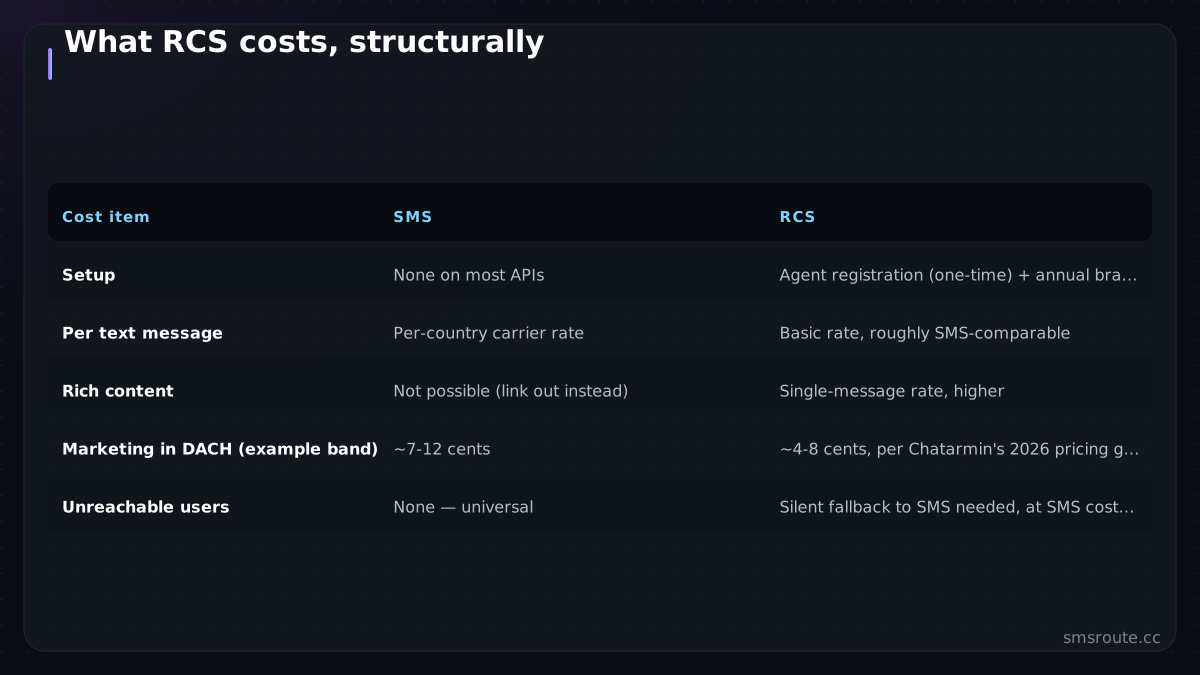
RCS pricing has more moving parts than SMS. Per AWS End User Messaging's billing documentation: a one-time agent registration fee, an annual brand-verification fee, and then per-message rates split by type. Basic messages (text, up to 160 characters) bill like SMS. Single messages (rich cards, media, longer text) bill higher. Outside the US, a reply can open a 24-hour conversational session at a flat session rate. For a 100,000 message campaign, total costs often range from $3,500 to $5,000 including per message rates, platform fees, and carrier surcharges.
| Cost item | SMS | RCS |
|---|---|---|
| Setup | None on most APIs | Agent registration (one-time) + annual brand verification |
| Per text message | Per-country carrier rate | Basic rate, roughly SMS-comparable |
| Rich content | Not possible (link out instead) | Single-message rate, higher |
| Marketing in DACH (example band) | ~7-12 cents | ~4-8 cents, per Chatarmin's 2026 pricing guide |
| Unreachable users | None — universal | Silent fallback to SMS needed, at SMS cost on top |
That DACH row explains the vendor enthusiasm honestly: in some markets RCS marketing is *cheaper* than SMS while performing better. Where that holds, switching marketing traffic is simply correct.
The split, message type by message type
- Marketing and promotions: strong case to switch. Verified sender, rich cards, carousels, and response rates of 15-25% versus 6-10% for SMS (Sendblue's 2026 comparison). Where per-message rates also undercut SMS, this is the clean win. Keep SMS fallback for non-RCS handsets.
- Order updates and alerts: situational. Rich tracking cards are nice; a plain SMS does the job at universal reach. Switch if your audience skews RCS-capable and your volume earns the setup fees; otherwise wait.
- OTP and login codes: mostly no. OTP needs maximum reach, minimum latency, zero dependencies — a code must land on the oldest handset, with no data plan, every time. You will run the SMS path anyway as fallback, so for OTP the 'switch' means operating two channels where one suffices. Our passkeys analysis covers where OTP itself is heading; RCS is not that story either.
- Two-way support conversations: RCS-friendly. Conversational session billing outside the US fits genuine dialogue; SMS threading is comparatively miserable.
Before you migrate anything, verify these
What should I check before migrating from SMS to RCS?
Verify carrier support in your target countries, RCS compatibility with your use case (e.g., OTPs often fail), and total cost including fallback SMS. SMSRoute lets you test routes with free credits before committing, ensuring your migration strategy is data-driven.
- Measure your audience's RCS reachabilityCapability lookup by country and handset mix, not global averages. RCS penetration varies hugely by market; your users are not the industry average.
- Price the fallback honestlyEvery RCS campaign carries an SMS shadow-cost for unreachable users. Model total spend as RCS-delivered plus SMS-fallback at the rates in our international cost guide.
- Budget the verification cycleAgent registration and brand verification take time and an annual fee — closer to the sender-ID registration processes in our country rules map than to an API signup.
- Keep transactional rails independentWhatever marketing does, keep OTP on a channel with universal reach and its own vendor. SMSRoute is a no-KYC SMS API with crypto billing (BTC, ETH, USDT, XMR, LTC, and SOL) — we are that rail, per the 5-line integration, and deliberately not an RCS reseller. SMSRoute's published route pages list delivery from $0.004/message (premium direct-carrier corridors up to $0.035) with sub-100ms median submission and ~98.6% delivered success (smsroute.cc route pages, 2026).
FAQ
Should I switch from SMS to RCS in 2026?
Is RCS cheaper than SMS?
Can I use RCS for OTP codes?
What do I need to start sending RCS business messages?
Send your first SMS in 5 minutes
How quickly can I start sending SMS with SMSRoute?
Sign up with just an email (no KYC), fund with crypto (BTC, ETH, USDT, XMR, LTC, SOL), and get your API key. You can send your first message in under 5 minutes. Free test credits are included to verify delivery before you add real balance.
No KYC. Pay with BTC, ETH, USDT, XMR, LTC, and SOL. Live routes to 149 countries.
Get an API key →