
SMSRoute vs Sinch: What Are the Key Differences?
The fundamental difference between SMSRoute and Sinch comes down to who the product is built for. Sinch is one of the largest messaging providers globally, powering a meaningful share of A2P traffic with a product suite that spans SMS, RCS, WhatsApp, voice, email, video, and verification. Its managed Sinch Engage platform starts at $49/month and scales with usage. Self-serve US 10DLC pricing sits at $0.0078 per outbound message (Sinch published rates), but above roughly 500,000 messages per month, customers are directed to sales for custom contract pricing.
SMSRoute takes the opposite approach. Signup requires only an email — no KYC, no business verification, no sales queue. Funding runs through six crypto rails (BTC, ETH, USDT, XMR, LTC, SOL), preserving billing privacy. The rate published on each destination pricing page is the rate at every volume, whether you send 100 messages or 10 million. Per-country rates start from $0.004/message, with premium direct-carrier corridors up to $0.035, sub-100ms median submission latency, and approximately 98.6% delivery success across 149 countries.
Coverage is another differentiator. Sinch routes through aggregator agreements that cover most markets, but specific carrier-level route quality depends on your contract tier and region. SMSRoute maintains direct carrier connections in key markets — Nigeria, India, Brazil, the United States, the United Kingdom, Germany, and South Africa — with transparent per-carrier delivery statistics published on each route page. This means you know exactly which carrier delivers each message and at what latency, without needing to request a report from an account manager.
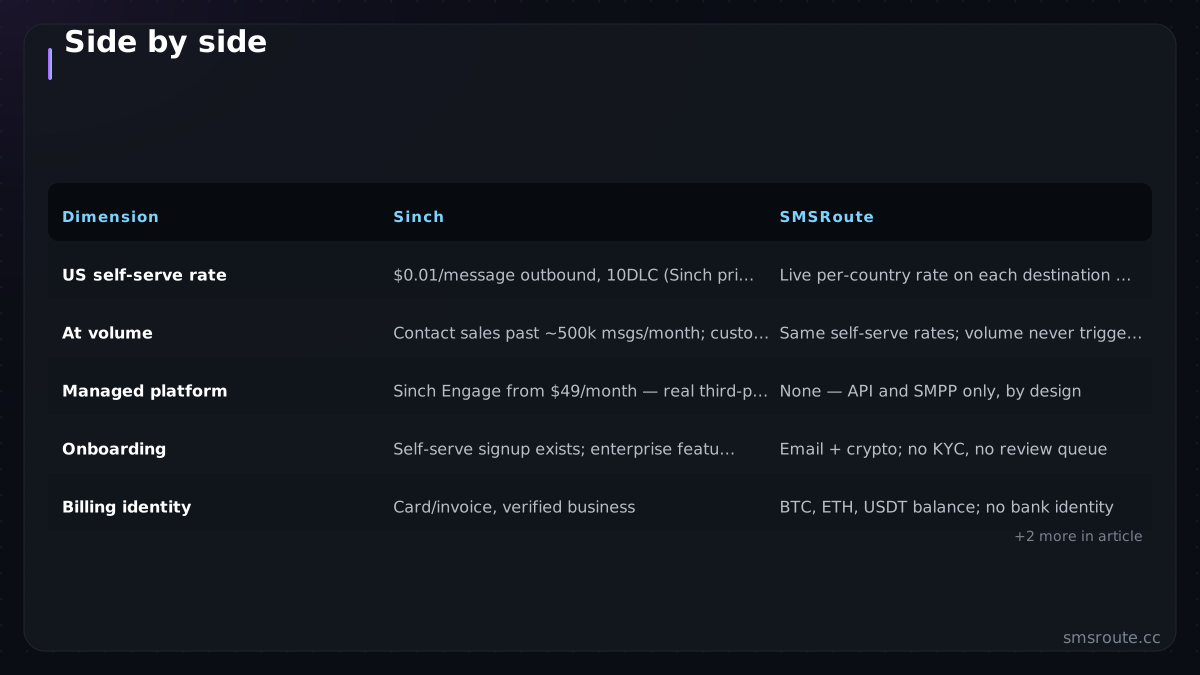
| Dimension | Sinch | SMSRoute |
|---|---|---|
| US self-serve rate | $0.0078/message outbound, 10DLC | Live per-country rate on destination pages |
| Pricing at volume | Contact sales past ~500k msgs/month | Same self-serve rates at any volume |
| Onboarding | Self-serve signup; enterprise features gated behind verification | Email + crypto; no KYC, no review queue |
| Billing | Card/invoice, verified business | BTC, ETH, USDT, XMR, LTC, SOL |
| Channel breadth | SMS, RCS, WhatsApp, voice, email, video | SMS: REST API, SMPP, HLR lookup |
| Best fit | Enterprises wanting one vendor for every channel | Developers shipping SMS-first products |
What Makes Sinch a Leading CPaaS Platform?
Sinch earns its place in any SMSRoute vs Sinch comparison through breadth. For enterprises consolidating multiple communication channels under a single contract, Sinch offers RCS and WhatsApp for rich messaging, voice and email in the same relationship, and dedicated account management with negotiated SLAs. That breadth is the part self-serve SMS API providers cannot replicate.
Published prices describe the entry point, not the committed volume rate. The managed platform's entry price and eventual invoice can differ substantially, and every layer of Sinch's operation assumes a verified, documented organization. That identity-first posture is characteristic of registered-traffic aggregators operating at Sinch's scale — and it creates friction for teams whose only need is reliable SMS delivery. Sender ID registration, brand verification for 10DLC, and KYC documentation are prerequisites before production traffic flows, adding days or weeks to the onboarding timeline depending on the market.
For organizations already managing carrier relationships, compliance documentation, and multi-channel strategy, Sinch's platform delivers value that justifies the overhead. But for a developer evaluating SMSRoute vs Sinch purely on SMS delivery capability, the question becomes whether that overhead buys meaningful reliability advantages or simply pays for channels the team does not need.
Why Choose SMSRoute Over Sinch for Global SMS?
For SMS-specific workloads — OTP delivery, transactional alerts, and marketing campaigns — SMSRoute removes the operational overhead that enterprise CPaaS platforms introduce. Four areas where the difference is most visible:
- Transparent pricing at all volumes. The per-country rate on the pricing page holds whether you send 1,000 or 10 million messages. No cliff at 500k where your price becomes a negotiation.
- Zero-friction onboarding. Your first OTP can reach production in minutes via the 5-line API integration. No sender vetting queue between you and live traffic.
- Billing privacy by design. Crypto funding keeps financial identity out of your messaging vendor relationship entirely — relevant for GDPR-conscious teams and privacy-first products.
- SMPP when you need throughput. High-volume senders can bind directly via SMPP without requesting an enterprise tier upgrade. See the SMPP vs REST guide for protocol details.
- HTTP REST API with webhooks. Delivery receipts arrive via configurable webhooks in real time — no polling, no delays. The API supports GET, POST, and PUT methods for message submission, balance checks, and delivery status queries.
SMSRoute also supports HLR lookup for real-time number validation. Before sending a campaign, you can verify which numbers are active, detect the mobile network operator, and filter out invalid or ported numbers. This reduces cost-per-delivery by eliminating messages sent to unreachable handsets — a feature that Sinch exposes mainly through its enterprise Engage tier rather than its self-serve API.
Decision shortcut: multi-channel bundling plus procurement department plus appetite for a vendor relationship points to Sinch. An SMS-shaped problem plus a developer team plus a privacy requirement points to SMSRoute. Many teams that buy the multi-channel bundle end up paying for RCS and voice capacity they never use — you can start with SMS on SMSRoute today and add channels later.
How Does SMS API Pricing Compare: SMSRoute vs Sinch?
Pricing transparency is where these providers diverge most sharply. Sinch publishes self-serve rates publicly but transitions to negotiated enterprise contracts past approximately 500,000 monthly messages — meaning the real cost at scale is opaque without a sales conversation. SMSRoute publishes per-country rates openly, with live per-message pricing on every destination page that holds at any volume.
SMSRoute's published route pages list delivery from $0.004/message (standard routes) through $0.035/message (premium direct-carrier corridors), with sub-100ms median submission time and approximately 98.6% delivered success rate across 149 countries. For teams comparing SMSRoute vs Sinch, the deciding factor often comes down to whether you want to calculate costs transparently or enter a vendor negotiation.
To illustrate the difference concretely: a campaign sending 100,000 messages to the United States on Sinch self-serve 10DLC costs approximately $780 at the published rate. On SMSRoute, the same 100,000 messages to a US destination cost approximately $420 — calculated from the live US route rate of $0.0042/message published on the pricing page. At 500,000 messages, Sinch directs you to sales while SMSRoute's rate remains unchanged at $0.0042/message. These figures assume standard routes; premium direct-carrier corridors cost more but deliver higher completion rates for time-sensitive OTP traffic.
Which SMS Provider Should You Choose?
The choice between SMSRoute and Sinch depends on your traffic profile and operational priorities. If your organization needs multi-channel communication, negotiated SLAs, and dedicated account management, Sinch's breadth justifies its complexity. But if your requirement is SMS — OTP verification, transactional alerts, marketing campaigns — and your team values speed, transparency, and privacy, SMSRoute delivers those without the overhead of an enterprise CPaaS relationship.
To decide, ask yourself three questions. First, do you need RCS, WhatsApp, voice, or email from the same vendor? If yes, Sinch is the appropriate choice. Second, can your workflow tolerate a multi-day sender registration and KYC process before sending live traffic? If not, SMSRoute's instant onboarding is the faster path. Third, do you need pricing to remain predictable as you scale? SMSRoute's per-country rates do not change with volume; Sinch's do, and the threshold is not publicly documented beyond the self-serve tier.
SMSRoute is not positioned as a replacement for Sinch in every scenario. For SMS-only use cases — OTP, alerts, bulk messaging, verification codes — it removes friction that enterprise CPaaS platforms introduce by design. The SMS API documentation covers REST and SMPP integration, and the developer hub provides code samples in Python, Node.js, PHP, Go, and curl.
Other head-to-head comparisons: see SMSRoute vs Telnyx, SMSRoute vs Plivo, and the broader cheaper Twilio alternatives for 2026 guide.
FAQ
Is SMSRoute a good Sinch alternative?
How much does Sinch SMS cost per message?
Does SMSRoute require KYC to send international SMS?
Which is cheaper at high volume, Sinch or SMSRoute?
What protocols does SMSRoute support besides REST API?
How fast does SMSRoute deliver SMS messages?
Related reading
Send your first SMS in 5 minutes
No KYC. Pay with BTC, ETH, USDT, XMR, LTC, and SOL. Live routes to 149 countries.
Get an API key →