The comparison people get backwards
SMS vs push notifications is not a cost comparison. It's a reach comparison with a cost footnote. Push costs nothing per message, but it only reaches users who installed your app, granted notification permission, and haven't since revoked it or uninstalled. SMS costs per message, but it reaches almost any phone, no app, no permission dance, no install required. So the question is never 'which is cheaper'. It's 'who do I need to reach, and does the message matter enough to pay for certainty'.
Usually the best system uses both, by rule.
Side by side
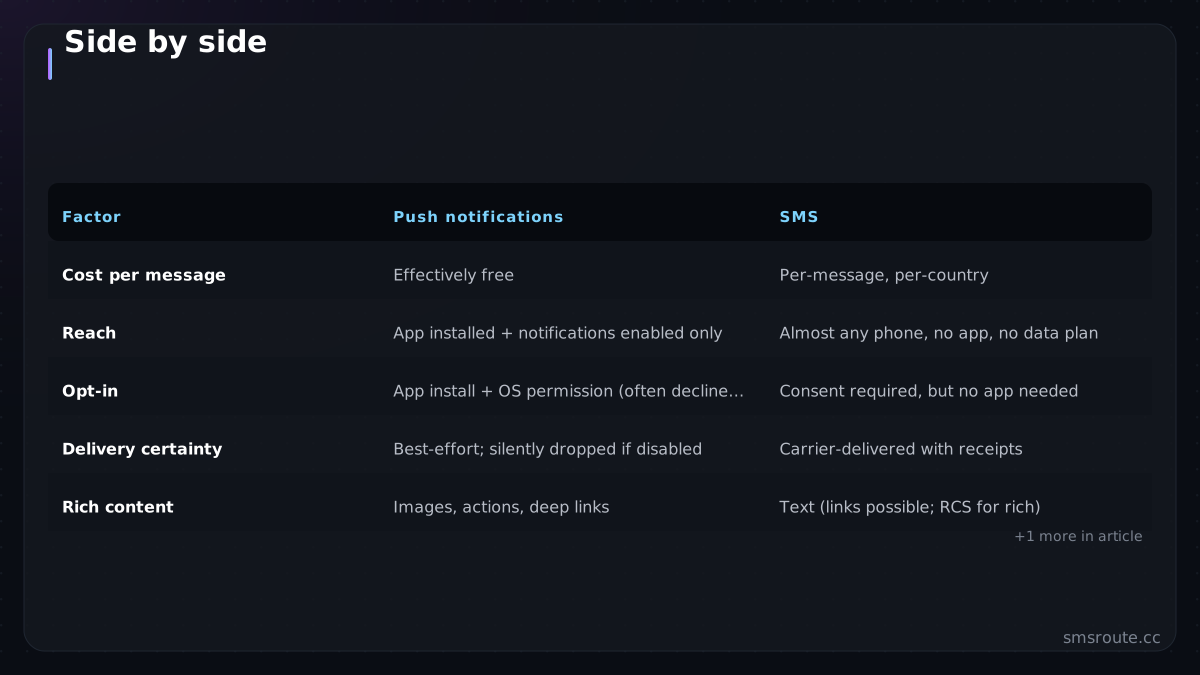
| Factor | Push notifications | SMS |
|---|---|---|
| Cost per message | Effectively free | Per-message, per-country |
| Reach | App installed + notifications enabled only | Almost any phone, no app, no data plan |
| Opt-in | App install + OS permission (often declined) | Consent required, but no app needed |
| Delivery certainty | Best-effort; silently dropped if disabled | Carrier-delivered with receipts |
| Rich content | Images, actions, deep links | Text (links possible; RCS for rich) |
| Reliability for critical msgs | Weak — depends on app + settings | Strong — the universal fallback |
A push notification to a user who disabled notifications (a large and growing share) simply vanishes. No error, no fallback, nothing. SMS to a valid number delivers and tells you it did.
The decision rule, by message type
- Must-arrive, time-critical (OTP, security alerts, delivery-blocking issues) → SMS. Certainty beats cost. These are exactly the messages you can't afford to have silently dropped, and SMS is the universal reach layer, the same argument as our multichannel fallback piece.
- Engagement, re-engagement, rich content → push. Free, supports images and deep links, and the audience already opted in by installing. Marketing nudges and in-app-relevant updates live here.
- Important but not critical → push with SMS fallback. Send push; if it's not acknowledged or the user has push disabled, fall back to SMS. Best of both — free where it works, certain where it matters.
- Users without your app → SMS, always. Push isn't an option; SMS is your only direct channel to them.
You pay for SMS only when push can't deliver, so you get free reach for the engaged majority and paid certainty for the tail — the same cost-aware logic that makes push-first work for high-volume senders.
Building the two-channel system
- Classify every message by criticalityMust-arrive vs nice-to-have. This one attribute drives the channel choice more than anything else.
- Default engagement to push, critical to SMSFree channel for the high-volume low-stakes traffic; paid channel for the low-volume high-stakes traffic. The economics work out naturally.
- Wire push-first fallback for the middleFor important-but-not-critical messages, try push, detect non-delivery or disabled notifications, and fall back to SMS. Track which users consistently need the fallback.
- Respect consent on bothPush needs OS permission; SMS needs its own consent and opt-out. They're separate permissions — never assume one covers the other.
SMSRoute is a no-KYC SMS API with crypto billing (BTC, ETH, USDT, XMR, LTC, and SOL), and we're the SMS half of this pairing — the reliable, universal-reach channel that catches what push can't deliver. According to the GSMA, SMS remains the most ubiquitous mobile messaging channel globally. SMSRoute's published route pages list delivery from $0.004/message (premium direct-carrier corridors up to $0.035) with sub-100ms median submission and ~98.6% delivered success (smsroute.cc route pages, 2026).
FAQ
Should I use SMS or push notifications?
Are push notifications cheaper than SMS?
What is push-first with SMS fallback?
Can push notifications replace SMS for OTP?
Send your first SMS in 5 minutes
No KYC. Pay with BTC, ETH, USDT, XMR, LTC, and SOL. Live routes to 149 countries.
Get an API key →