The uncomfortable 2026 answer
The SMS OTP vs email OTP question in 2026 is a bit like asking which lock is stronger when both keys are under the mat. NIST SP 800-63B's recent revision restricts SMS OTP as an authenticator, citing SIM-swap fraud, SS7 interception, and real-time phishing proxies. It treats email OTP as no stronger. Regulators are moving in the same general direction, with a number of banking regulators signaling a shift away from both SMS and email OTP toward stronger authentication for financial services in the years ahead. We sell SMS delivery, and we will still tell you plainly: neither channel is a strong *primary* authenticator anymore. For the authoritative reference, see NIST SP 800-63B.
The question is not 'which is secure' but 'how does each fail, and where does each still belong'. Both remain everywhere and both still have honest jobs.
How each one gets broken
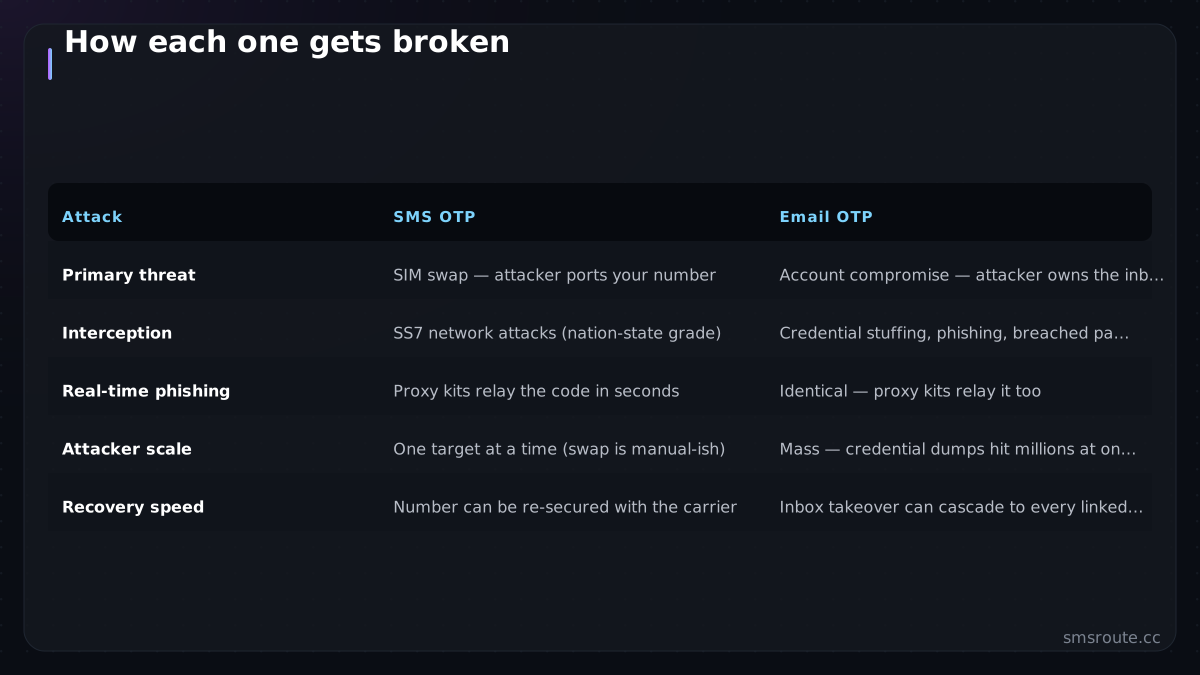
| Attack | SMS OTP | Email OTP |
|---|---|---|
| Primary threat | SIM swap — attacker ports your number | Account compromise — attacker owns the inbox |
| Interception | SS7 network attacks (nation-state grade) | Credential stuffing, phishing, breached passwords |
| Real-time phishing | Proxy kits relay the code in seconds | Identical — proxy kits relay it too |
| Attacker scale | One target at a time (swap is manual-ish) | Mass — credential dumps hit millions at once |
| Recovery speed | Number can be re-secured with the carrier | Inbox takeover can cascade to every linked account |
Read the 'attacker scale' row carefully — it is the real difference. SIM swaps are targeted and comparatively costly per victim; email compromise scales with every password breach. For a mass attacker, email OTP is often the softer, broader target. For a determined attacker after one high-value account, SMS's SIM-swap path is the classic route. Different threat models, different weak channel.
The circular dependency nobody notices
Here is the trap that makes 'just use email OTP instead' backfire. If a user's email account is *itself* protected by SMS OTP, as countless are, then email OTP inherits SMS's weakness. One SIM swap takes the phone, the phone unlocks the email, and the email unlocks everything using email OTP. You did not add a second factor; you added a second door with the same key. Mapping which of your fallback channels secretly depend on the others is a five-minute exercise that prevents a whole class of account takeovers.
The general lesson from our passkeys analysis applies here too: OTP of any transport is now a fallback factor, not a fortress. Design it as the recovery rung, defend that rung hard, and push primary auth toward phishing-resistant methods like TOTP or passkeys.
Where each still earns its place
- SMS OTP wins on reach and immediacy. It hits any handset in seconds with no app or data plan, which is why it remains the default for phone-number verification and time-sensitive recovery. When the job is 'prove control of this number now', SMS is the tool. Messages are encoded in GSM-7 (160-character segments) or UCS-2 for special characters, with concatenation via UDH for longer payloads.
- Email OTP wins on cost and no-phone flows. It is effectively free per send and works for users you only know by email. Fine for low-stakes verification and as an alternate recovery channel, provided it is not circularly protected by SMS.
- Both need the same hardening. Short expiry, capped attempts, rate limits against pumping, and SIM-swap awareness for high-value actions. These are the defaults in our OTP best-practices guide.
- Neither should stand alone for sensitive accounts. Banking, primary email, anything with money or identity behind it — layer a phishing-resistant factor, and keep O
Building the honest version
The defensible 2026 pattern: passkeys or an authenticator app as the primary factor, SMS OTP as the phone-verification and recovery rung, email OTP as a secondary recovery channel. Check the dependency map so they do not protect each other. For the SMS rung specifically you want reliable, fast delivery to any handset, which is exactly the reach argument that keeps SMS in the stack at all. Using direct routes via SMPP or REST APIs with proper retry logic and DLR tracking ensures high delivery rates.
SMSRoute is a no-KYC SMS API with crypto billing (BTC, ETH, USDT, XMR, LTC, and SOL). We are the SMS delivery
layer for that recovery rung, direct routes to 149 countries, 5-line integration. We are not going to pretend SMS OTP is what
it was in 2015; we are going to deliver the messages reliably for the real, narrower job it still does. That
honesty is the same one we bring to passkeys and every other place
SMS's role is shrinking but not vanishing. SMSRoute's published route pages list delivery from $0.004/message
(premium direct-carrier corridors up to $0.035) with sub-100ms median submission and ~98.6% delivered success (
No KYC. Pay with BTC, ETH, USDT, XMR, LTC, and SOL. Live routes to 149 countries.Related reading
FAQ
Is SMS OTP or email OTP more secure?
Why is using email OTP instead of SMS not automatically safer?
Did NIST ban SMS OTP?
When should I still use SMS OTP?
Send your first SMS in 5 minutes