- What crypto users need from an SMS verification service
- Why real SIM numbers matter for crypto exchanges
- Comparison of SMS verification services for crypto
- How to choose: one-time activation vs rental
- Honest limits: what not to use a temporary number for
- Legality of temporary numbers for crypto verification
- How to start with SMSRoute for sending OTPs
- Related reading
What crypto users need from an SMS verification service
An SMS verification service for crypto users must deliver real SIM-based numbers that pass carrier-lookup checks. Major exchanges like Binance and Kraken actively block VoIP and disposable lines. Most major platforms now run carrier-type lookups on submitted numbers. Virtual or VoIP-flagged lines are routinely rejected. Number-rental vendors themselves advertise 'real SIM' inventory precisely because VoIP acceptance has collapsed.
Crypto users also value privacy and speed. Many prefer paying with BTC, ETH, or USDT rather than a credit card linked to their identity. That's where no-KYC providers like SMSRoute fit: you fund a balance in crypto, grab an API key, and send OTPs in minutes. No documents, no vetting wait.
Why real SIM numbers matter for crypto exchanges
Exchanges use SMS verification as a second factor. If your number is flagged as VoIP or disposable, the code either never arrives or the exchange rejects it. The FBI's IC3 annual report logged roughly $48 million in SIM-swap losses in 2023 (FBI IC3, 2023). Crypto holders are a primary target. Real SIM numbers reduce that risk because they're tied to a physical identity, which is harder to spoof.
Disposable numbers fail often enough that rental vendors sell 'real SIM' tiers as the fix. For a time-sensitive login or withdrawal, one failed code means a locked account. Services that provide real SIM rentals (like MobileSMS.io, PVAPins, or SMS-Activate) advertise higher success rates, but you pay for it: MobileSMS.io charges $15 for a 7-day rental, $30 for 30 days (mobilesms.io, 2026).
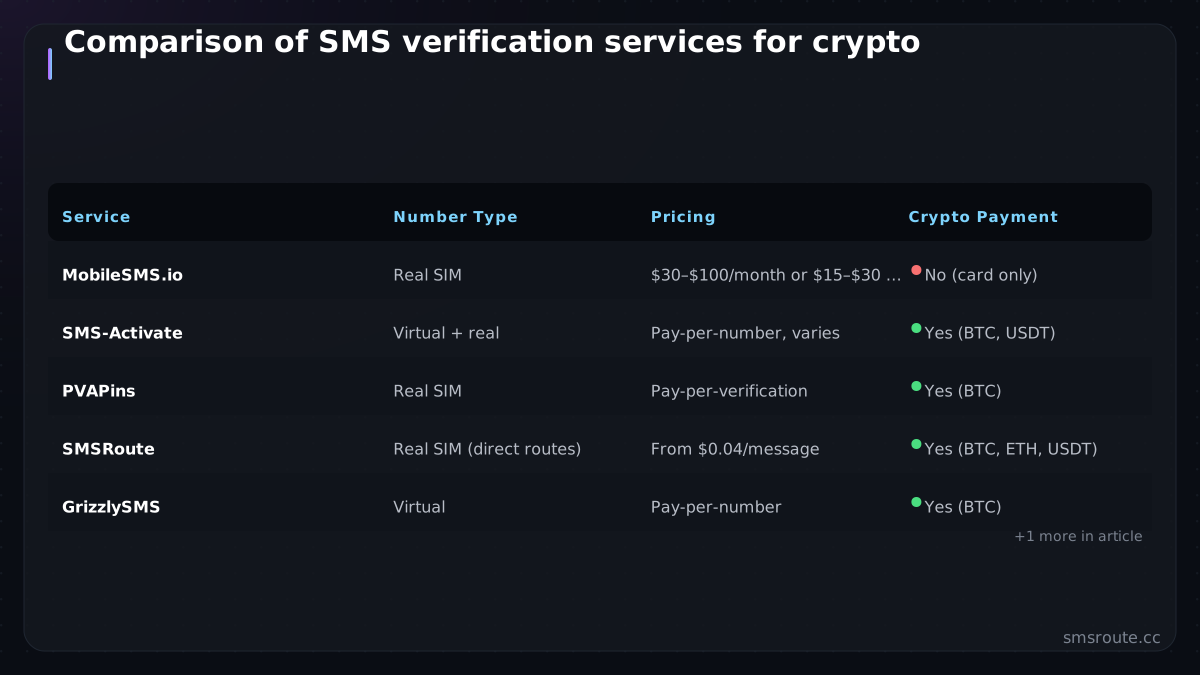
Comparison of SMS verification services for crypto
| Service | Number Type | Pricing | Crypto Payment | Best For |
|---|---|---|---|---|
| MobileSMS.io | Real SIM | $30–$100/month or $15–$30 rental | No (card only) | Long-term rentals, high success |
| SMS-Activate | Virtual + real | Pay-per-number, varies | Yes (BTC, USDT) | One-time activations, low cost |
| PVAPins | Real SIM | Pay-per-verification | Yes (BTC) | Verified accounts, bulk needs |
| SMSRoute | Real SIM (direct routes) | From $0.004/message | Yes (BTC, ETH, USDT, XMR, LTC, and SOL) | OTP sending, no-KYC start |
| GrizzlySMS | Virtual | Pay-per-number | Yes (BTC) | Quick verifications, low cost |
| SMSFAST | Virtual + real | Pay-per-number | Yes (BTC) | Variety of countries |
SMSRoute's own published route data shows delivery from $0.004/message (premium direct-carrier corridors up to $0.035) with sub-100ms median submission and ~98.6% delivered success on direct routes (smsroute.cc route pages, 2026). That's competitive for OTP sending, but note: SMSRoute is an API for sending OTPs, not a number rental service. If you need a temporary number to receive verification codes, MobileSMS.io or PVAPins are better fits.
How to choose: one-time activation vs rental
A one-time activation gives you a number for a single verification — you pay, receive the code, and the number is recycled. Services like SMS-Activate and SMSFAST specialize in this. A rental gives you a number for a set period (7, 15, or 30 days), useful if you need ongoing access for account recovery or multiple verifications. MobileSMS.io and PVAPins offer rentals.
Rentals cost more but reduce the risk of the number being reused by someone else. For crypto exchanges that allow 2FA resets, a rental ensures you can receive codes over time without buying a new number each time.
Honest limits: what not to use a temporary number for
Temporary numbers (even real SIM rentals) are not suitable for high-assurance flows like bank-grade authentication or regulatory KYC. Several banking regulators have pushed OTP off SMS for certain high-assurance flows (e.g., RBI in India, 2025; EU PSD2 SCA). For crypto, using a temporary number for account recovery on an exchange that ties identity to the phone number can lock you out if the rental expires.
Also, never use a free number for crypto verification. Free public numbers are almost always VoIP or disposable, and widely blocklisted by exchanges. They're also likely to be flagged as spam, and the code may be intercepted by another user.
Legality of temporary numbers for crypto verification
Using a temporary number is not illegal per se, but it may violate the terms of service of the exchange. Binance, for example, prohibits using virtual phone numbers for verification. If detected, your account may be suspended. For compliance, always check the exchange's policy. In jurisdictions with strict KYC laws (e.g., EU, Singapore), using a temporary number could be seen as evading identity checks.
How to start with SMSRoute for sending OTPs
If you're a developer building a crypto platform that needs to send OTPs to users, SMSRoute offers a no-KYC API with crypto billing. Here's the quick start:
curl -X POST https://api.smsroute.cc/sms/send \
  -H 'Authorization: Bearer YOUR_API_KEY' \
  -H 'Content-Type: application/json' \
  -d '{"to": "+2348012345678", "from": "SMSRoute", "message": "Your code: 428913"}'
Fund with BTC, ETH, USDT, XMR, LTC, or SOL, get your key, and send. No identity documents, no approval wait. SMSRoute is a no-KYC SMS API with crypto billing — built for OTP and transactional traffic. It's not a number rental service, so for receiving verification codes, pair it with a real SIM rental from MobileSMS.io or PVAPins.
Related reading
For more on securing crypto platforms with SMS, see How Crypto Platforms Use Temporary Numbers and Secure SMS Verification for Crypto Exchanges. For a broader look at no-KYC SMS APIs, read our complete guide.
Related reading
FAQ
Is using a temporary number for crypto SMS verification legal and safe?
Why wasn't my crypto verification code sent?
What is the correct phone-number format for verification?
What's the difference between a one-time activation and a rental?
What should I not use a temporary number for?
What should I do if the code arrives but does not work?
Can I use a free number for crypto verification?
Send your first SMS in 5 minutes
No KYC. Pay with BTC, ETH, USDT, XMR, LTC, and SOL. Live routes to 149 countries.
Get an API key →