The question isn't 'is SMS 2FA secure' — it's 'secure enough for what'
Is SMS 2FA secure enough for my use case?
SMS 2FA is secure enough for low-value accounts like newsletters or forums where convenience outweighs risk. For high-value accounts (banking, crypto), it's a fallback, not primary. SMSRoute's adaptive multi-route delivery and real-time DLRs ensure reliable, traceable OTPs without compromising speed or privacy.
SMS 2FA gets a lot of blanket verdicts, and most are too simple in both directions. 'It's broken, never use it' ignores that it still protects billions of accounts and is vastly better than no second factor. 'It's fine, everyone uses it' ignores that NIST SP 800-63B Rev 4 now classifies SMS one-time passcodes as a restricted authenticator and that SIM swaps have drained hundreds of millions from high-value accounts. The honest framing is neither: SMS 2FA's security is *relative to what it protects*. A forum login and a bank account are not the same decision.
We sell SMS delivery, so weigh this accordingly — but the whole point is to tell you where SMS 2FA is genuinely fine and where it is genuinely not, rather than sell you sends you shouldn't make.
What SMS 2FA is good and bad at
What are the pros and cons of SMS 2FA?
SMS 2FA excels at universal reach (any phone, no app) and fast setup. Its weakness is SIM-swap attacks. SMSRoute mitigates this with automatic failover across 149 countries and real-time delivery reports, ensuring OTPs reach the right device. For high-risk accounts, pair with app-based 2FA.
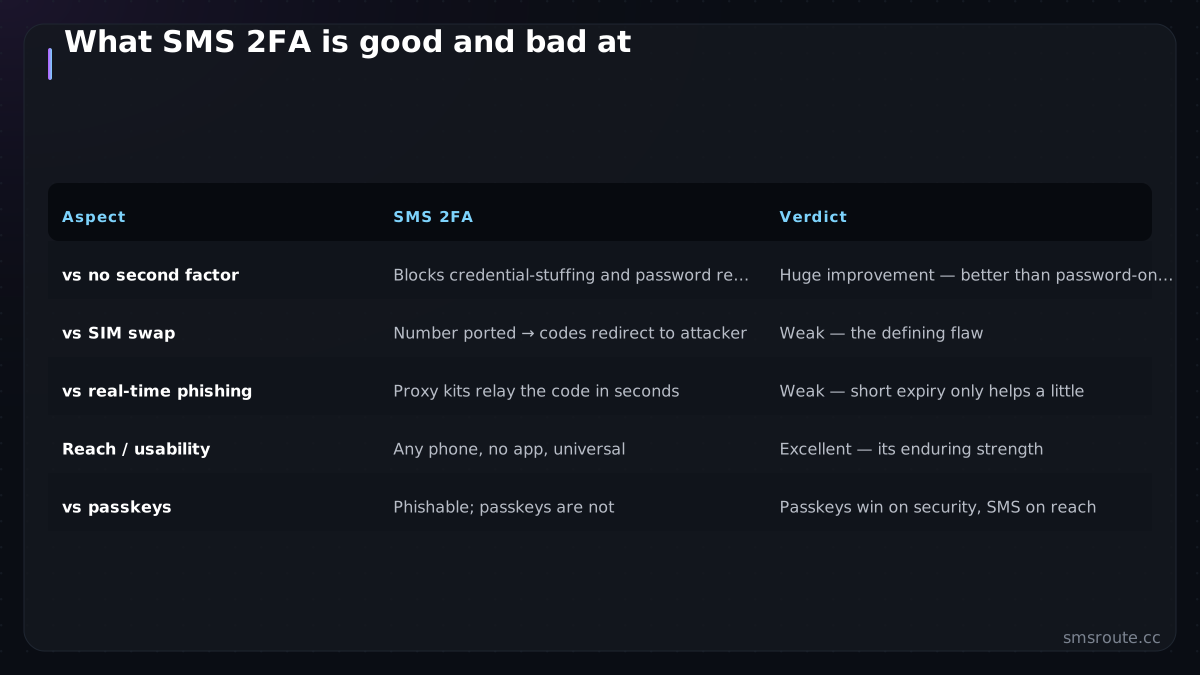
| Aspect | SMS 2FA | Verdict |
|---|---|---|
| vs no second factor | Blocks credential-stuffing and password reuse | Huge improvement — better than password-only |
| vs SIM swap | Number ported → codes redirect to attacker | Weak — the defining flaw |
| vs real-time phishing | Proxy kits relay the code in seconds | Weak — short expiry only helps a little |
| Reach / usability | Any phone, no app, universal | Excellent — its enduring strength |
| vs passkeys | Phishable; passkeys are not | Passkeys win on security, SMS on reach |
Read the table as a single message: SMS 2FA's weakness is targeted attacks (SIM swap, real-time phishing), and its strength is universal reach against the common attacks (stolen or reused passwords). So it fails exactly where the stakes are highest and succeeds exactly where the volume is highest. That is why the answer is contextual, not binary.
The decision, by account value
How should I decide whether to use SMS 2FA based on account value?
For low-value accounts (social media, forums), SMS 2FA is sufficient. For medium-value (email, shopping), use it as a secondary factor. For high-value (banking, crypto), avoid SMS as primary—use TOTP or hardware keys. SMSRoute's no-KYC API lets you test routes risk-free with free credits.
- Low-stakes accounts (forums, newsletters, casual apps) → SMS 2FA is fine. The realistic threat is password reuse, not a targeted SIM swap. SMS blocks the former handily, and its universal reach maximizes adoption. Perfect-is-the-enemy-of-good applies.
- Medium-stakes (most consumer apps, e-commerce) → SMS 2FA acceptable, passkeys better. Offer passkeys as primary, keep SMS as an on-ramp and fallback so users who won't set up a passkey still have *a* second factor.
- High-stakes (banking, crypto, primary email, admin) → not as the primary or sole factor. These are SIM-swap targets; use phishing-resistant factors and treat SMS as notification or hard-limited fallback only — the case our crypto exchange guide makes in detail.
- Regulated sectors → check the mandate. Some regulators now require moving off SMS OTP (UAE banks, India) — the compliance layer overrides your own risk call.
The trap is applying one verdict everywhere. A company that rips SMS 2FA off its forum because 'NIST said so' loses a large share of users who have no other second factor, in exchange for a threat model that mostly applies to high-value accounts.
Doing SMS 2FA right where you use it
How can I implement SMS 2FA correctly?
Use a reliable API with automatic failover, real-time DLRs, and sender ID control. SMSRoute offers all three: adaptive multi-route delivery across 149 countries, instant delivery reports, and custom sender IDs on request. Start with free test credits to verify routes before funding.
- Never make it the only option for valuable accountsOffer passkeys or an authenticator as the stronger primary; let SMS be the reach-maximizing fallback, positioned in a multichannel ladder.
- Harden the SMS itselfShort expiry, capped attempts, per-number rate limits against pumping, and single-segment linkless copy. These don't fix SIM swap but they close the easy holes.
- Detect SIM-swap signalsA recent SIM change flagged by a number lookup should add friction on sensitive actions — the single most useful SMS-2FA-specific defense.
- Step up, don't relyFor any high-value action, require a fresh strong factor, never a cached SMS session. SMS can gate a login; it shouldn't alone gate a withdrawal.
SMSRoute is a no-KYC SMS API with crypto billing (BTC, ETH, USDT, XMR, LTC, and SOL), and our honest position on SMS 2FA is the one this guide argues: it's a genuine security improvement for most accounts and the wrong sole guard for the valuable few. Deliver it reliably, harden it, layer it under stronger factors where the stakes rise, and it earns its place. Treat it as bulletproof and it becomes a liability — the distinction, as always, is the account behind the code, and the passkeys arc shows where primary auth is heading regardless. SMSRoute's published route pages list delivery from $0.004/message (premium direct-carrier corridors up to $0.035) with sub-100ms median submission and ~98.6% delivered success (smsroute.cc route pages, 2026).
Related on SMSRoute: for channel and number-type specifics, see toll-free SMS verification and RCS verification troubleshooting.
Related reading
FAQ
Is SMS 2FA still safe to use in 2026?
Why did NIST restrict SMS 2FA?
Should I remove SMS 2FA from my app?
What's better than SMS 2FA?
Send your first SMS in 5 minutes
No KYC. Pay with BTC, ETH, USDT, XMR, LTC, and SOL. Live routes to 149 countries.
Get an API key →