The score you can't see but always pay for
Every message you send builds a profile. Carriers and their firewalls track how your traffic behaves: volume patterns, content, complaint rates, and how many messages hit invalid numbers. They distill it into an SMS sender reputation that decides how much of your traffic gets delivered versus filtered. You never see the number. You see its effects: a healthy reputation delivers cleanly, a damaged one watches messages vanish silently. It builds slowly and destroys quickly, which is exactly the wrong shape for something invisible.
Here's what builds it, what wrecks it, and how to recover.
What builds and what wrecks reputation
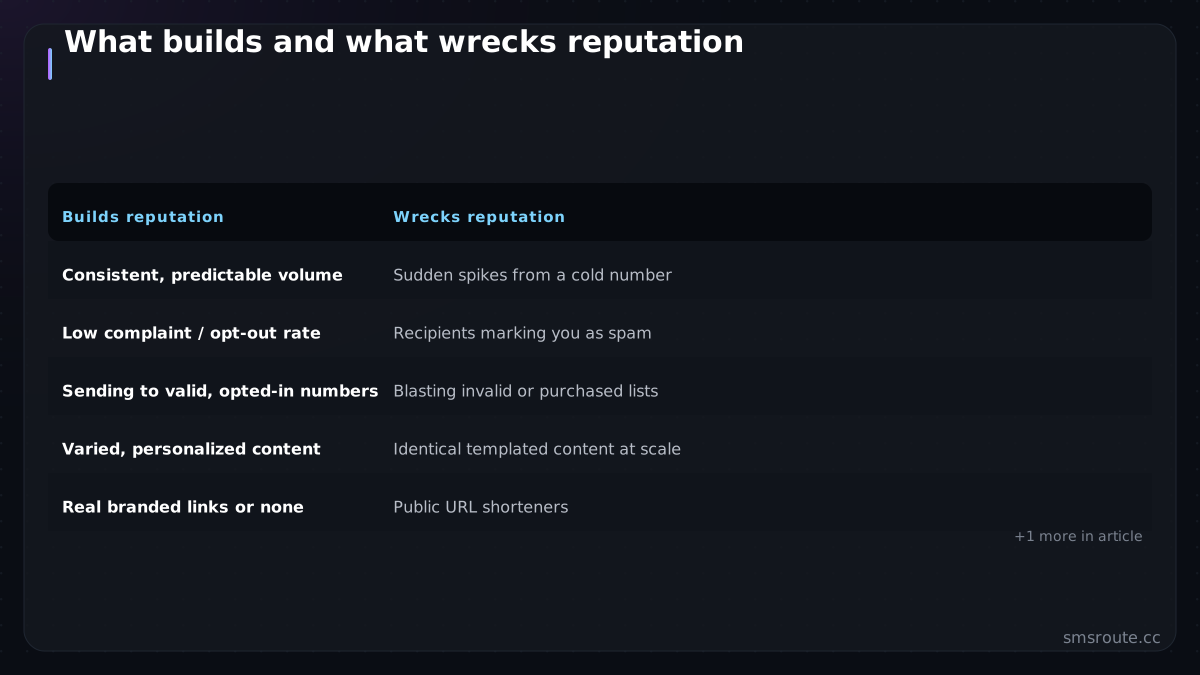
| Builds reputation | Wrecks reputation |
|---|---|
| Consistent, predictable volume | Sudden spikes from a cold number |
| Low complaint / opt-out rate | Recipients marking you as spam |
| Sending to valid, opted-in numbers | Blasting invalid or purchased lists |
| Varied, personalized content | Identical templated content at scale |
| Real branded links or none | Public URL shorteners |
| Honoring opt-outs immediately | Messaging people who said STOP |
Two wreckers deserve emphasis because they're so common and so avoidable: sending to invalid numbers (fix with validation) and public link shorteners (fix with branded domains). Carriers often block bit.ly links due to high spam volume. Branded domains replace that with your own custom short URL, restoring carrier trust.
Warming up a new number
A brand-new number or route has no reputation. Carriers treat that with suspicion, not neutrality. Blasting from cold looks exactly like a compromised number or a spammer, so you ramp instead.
- Start small and engagedSend your first traffic to your most engaged, definitely-opted-in recipients. These are the people most likely to read and least likely to complain. Good early signals set the baseline.
- Ramp volume graduallyIncrease over days, not minutes. Let the carrier build a history of normal business behavior before you hit full volume. This is the same warm-up logic the firewall guide describes.
- Watch delivery as you scaleReconcile delivery receipts (DLRs) at each step. A drop as you ramp means you're going too fast or hitting a content or quality problem. Pause and diagnose before pushing.
- Keep quality high throughoutUse valid numbers, clean content, and honored opt-outs from message one. A good reputation is easiest to build when you never give the firewall a reason to doubt you.
Recovering a damaged reputation
- Stop the damage first. Identify what tanked it (a bad list, a spike, a spammy campaign) and stop doing it. Reputation can't recover while the cause continues.
- Clean your list. Validate and remove invalid, dead, and unengaged numbers. Sending to them is an ongoing negative signal.
- Re-warm slowly. Treat the recovering number like a new one: small, engaged, gradual. There's no fast recovery. The score rebuilt slowly is the only kind.
- Fix the content and links. Vary templated copy, drop public shorteners, and make sure every message is one a recipient would want.
- Consider a fresh start if damage is severe. Sometimes a badly-burned route costs more to rehabilitate than a clean start with disciplined sending. But the underlying habits must change or you'll burn the new one too.
There's no reputation reset button and no shortcut. The firewall's memory is long by design. That's what makes reputation meaningful. The only reliable strategy is to build it carefully.
The provider's role
Part of your delivered reputation isn't yours alone. You inherit some of your provider's route reputation. Traffic terminating through low-quality or grey routes carries that baggage no matter how clean your own sending is. So provider choice is a reputation decision: direct carrier routes with good standing give your careful sending a clean surface to build on. The CTIA sets messaging guidelines that carriers enforce, and the GSMA defines global mobile network standards that shape how reputation is calculated. For A2P (application-to-person) messaging, compliance with frameworks like 10DLC in the US or DLT in India is essential to maintain a good reputation. 10DLC is a US registration system for business text numbers, while DLT is India's centralized platform for tracking commercial messages. Both verify sender identity, preventing spam and protecting carrier trust.
SMSRoute is a no-KYC SMS API with crypto billing (BTC, ETH, USDT, XMR, LTC, and SOL) running direct carrier routes. That is the foundation your sender reputation builds on, but the reputation itself is earned by how you send. Warm up, keep lists clean, honor opt-outs, vary content, and monitor delivery. You build the invisible asset that keeps your messages arriving. Neglect it and you'll learn it exists only when your delivery rate drops.
Related reading
FAQ
What is SMS sender reputation?
How do I improve SMS deliverability reputation?
How do I warm up a new SMS number?
Can I recover a damaged SMS sender reputation?
Send your first SMS in 5 minutes
No KYC. Pay with BTC, ETH, USDT, XMR, LTC, and SOL. Live routes to 149 countries.
Get an API key →