Why the same message shows a different sender everywhere
Why does my SMS sender ID change depending on the recipient's country?
Each country has its own telecom regulations for sender IDs. Some require pre-registration, others allow alphanumeric IDs, and some override with a numeric route. SMSRoute automatically adapts to local rules, using smart shared pools or custom IDs where supported, so your message always reaches the recipient correctly.
Sender ID rules by country are set at the destination, not the origin. An alphanumeric sender, 'YourBrand' instead of a phone number, lives or dies by local rules. Send one campaign to ten countries and the sender your recipients see may be your brand, a random long number, a shared shortcode, or the word 'Unverified', depending entirely on local rules. There is no global registry; there are ~200 national regimes, and aggregator documentation (Plivo's and Infobip's country matrices are the best public references) is where the current state actually lives.
Two big 2026 additions make the point.
The 2026 map, in four tiers
What are the four tiers of SMS sender ID rules by country in 2026?
Tier 1: Countries requiring pre-registration (e.g., India, US). Tier 2: Countries allowing alphanumeric IDs without registration. Tier 3: Countries that override sender IDs with numeric routes. Tier 4: Countries with dynamic or per-operator rules. SMSRoute covers all 149 countries, automatically applying the correct tier for each destination.
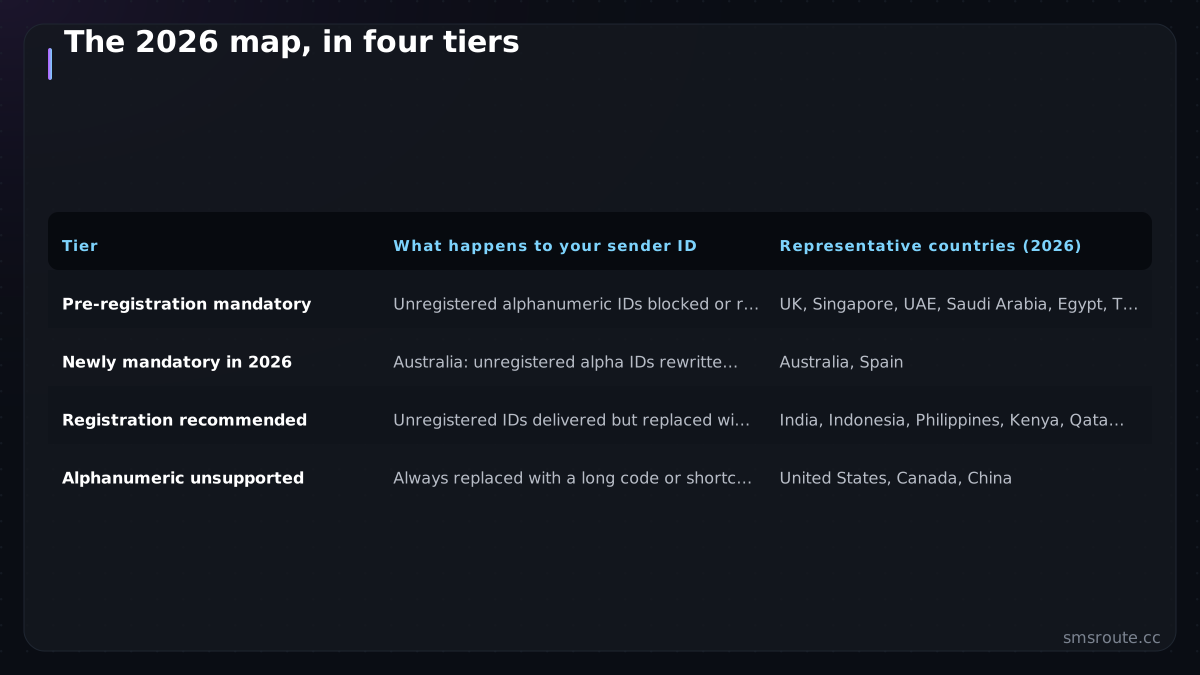
| Tier | What happens to your sender ID | Representative countries (2026) |
|---|---|---|
| Pre-registration mandatory | Unregistered alphanumeric IDs blocked or replaced | UK, Singapore, UAE, Saudi Arabia, Egypt, Turkey, Norway, Bangladesh, Sri Lanka, Nepal — per Plivo's and SMS.to's country lists |
| Newly mandatory in 2026 | Australia: unregistered alpha IDs rewritten to 'Unverified' from 1 July 2026 (ACMA register); Spain: unregistered aliases blocked from 15 Sep 2026 (CNMC) | Australia, Spain |
| Registration recommended | Unregistered IDs delivered but replaced with a generic sender | India, Indonesia, Philippines, Kenya, Qatar, Oman |
| Alphanumeric unsupported | Always replaced with a long code or shortcode regardless of registration | United States, Canada, China |
Read the last row twice if you are US-focused: no registration buys a branded alphanumeric sender in the US — the 10DLC system is number-based by design (the full regime is in the US A2P 10DLC guide). And the Australia change is retroactive in effect: *existing* alpha tags needed registering too, or they became 'Unverified' overnight — a rebrand nobody chose, applied by the regulator. For more details, see the ACMA's official guidance.
This map moves. Spain's rules were announced for September 2026; Australia's regime phased in across 2025-26 (per ACMA and DLA Piper's regulatory tracking).
Planning traffic around the rules
How should I plan my SMS traffic to comply with sender ID rules?
Use SMSRoute's real-time route intelligence to select the best sender ID per country. Pre-register custom IDs where required, or rely on our smart shared pool for compliant delivery. Our API and dashboard show per-country requirements, so you can route traffic efficiently without manual guesswork.
- Split traffic by purpose firstOTP and transactional messages survive a generic sender fine: the user is waiting for the code. Branded marketing is where sender ID actually earns money. Register where the marketing goes; route OTP wherever delivery is best.
- Put identity in the body for OTP'YourApp: your code is 481902' works under any sender regime. The copy pattern from our OTP best-practices guide. This one habit makes your login flow sender-ID-proof globally.
- Register early for mandatory tiersRegistration lead times run days to weeks (company docs, use-case declarations, sample content). Australia and Spain both punished late movers with blocked or rewritten senders mid-campaign.
- Test the actual result per countrySend to SIMs you control in each destination and look at what arrives. Rules on paper and carrier behavior diverge. The same test methodology we recommend for route quality answers both questions in one pass.
How this interacts with route choice
How do sender ID rules affect my SMS route selection?
Sender ID rules directly impact which routes are available for each country. SMSRoute's adaptive multi-route system automatically selects the optimal route that respects local sender ID regulations while maximizing delivery rates. You get compliant, high-deliverability sending without managing multiple providers.
Sender-ID rules and routing regimes stack. India is the clearest case: a registered DLT header requires the domestic route, while the international route delivers with a numeric sender regardless. The full trade-off is in our DLT guide. For India-specific rules, refer to the TRAI's DLT guidelines.
SMSRoute is a no-KYC SMS API with crypto billing (BTC, ETH, USDT, XMR, LTC, and SOL), built OTP-first for exactly that second pattern: direct routes to 149 countries with live per-country pricing on each destination page, and message-body branding doing the identity work. Where your strategy needs registered marketing headers in mandatory-tier countries, pair us for transactional with a registration-capable provider for those campaigns. The two-provider pattern is normal, not a failure. SMSRoute's published route pages list delivery from $0.004/message (premium direct-carrier corridors up to $0.035) with sub-100ms median submission and ~98.6% delivered success (smsroute.cc route pages, 2026).
Related reading
FAQ
Which countries require sender ID registration in 2026?
Can I use a branded sender ID in the United States?
What happens if I send with an unregistered sender ID?
Do OTP messages need a registered sender ID?
Send your first SMS in 5 minutes
No KYC. Pay with BTC, ETH, USDT, XMR, LTC, and SOL. Live routes to 149 countries.
Get an API key →