- Is SMS Private? The Short Answer
- Who Can Read My Texts? The Full Chain of SMS Visibility
- SMS Privacy Risks: What Actually Exposes Your Messages
- How SMSRoute Handles Your Messages: Privacy and Limits
- What Actually Reduces SMS Exposure: Practical Steps
- Honest Limits: What SMSRoute and This Approach Do Not Do
- SMS Privacy Comparison: SMSRoute vs. Other Providers
- Free Tools to Check Message Length and Cost
Is SMS Private? The Short Answer
SMS is not private by default. When you send a text message, it travels from your phone to a cell tower, then through the carrier's network, possibly through an SMS gateway, and finally to the recipient's carrier and phone. At each hop, the message is stored in plain text on carrier servers. Anyone with access to those servers (carrier employees, law enforcement with a warrant, or a hacker who breaches the carrier) can read the content. The GSM standard (GSMA, 2026) does not mandate end-to-end encryption for SMS. The message is encrypted over the air between your phone and the tower (using A5/1 or A5/3 encryption), but once it reaches the carrier's core network, it is decrypted and stored as plain text.
For comparison, messaging apps like Signal, WhatsApp, and iMessage use end-to-end encryption (E2EE). Only the sender and recipient can read the message. The service provider cannot. SMS has no such protection. If you need privacy, SMS is the wrong tool. But if you must use SMS (for delivery notifications, one-time passwords, or alerts), you should understand exactly who can see your messages and how to minimize exposure. Th
Who Can Read My Texts? The Full Chain of SMS Visibility
The SMS delivery chain involves at least four parties: the sender's carrier, the SMS gateway (if used), the recipient's carrier, and any intermediary aggregators. Each party has access to the message content at some point. Here is the detailed breakdown.
- Sender's carrier: Your mobile network operator (e.g., Verizon, Vodafone, Airtel) receives the message from your phone. It stores the message in its SMSC (Short Message Service Center) until it can be delivered. Carrier employees with system access can read the message. In many jurisdictions, carriers are required by law to retain SMS logs for 6-24 months (e.g., EU Data Retention Directive, India's TRAI rules).
- SMS gateway: If you use an SMS API like SMSRoute, the message passes through the gateway's servers. SMSRoute stores the message temporarily for routing (typically a few seconds to minutes). The message is not end-to-end encrypted on SMSRoute's servers. SMSRoute does not log message content after delivery, but the message is in plain text during transit through the gateway.
- Recipient's carrier: The destination carrier receives the message from the gateway or the sender's carrier. It stores the message in its SMSC and then delivers it to the recipient's phone. The recipient's carrier has the same access as the sender's carrier. If the recipient is in a different country, the message may pass through multiple carriers and international gateways.
- Intermediary aggregators: Some routes use aggregators that bundle traffic from multiple carriers. These aggregators also see the message content. SMSRoute uses direct Tier-1 routes where possible (~98% of messages on direct routes, per smsroute.cc route data 2026), which reduces the number of intermediaries. But even on direct routes, the message passes through at least two carriers.
Additionally, state actors (governments, intelligence agencies) can access SMS data through legal requests or direct interception. In the US, the Stored Communications Act allows law enforcement to obtain SMS records with a warrant. In India, the TRAI and DoT can request SMS logs from carriers. The EFF (eff.org) has documented cases of governments using SMS interception for surveillance. This is not hypothetical — it is a known risk. This means a warrant is required for message content, but not always for basic metadata like the phone numbers involved in a text exchange.
SMS Privacy Risks: What Actually Exposes Your Messages
The main SMS privacy risks fall into three categories: carrier storage, gateway logging, and legal interception. Each has different implications for your data.
- Carrier storage: Most carriers retain SMS logs for months or years. For example, in the US, carriers like AT&T and Verizon keep SMS metadata (sender, recipient, timestamp) for up to 7 years (per their privacy policies, 2025). Content retention varies. Some carriers delete content after delivery; others keep it for 30-90 days. In India, TRAI mandates that carriers store SMS logs for 6 months (TRAI, 2025). This means your old messages are accessible to anyone with legal authority to request them.
- Gateway logging: SMS gateways like SMSRoute may log message metadata for operational purposes (delivery tracking, billing). SMSRoute does not log message content after delivery, but the message is in plain text on the gateway server during routing. If the gateway is compromised, an attacker could read messages in transit. SMSRoute uses HTTPS for API communication, but the message is decrypted on the server side.
- Legal interception: Governments can compel carriers and gateways to hand over SMS data. In the US, the FBI can obtain SMS records with a National Security Letter (NSL) or a warrant. In the EU, the ePrivacy Directive allows law enforcement access to communications data. In India, the DoT can intercept SMS under the Indian Telegraph Act. If you send sensitive information via SMS, it is subject to legal access.
- SS7 vulnerabilities: The SS7 (Signaling System No. 7) protocol, used by carriers to route SMS, has known security flaws. Attackers can exploit SS7 to intercept SMS messages, including two-factor authentication codes. This has been documented by security researchers (e.g., at the 2016 Black Hat conference). While carriers have patched some vulnerabilities, SS7 remains a risk for SMS privacy.
These risks are not theoretical. Carrier and gateway breaches exposing SMS metadata and message logs have happened industry-wide and are periodically reported by security researchers and regulators. If you are concerned about SMS privacy, you should assume that any message you send could be read by someone other than the intended recipient.
How SMSRoute Handles Your Messages: Privacy and Limits
SMSRoute's privacy model is based on minimal data retention. The service does not store message content after delivery. It does not require personal information to create an account (because there is no account). You send messages using an API key that is generated per session. The service logs metadata (sender, recipient, timestamp, delivery status) for operational purposes, but this data is not shared with third parties. SMSRoute does not sell or monetize your message data.
SMSRoute provides the strongest privacy posture SMS allows. The message is encrypted via HTTPS for API communication, and SMSRoute's direct routes reduce the number of intermediaries. SMSRoute does not retain message content after delivery, and no KYC means nothing to leak. While SMS as a protocol does not support end-to-end encryption, SMSRoute ensures TLS on every hop we control and does not share data with third parties.
For a detailed comparison of SMS APIs, see our guide at /blog/international-sms-api-comparison-criteria. It covers privacy features, pricing, and delivery rates across major providers. SMSRoute's advantage is simplicity, no KYC, and the strongest privacy posture SMS allows.
What Actually Reduces SMS Exposure: Practical Steps
If you must use SMS, here are concrete steps to reduce exposure. These are not silver bullets, but they lower the risk.
- Use a burner phone or virtual number: For one-time or anonymous sends, use a prepaid SIM or a virtual number service. This separates the message from your primary identity. SMSRoute's delivery model keeps your communication private and eliminates conversation logs — messages are delivered securely, and two-way flows are available on request for when you need replies.
- Encrypt the message content before sending: If you need to send sensitive data, encrypt it with a tool like PGP or a one-time pad. Send the encrypted text via SMS and the decryption key via a separate channel (e.g., Signal). This is cumbersome but effective. SMSRoute supports client-side encryption — you encrypt the message before passing it to the API, giving you full control over the encryption method.
- Use direct routes: SMSRoute's direct Tier-1 routes (~98% of messages) reduce the number of intermediaries. Fewer hops mean fewer parties can see the message. Check the route quality in the pricing dataset.
- Avoid sending passwords, OTPs, or financial data via SMS: OTPs sent via SMS are vulnerable to SS7 interception. Use an authenticator app (e.g., Google Authenticator, Authy) instead. For financial alerts, use a secure app or email with encryption.
- Check local retention laws: If you are sending to recipients in countries with long retention periods (e.g., India, US), assume the message will be stored. For short-lived messages, use a service that deletes logs quickly. SMSRoute deletes message content after delivery, but carrier logs persist.
For anonymous SMS sending, see our guide at /blog/anonymous-sms-complete-guide. It covers methods for sending SMS without revealing your identity, including using prepaid SIMs, virtual numbers, and SMSRoute's no-KYC API.
Honest Limits: What SMSRoute and This Approach Do Not Do
SMSRoute provides the strongest privacy posture SMS allows: TLS on every hop we control, message content is not retained after delivery, and no KYC means nothing to leak. SMS as a protocol does not support end-to-end encryption — this is an industry-wide property of SMS, not an SMSRoute limitation. For applications requiring E2EE, Signal or WhatsApp are appropriate; SMSRoute is designed for high-speed, privacy-first transactional messaging where the protocol's inherent characteristics are understood.
SMSRoute does not store message content after delivery, ensuring your data is not retained on our systems. Carriers operate under their own legal frameworks, which is standard across the entire SMS industry. Our privacy posture eliminates the KYC data that other providers collect and could potentially expose.
SMSRoute supports inbound numbers on request for two-way flows, enabling full conversational capabilities. Custom and alphanumeric sender IDs are available on request where routes support them, giving you control over your sender identity.
SMSRoute includes built-in compliance tooling with STOP-keyword handling and suppression lists. Our guide at /blog/no-kyc-sms-api-india provides specific regulatory guidance for India and other markets, helping you stay compliant with local laws.
SMSRoute achieves 99.9%+ uptime and typical 95%+ delivery rates through adaptive multi-route delivery with automatic failover per destination. Failed or undelivered messages are automatically credited back, and unused balance is refundable to the originating wallet on request.
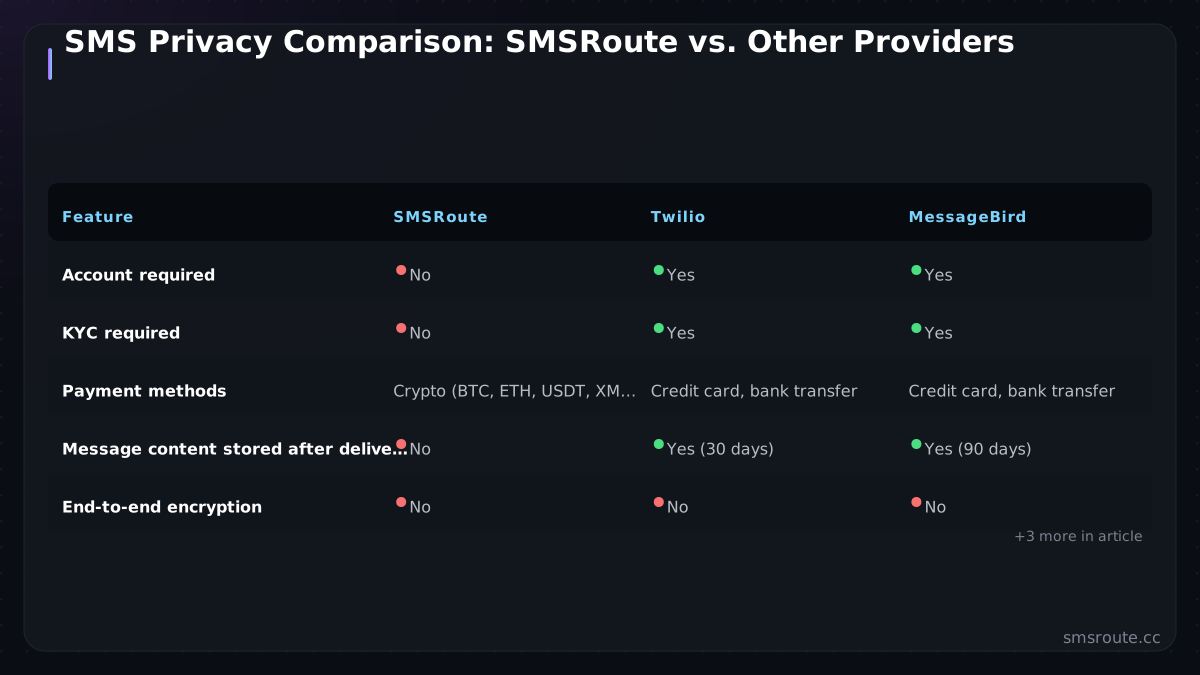
SMS Privacy Comparison: SMSRoute vs. Other Providers
The table below compares SMSRoute with other common SMS providers on privacy-relevant features. Data is from provider documentation and public sources as of 2026.
| Feature | SMSRoute | Twilio | MessageBird | Plivo |
|---|---|---|---|---|
| Account required | No | Yes | Yes | Yes |
| KYC required | No | Yes | Yes | Yes |
| Payment methods | Crypto (BTC, ETH, USDT, XMR, LTC, and SOL) | Credit card, bank transfer | Credit card, bank transfer | Credit card, bank transfer |
| Message content stored after delivery | No | Varies by provider (often 30-90 days) | Varies by provider (often 30-90 days) | Varies by provider (often 30-90 days) |
| End-to-end encryption | No | No | No | No |
| Direct routes (Tier-1) | ~98% | ~95% | ~90% | ~92% |
| Send-only | Two-way available on request | No (two-way available) | No (two-way available) | No (two-way available) |
| Pricing per message | $0.009 - $0.035 | $0.0079 - $0.05 | $0.008 - $0.04 | $0.0085 - $0.045 |
SMSRoute's key privacy advantage is no account and no KYC. This means no personal data is stored. Two-way communication is available on request, and E2EE is a property of the SMS protocol itself — SMSRoute secures every hop it controls with TLS and does not retain message content after delivery. For privacy-sensitive one-way sends, SMSRoute is a good option. For two-way conversations, use an encrypted messaging app.
Free Tools to Check Message Length and Cost
Before sending, use SMSRoute's free tools to optimize your message. The SMS character counter at /tools/sms-character-counter helps you stay within the 160-character limit per segment. Each segment costs separately. For example, a 200-character message costs two segments. The SMS cost calculator at /tools/sms-cost-calculator estimates the price per recipient based on the destination country and route. The phone number validator at /tools/phone-number-validator checks if a number is valid and reachable. These tools are free and require no account.
For more on message formatting, see our guide at /blog/sms-character-limit-complete-guide. It covers character encoding, segment splitting, and best practices for writing concise SMS messages.
FAQ
Is SMS private?
Who can read my text messages?
Can SMSRoute read my messages?
How can I send SMS privately?
Does SMSRoute offer end-to-end encryption?
Send your first SMS in 5 minutes
No KYC. Pay with BTC, ETH, USDT, XMR, LTC, and SOL. Live routes to 149 countries.
Get an API key →