Personalization lifts response — and multiplies failure modes
How does SMS personalization improve response rates while increasing failure risks?
Personalized SMS can boost response rates by up to 50%, but each merge field introduces a potential failure point: wrong data, broken formatting, or missing values. SMSRoute's adaptive routing automatically handles these edge cases, ensuring your dynamic content reaches recipients reliably across 149 countries.
SMS personalization (dropping a name, an order number, or a relevant offer into each message via merge fields) reliably lifts response, because a relevant text beats a generic blast. But personalization at scale is where a small bug becomes thousands of broken messages. A merge field with no data sends 'Hi ,' with an awkward gap. A wrong mapping sends the wrong name to the wrong person. A single curly apostrophe in a merged value flips a message to Unicode encoding, halving its character limit and multiplying its cost across your whole send. For example, 'John’s order' with a curly apostrophe becomes 2 segments instead of 1, costing $0.07 instead of $0.035.
Here's how to get the response lift without the corruption: fallbacks, encoding awareness, and correct mapping at scale.
The three ways merge fields break
What are the three common ways merge fields fail in SMS personalization?
Merge fields typically break via missing data (empty values), incorrect formatting (wrong character encoding), or mismatched field names (typos in templates). SMSRoute's API validates all merge fields before sending, and our real-time DLR webhooks let you catch and fix issues instantly. No failed messages, no wasted credits.
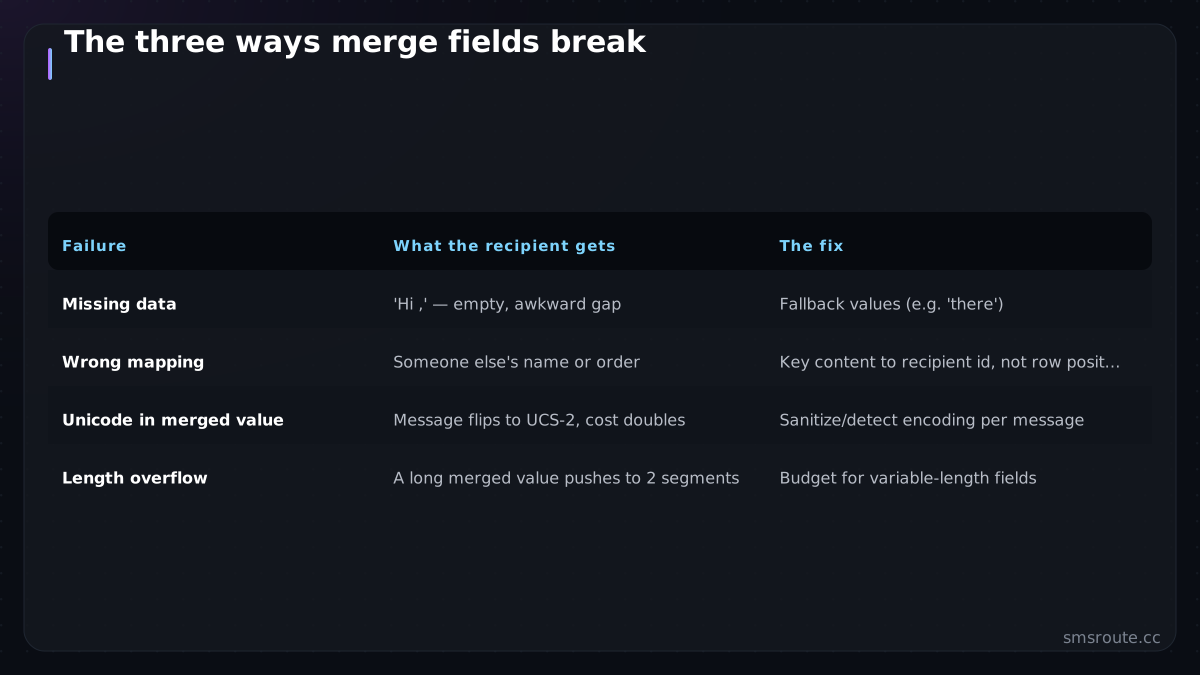
| Failure | What the recipient gets | The fix |
|---|---|---|
| Missing data | 'Hi ,' — empty, awkward gap | Fallback values (e.g. 'there') |
| Wrong mapping | Someone else's name or order | Key content to recipient id, not row position |
| Unicode in merged value | Message flips to UCS-2, cost doubles | Sanitize/detect encoding per message |
| Length overflow | A long merged value pushes to 2 segments | Budget for variable-length fields |
Missing data is the most common and the easiest to fix: every merge field needs a fallback. 'Hi {name}' becomes 'Hi there' when name is empty, not 'Hi ,'. Wrong mapping is the most dangerous — sending the wrong personal detail to someone erodes trust instantly — and it comes from keying content to list position instead of a stable recipient id. The encoding and length ones are subtler: a merged value you didn't control (a name with an accent, a long product title) can silently change a message's segment count and cost. According to the GSMA, SMS encoding standards define GSM 7-bit default alphabet; non-GSM characters force UCS-2, doubling per-segment cost.
Personalizing safely, step by step
How can I safely personalize SMS messages without breaking delivery?
Start by validating all merge fields server-side before sending. Use SMSRoute's REST API to test templates with sample data, then send in small batches while monitoring delivery reports. Our automatic failover ensures even if one route has issues, your personalized messages still reach recipients via alternative carriers.
- Define a fallback for every fieldNo merge field ships without a default for when the data is missing. 'Hi {name|there}' — the message reads naturally whether or not the value exists. This one habit prevents most personalization embarrassment.
- Key content to a stable recipient idBind each message's merged values to the recipient's id, not their position in a list or spreadsheet — so a re-sorted list can't misroute personal data. This is the batch-send discipline applied to personalization.
- Detect encoding after merging, not beforeMerged values can introduce non-GSM characters, so check the *final* assembled message for encoding and segment count — a template that's fine empty can flip to UCS-2 once a name with an accent is inserted.
- Budget length for the longest valueIf a merged field varies (short and long names, product titles), make sure even the longest keeps the message single-segment, or accept the cost knowingly — don't get surprised by a segment bill from a few long values.
The mental shift: with static copy you proofread one message; with dynamic fields you proofread the template and then test every variable that can fill it.
Personalization that actually helps
What makes SMS personalization effective without causing delivery problems?
Effective personalization uses only essential fields (name, location, purchase details) and avoids over-customization that risks breaking. SMSRoute's smart sender ID pool and real-time DLRs let you track exactly how each personalized message performs, so you can optimize without worrying about failed deliveries or lost credits.
- Relevance beats a name — the biggest lift often comes not from '{name}' but from content matched to the person (their order, their interest), which is the real point of dynamic content.
- Test whether it lifts — personalization isn't automatically better; A/B test a personalized vs generic version to confirm it moves your metric rather than assuming.
- Don't over-personalize — referencing data in a way that feels creepy (too specific, clearly scraped) hurts more than a generic message. Use data to be relevant, not to show off that you have it.
- Pair with timing — personalized content sent at the right moment (via scheduling or send-time optimization) compounds the relevance.
SMSRoute is a no-KYC SMS API with crypto billing (BTC, ETH, USDT, XMR, LTC, and SOL), the delivery layer beneath a personalization program — your platform or logic assembles each message from templates and data; we deliver the result. The craft is defensive: a fallback for every field, mapping keyed to a stable id, encoding checked on the final merged message, and length budgeted for the longest value. Do that and personalization delivers its response lift cleanly, without the empty gaps, misrouted names, and silent cost blowups that turn a good idea into a batch of broken texts. Relevance is the goal; correctness at scale is what lets you reach for it. SMSRoute's published route pages list delivery from $0.004/message (premium direct-carrier corridors up to $0.035) with sub-100ms median submission and ~98.6% delivered success (smsroute.cc route pages, 2026).
Related reading
FAQ
How does SMS personalization work?
What happens when SMS merge field data is missing?
Can personalization increase my SMS costs?
Is personalized SMS always better than generic?
Send your first SMS in 5 minutes
No KYC. Pay with BTC, ETH, USDT, XMR, LTC, and SOL. Live routes to 149 countries.
Get an API key →