The three channels at a glance
For OTP delivery, the SMS vs WhatsApp vs RCS decision comes down to three channels that dominate in 2026: plain SMS, WhatsApp business messaging, and RCS (Rich Communication Services). (Confused about how RCS and WhatsApp relate? They're entirely separate — see our RCS vs WhatsApp explainer.) For the authoritative reference, see the GSMA RCS Universal Profile.
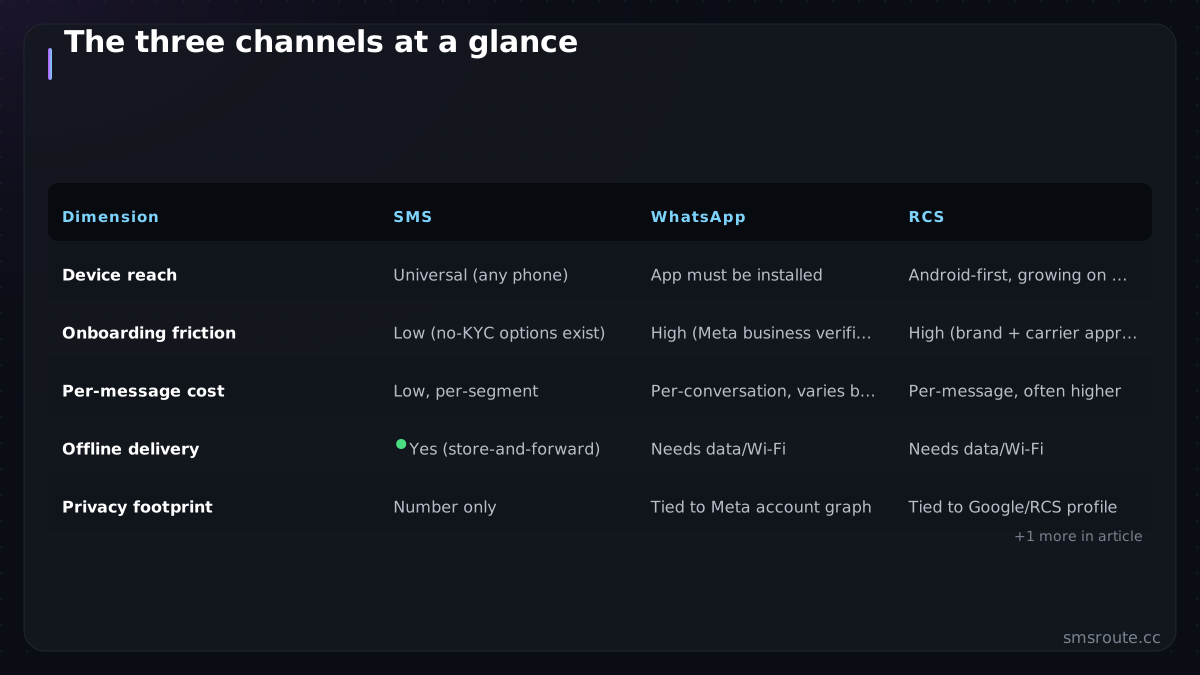
| Dimension | SMS | RCS | |
|---|---|---|---|
| Device reach | Universal (any phone) | App must be installed | Android-first, growing on iOS |
| Onboarding friction | Low (no-KYC options exist) | High (Meta business verification) | High (brand + carrier approval) |
| Per-message cost | Low, per-segment | Per-conversation, varies by country | Per-message, often higher |
| Offline delivery | Yes (store-and-forward) | Needs data/Wi-Fi | Needs data/Wi-Fi |
| Privacy footprint | Number only | Tied to Meta account graph | Tied to Google/RCS profile |
| Best for | Universal fallback, no-KYC launches | Rich two-way support flows | Branded verified messaging |
When SMS wins
SMS stays the default OTP channel for one reason: it reaches every phone, online or off, with no app install.
- You need universal reach across devices, OSes, and low-connectivity regions.
- You want to ship fast — no-KYC SMS APIs skip the multi-day business verification that WhatsApp and RCS require.
- Privacy matters — SMS carries only a phone number in international format (E.164), not an identity graph tied to a Meta or Google account.
- You want predictable, per-segment pricing you can model against message volume, noting that each segment is limited to 160 characters in GSM-7 encoding.
When WhatsApp or RCS make sense
If your OTP is the front door to a rich, two-way conversation (order support, appointment changes, account recovery with follow-up), WhatsApp's session model can be worth its onboarding cost. RCS shines when verified brand identity in the messaging thread materially raises trust, such as banking or high-value commerce, and your audience skews to supported Android handsets.
A simple decision rule
- Start with reachIf you cannot guarantee your users have WhatsApp or an RCS-capable handset, SMS is your baseline — full stop.
- Check time-to-launchIf you need to ship this week, SMS (especially a no-KYC API) avoids the verification queues that gate WhatsApp and RCS.
- Layer richness only where it paysAdd WhatsApp/RCS for the specific flows or segments where two-way or verified branding lifts a measured metric — not by default.
The costs the channel choice hides
Each channel carries a cost profile that a simple per-message comparison misses. SMS bills per segment at per-country rates, with US traffic carrying carrier surcharges on top. WhatsApp bills per delivered authentication template, cheap in some corridors but with a 3-18x international surcharge in nine markets. RCS carries agent-registration and annual brand-verification fees before a single message. So the 'cheapest channel' depends entirely on your country mix and volume — model all three against your real traffic, not a headline rate. These fees typically range from $500 to $2000 per year, with rates set individually by each mobile carrier like T-Mobile or Verizon. For example, a 6 digit OTP message in the United States costs 0.0075 USD per segment, while in India it costs 0.0020 USD per segment.
There's a reach cost too, and it's the one that catches teams. WhatsApp only reaches installed users, and RCS only reaches capable handsets, so both require an SMS fallback for everyone they miss — which means the honest comparison is never one channel versus another. It's WhatsApp-plus-SMS or RCS-plus-SMS versus SMS-alone: two integrations and two vendor relationships versus one. That fallback dependency is why SMS stays the base of the stack even as the rich channels grow. SMSRoute's pu
Where each fits, in one line
- SMS — universal reach, fastest launch (especially no-KYC), predictable cost, and the mandatory fallback under the others. The default OTP channel.
- WhatsApp — worth its Meta verification where your audience lives on it (Brazil, India, Indonesia) and you want rich two-way follow-up; watch the international auth surcharge.
- RCS — verified brand identity in the thread for high-trust flows on capable Android/iOS handsets, with automatic SMS fallback built into the standard.
- The honest default — SMS primary, with WhatsApp or RCS layered only where a measured metric justifies the extra integration, per the multichannel fallback architecture.
Related reading
FAQ
Is WhatsApp cheaper than SMS for OTP?
Does RCS replace SMS for 2FA?
Which channel is best for privacy-focused apps?
Can one API send all three?
Yes. SMSRoute’s single API handles SMS, WhatsApp, and RCS messaging through one integration. You send messages to any channel using the same endpoint and credentials, with automatic routing based on the destination. This unified approach simplifies development, reduces maintenance, and ensures consistent delivery across all three channels without managing separate APIs or providers.
Send your first SMS in 5 minutes
No KYC. Pay with BTC, ETH, USDT, XMR, LTC, and SOL. Live routes to 149 countries.
Get an API key →