Why crypto is the worst place to trust SMS alone
SMS OTP for crypto exchanges, used as the sole factor, is dangerous — and here is why. A crypto account is the highest-value target a SIM-swap attacker can hit. Transactions are irreversible. Liquidity is instant. There are no chargebacks. When an attacker ports a victim's number to their own SIM, every SMS code and password reset flows straight to them. In November 2022, co-conspirators moved over $400 million out of FTX hot wallets after a single AT&T store SIM swap. That remains the largest publicly attributed loss of its kind. The FBI's IC3 has logged hundreds of millions in cumulative SIM-swap losses, and crypto takeovers drive the biggest individual incidents. (Source: FBI IC3 Internet Crime Report) The attackers used social engineering to trick an AT&T employee into transferring control of the target’s phone number. The stolen funds have not been recovered. From 2020 to 2024, the IC3 reported $272.7 million in total SIM-swap losses. See the report: https://www.ic3.gov/Media/PDF/AnnualReport/2024_IC3Report.pdf
That does not mean SMS has no place here. It means its place is narrow and supporting, never the last line.
The threat model, plainly
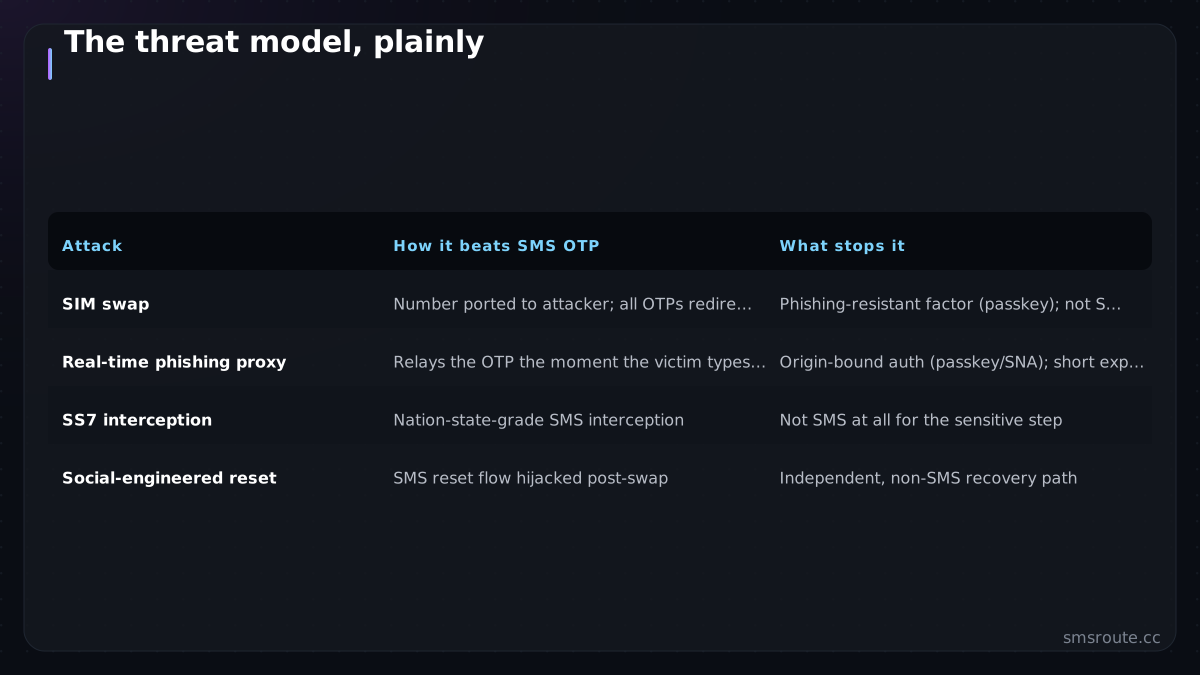
| Attack | How it beats SMS OTP | What stops it |
|---|---|---|
| SIM swap | Number ported to attacker; all OTPs redirect | Phishing-resistant factor (passkey); not SMS |
| Real-time phishing proxy | Relays the OTP the moment the victim types it | Origin-bound auth (passkey/SNA); short expiry helps only marginally |
| SS7 interception | Nation-state-grade SMS interception | Not SMS at all for the sensitive step |
| Social-engineered reset | SMS reset flow hijacked post-swap | Independent, non-SMS recovery path |
Every row that a determined attacker uses against a crypto account defeats SMS specifically. That is why NIST SP 800-63B Rev 4 formally classifies SMS one-time passcodes as a restricted authenticator. The detail is in our SMS-vs-email OTP piece. And it explains why serious exchanges have moved primary auth to passkeys and authenticator apps. (Source: NIST SP 800-63B Rev 4)
Where SMS still legitimately fits
Narrow, supporting roles — not the guard on the vault door:
- Onboarding number verification: proving a signup controls a reachable number, before any funds exist. Low stakes, SMS is fine.
- Low-risk notifications: 'a login occurred', 'a withdrawal was requested'. As an *alert*, not an *authorization*, SMS reach is an asset.
- A fallback rung, rate-limited hard: behind passkeys and an authenticator, SMS can catch users locked out of stronger factors, provided high-value actions demand more. This is the multichannel fallback pattern with SMS deliberately low in the order.
- Never: as the sole gate on a withdrawal, a password reset that unlocks funds, or the only 2FA on the account.
Keep that line and SMS stays an asset instead of a liability.
The layered setup crypto accounts need
- Passkey or authenticator as primaryPhishing-resistant, origin-bound, immune to SIM swap. This is the front door for any account holding value — the direction our passkeys analysis documents as the 2026 default.
- Step-up on sensitive actionsWithdrawals, new withdrawal addresses, and security-setting changes require the strong factor freshly, never a cached SMS session. Consider Silent Network Authentication where a phishing-proof phone check adds signal.
- SMS as notify + hard-limited fallbackUse SMS to alert on account events and, if at all, as a heavily rate-limited recovery rung — with per-number caps against pumping and a withdrawal freeze window after any recovery event.
- Detect SIM-swap signalsA recent SIM change is a fraud input: a number lookup can flag it, and a fresh swap should trigger extra friction or a temporary hold on high-value actions.
SMSRoute is a no-KYC SMS API with crypto billing (BTC, ETH, USDT, XMR, LTC, and SOL). It would be easy for us to just sell you the OTP sends. Here is the honest version instead. For a crypto exchange, buy SMS for onboarding verification and event notifications. Put passkeys on the vault door. If you use SMS as a fallback rung at all, cap it hard, and never let it authorize a withdrawal alone. In that supporting role, delivered reliably, SMS is genuinely useful. As the last line of defense on a crypto account, it is a $400M lesson nobody should need to repeat. SMSRoute's published route pages list delivery from $0.004/message (premium direct-carrier corridors up to $0.035) with sub-100ms median submission and ~98.6% delivered success (smsroute.cc route pages, 2026).
Related on SMSRoute: for the buyer's-eye view, see SMS verification for crypto users and SMS for Telegram bots.
Related reading
FAQ
Is SMS OTP safe for a crypto exchange?
Why are crypto exchanges moving away from SMS 2FA?
Can I use SMS at all on a crypto platform?
How do I protect crypto accounts from SIM swap?
Send your first SMS in 5 minutes
No KYC. Pay with BTC, ETH, USDT, XMR, LTC, and SOL. Live routes to 149 countries.
Get an API key →