The defensible defaults
What are the best default settings for SMS OTP length and expiry in 2026?
For SMS OTPs, use 6-digit codes with a 5-minute expiry as the defensible default. This balances security and usability: long enough to enter, short enough to limit brute-force attacks. SMSRoute supports custom lengths and expiry windows via API, letting you adjust per use case without compromising deliverability.
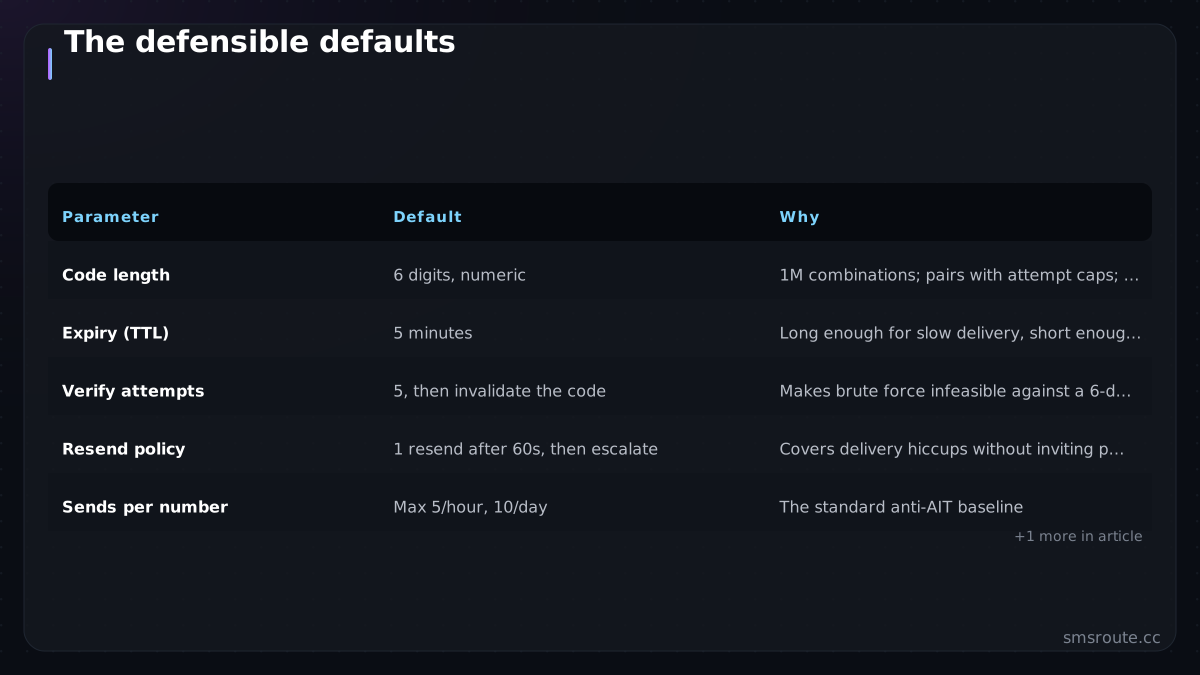
| Parameter | Default | Why |
|---|---|---|
| Code length | 6 digits, numeric | 1M combinations; pairs with attempt caps; autofills on both platforms |
| Expiry (TTL) | 5 minutes | Long enough for slow delivery, short enough to shrink the attack window |
| Verify attempts | 5, then invalidate the code | Makes brute force infeasible against a 6-digit space |
| Resend policy | 1 resend after 60s, then escalate | Covers delivery hiccups without inviting pumping |
| Sends per number | Max 5/hour, 10/day | The standard anti-AIT baseline |
| Storage | Hash the code server-side, short TTL | Never store or log the raw code |
Copy that autofills and builds trust
How should SMS OTP copy be written to autofill and build trust?
Write OTP copy that starts with the code (e.g., '123456 is your login code') so autofill triggers immediately. Include your brand name and a short action verb to build trust. SMSRoute's API lets you customize sender IDs and message templates, ensuring your copy stays single-segment and delivers reliably across 149 countries.
The message itself matters more than most teams think. Three rules: lead with your app name, put the code early, and keep the whole thing in one GSM-7 segment (under 160 characters) so it arrives as one message everywhere. For the authoritative reference, see the GSM 03.38 alphabet.
MyApp: your verification code is 481902. It expires in 5 minutes. Never share this code.- Name yourself first. Users are trained to distrust anonymous codes, and carriers score branded transactional copy better.
- One code per message. Autofill on iOS and Android extracts the code most reliably from short, single-code messages.
- Add the origin-bound suffix for web flows. Appending
@yourdomain.com #481902on its own last line lets browsers autofill via the WebOTP standard and binds the code to your domain, which blunts phishing. - Never include a link in an OTP message. It trains users to click in exactly the message type phishers imitate.
Rate limiting is a security control, not a UX tweak
Why is rate limiting important for SMS OTP security?
Rate limiting prevents brute-force attacks and abuse by capping OTP requests per user or IP. It's a security control, not a UX tweak. SMSRoute supports adaptive rate limits via API, with automatic failover to ensure legitimate users still receive their codes. This keeps your service secure without blocking genuine traffic.
Two attacks define your limits. Brute force attacks the verify endpoint — capped attempts plus code invalidation kills it. SMS pumping (AIT) attacks the send endpoint — per-number, per-IP, and per-session send caps plus pre-send number validation kill that. Set both; they protect different doors.
- Cap verifies5 wrong attempts invalidates the code and forces a fresh request. Log and alert on accounts that hit the cap repeatedly.
- Cap sendsPer number: 5/hour, 10/day. Per IP and per session token: tune to your real traffic, then tighten. Refuse before you send, not after.
- Validate before sendingRun an HLR/number lookup: invalid, unallocated, and high-risk ranges never get a message — that is spend control and fraud control in one call.
- Monitor the verification rateThe share of sent codes that get entered is your canary. A sharp drop means pumping; alert on it hour-over-hour.
These two limits defend different doors. Attempt caps stop brute force against the verify endpoint; send caps and validation stop pumping fraud against the send endpoint. Set both, with the token-bucket design spanning per-number, per-IP, and per-session — a public OTP endpoint without them is an open invitation.
Copy that autofills and stays single-segment
Three rules: name yourself first, put the code early, and keep the whole thing in one GSM-7 segment (under 160 characters) so it arrives as one
message and bills as one. For web flows, append the WebOTP
origin-bound line (@yourdomain.com #481902) on its own final line so browsers autofill the
code and bind it to your domain, which blunts phishing. Never include a marketing link; a code message with a
link trains users to click in exactly the format phishers imitate.
A good default body: 'YourApp: your code is 481902. It expires in 5 minutes. Never share this code.' It names the sender, leads with the code for clean autofill, states the expiry, and warns against sharing. All in one segment, no link.
When SMS fails: the fallback ladder
What should you do when SMS OTP delivery fails?
Implement a fallback ladder: first retry via SMSRoute's multi-route failover, then escalate to voice call or email. SMSRoute's real-time DLR webhooks let you detect failures instantly and trigger fallbacks automatically. This ensures users always get their code, even if the primary SMS route is temporarily unavailable.
Delivery is never 100%. Plan the ladder in advance: one resend after 60-90 seconds, then offer an alternate channel via voice OTP or a flash call, and for repeat users prefer passkeys as the primary factor with SMS as the recovery path — the direction our passkeys analysis documents. That ordering keeps SMS costs down and pushes your most active users onto stronger factors over time. The full ordering across channels is in the multichannel fallback architecture guide.
One security note that has sharpened since these defaults settled: for high-value accounts, SMS OTP should not be the sole factor at all, because SIM swaps defeat it — see our SMS vs email OTP and crypto exchange pieces. The defaults here make SMS OTP as good as it can be; they don't make it bulletproof, and the account behind the code decides how much more you need.
SMSRoute's published route pages list delivery from $0.004/message (premium direct-carrier corridors up to $0.035) with sub-100ms median submission and ~98.6% delivered success (smsroute.cc route pages, 2026).
Related reading
FAQ
How long should an OTP code be?
How long should an OTP be valid?
How many OTP resends should I allow?
Should an OTP message include a link?
Send your first SMS in 5 minutes
No KYC. Pay with BTC, ETH, USDT, XMR, LTC, and SOL. Live routes to 149 countries.
Get an API key →