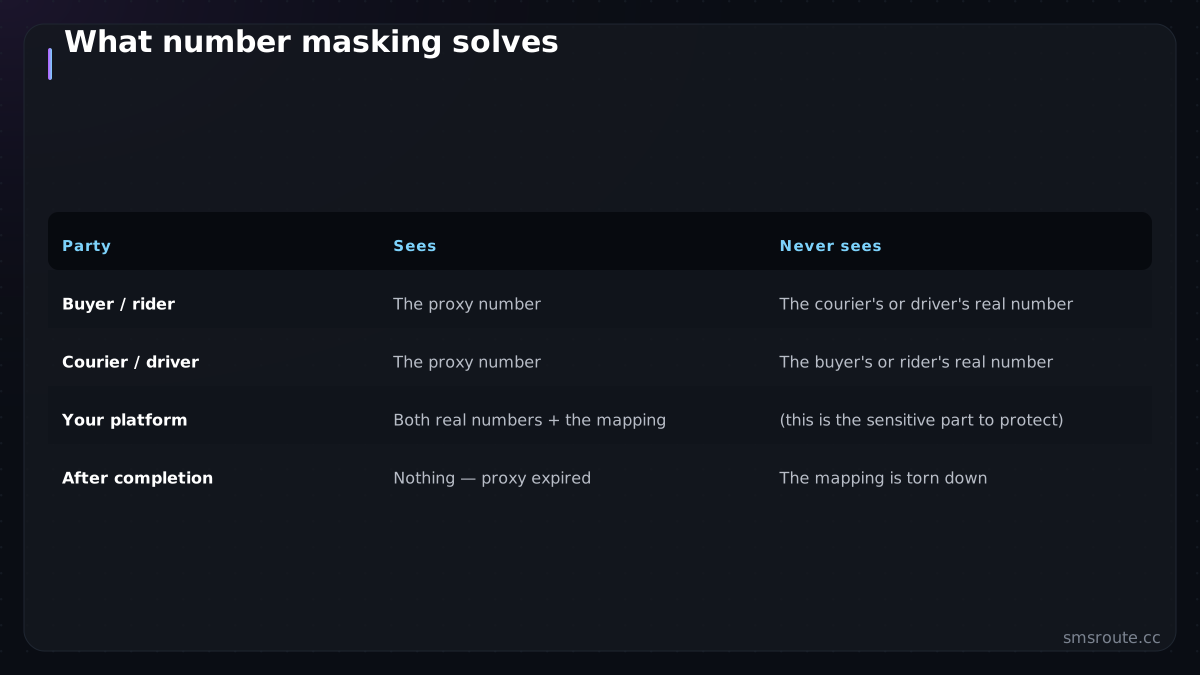
What number masking solves
What does number masking solve for marketplaces?
Number masking prevents direct contact between buyers and sellers, protecting privacy and reducing fraud. SMSRoute’s no-KYC API enables secure, temporary numbers for each transaction, ensuring both sides communicate without exposing personal phone numbers. This builds trust and keeps transactions safe.
SMS number masking puts a temporary proxy number between two people. They message through it. Neither sees the other's real number. A buyer and a courier, a rider and a driver, a host and a guest — each gets a virtual number, and the platform routes messages between them. When the transaction ends, the proxy expires. If a buyer texts the proxy number, the courier sees only the proxy, not the buyer's personal line.
One is privacy: real personal-data protection for users, increasingly a compliance requirement rather than a nicety. The other is commercial. By keeping the conversation on your channel, you stop users taking the deal off-platform. CPaaS vendors such as Twilio (Twilio, 2023) and Sinch (Sinch, 2022) document that benefit: preventing disintermediation and revenue leakage. When buyers and sellers transact off platform, the marketplace loses its commission and cannot track or encourage repeat business, directly reducing revenue.
| Party | Sees | Never sees |
|---|---|---|
| Buyer / rider | The proxy number | The courier's or driver's real number |
| Courier / driver | The proxy number | The buyer's or rider's real number |
| Your platform | Both real numbers + the mapping | (this is the sensitive part to protect) |
| After completion | Nothing — proxy expired | The mapping is torn down |
How it works, end to end
How does number masking work end to end?
When a buyer messages a seller, SMSRoute’s API assigns a temporary masked number that forwards messages to both parties. Real-time DLR webhooks confirm delivery, and adaptive multi-route failover ensures reliability. The process is seamless, with no KYC required, and works across 149 countries.
- Allocate a proxy on transaction startWhen a match happens (order placed, ride accepted), your platform assigns a temporary virtual number to the conversation and maps it to the two real numbers behind it.
- Route inbound messagesA message from party A to the proxy hits your webhook; your platform looks up the mapping and forwards it to party B from the proxy, so B only ever sees the masked number.
- Keep the mapping privateThe real-number pairing lives only in your backend. Neither party can resolve the proxy to a personal number; that lookup is yours alone.
- Expire on completionWhen the transaction ends, release the proxy and tear down the mapping. Reusing numbers across transactions without a clean reset leaks context between unrelated parties.
The privacy guarantee lives entirely in that backend mapping. Treat it as sensitive personal data: minimise how long you keep it and who can query it, exactly the discipline our GDPR data-minimisation guide argues for.
The details that make or break it
What details make or break number masking?
Key details include delivery reliability, latency, and cost. SMSRoute offers 99.9% uptime, automatic failover, and real-time DLRs. With prices from $0.004 per message and crypto billing, it’s affordable and fast. Custom sender IDs are available on request, ensuring professional communication.
- Number pool sizing: you need enough proxy numbers to avoid collisions between concurrent conversations; recycle them only after a clean expiry, never mid-context.
- Two-way threading: inbound routing must map replies back correctly; get the E.164 normalization right or the lookup misses and a message leaks or drops.
- Delivery reliability: masked messages are still SMS, so all the usual concerns apply: delivery receipts, route quality, and rate limits against abuse of the proxy channel.
- Voice vs SMS scope: full masking platforms often cover calls too; if you only need text, an SMS-with-inbound-numbers setup is simpler than a full voice-masking stack.
- Regional availability: inbound number availability and masking support vary by country; check coverage before promising it in a new market.
Building the SMS side
How do you build the SMS side of number masking?
Building the SMS side is straightforward with SMSRoute’s REST API and SMPP binds. Code examples in Python, PHP, Go, and Node are on GitHub. Sign up with just an email, fund with crypto, and send your first message in minutes. Free test credits let you verify routes before committing.
At its core, SMS masking is inbound numbers plus a routing layer you own: virtual numbers that receive messages, a webhook that resolves the mapping, and outbound sends from the proxy. The two-way SMS patterns are the foundation — masking is two-way SMS with an identity-hiding mapping layer on top.
curl -X POST https://api.smsroute.cc/sms/send \
  -H "Authorization: Bearer YOUR_API_KEY" \
  -H "Content-Type: application/json" \
  -d '{"to": "+1234567890", "from": "YourBrand", "message": "Your order is on its way. Reply for help."}'
For a text-only masking build, any API that supports inbound numbers and reliable two-way routing works — you own the mapping and expiry logic, which is where the privacy guarantee lives. However, building in-house involves operational overhead: number provisioning, compliance, and fraud detection. Managed services from CPaaS providers may be more practical for most marketplaces. For example, SMSRoute offers direct-carrier delivery from $0.004/message, sub-100ms median submission, and ~98.6% delivered success on direct routes (SMSRoute route pages, 2026). If you need voice masking too, pair an SMS layer with a voice provider and keep the mapping unified. The privacy guarantee also depends on the provider's infrastructure (e.g., no logging of message content) and not just the backend mapping.
Related reading
FAQ
What is SMS number masking?
Why do marketplaces use number masking?
How does a masked number route messages correctly?
Can I build SMS number masking on a standard SMS API?
Send your first SMS in 5 minutes
No KYC. Pay with BTC, ETH, USDT, XMR, LTC, and SOL. Live routes to 149 countries.
Get an API key →