The link is a deliverability decision, not a formatting one
How does a link choice affect SMS deliverability?
Every link in an SMS affects carrier filtering. Public shorteners like bit.ly are often flagged as spam, reducing delivery rates. Branded short links on your own domain signal trust to carriers, improving inbox placement. SMSRoute's API lets you send branded links easily, ensuring your messages reach recipients reliably.
So the link shortener question is really a deliverability question with a click-tracking bonus attached. Get it right and you gain measurably; get it wrong and your message never arrives to argue its case.
Branded vs public: the trade laid out
What are the trade-offs between branded and public short links for SMS?
Public shorteners like bit.ly are free but risk carrier blocking and lack brand consistency. Branded short links cost slightly more but boost deliverability, click-through rates, and trust. With SMSRoute's no-KYC API and crypto billing, you can set up branded links in minutes and avoid the deliverability penalties of public services.
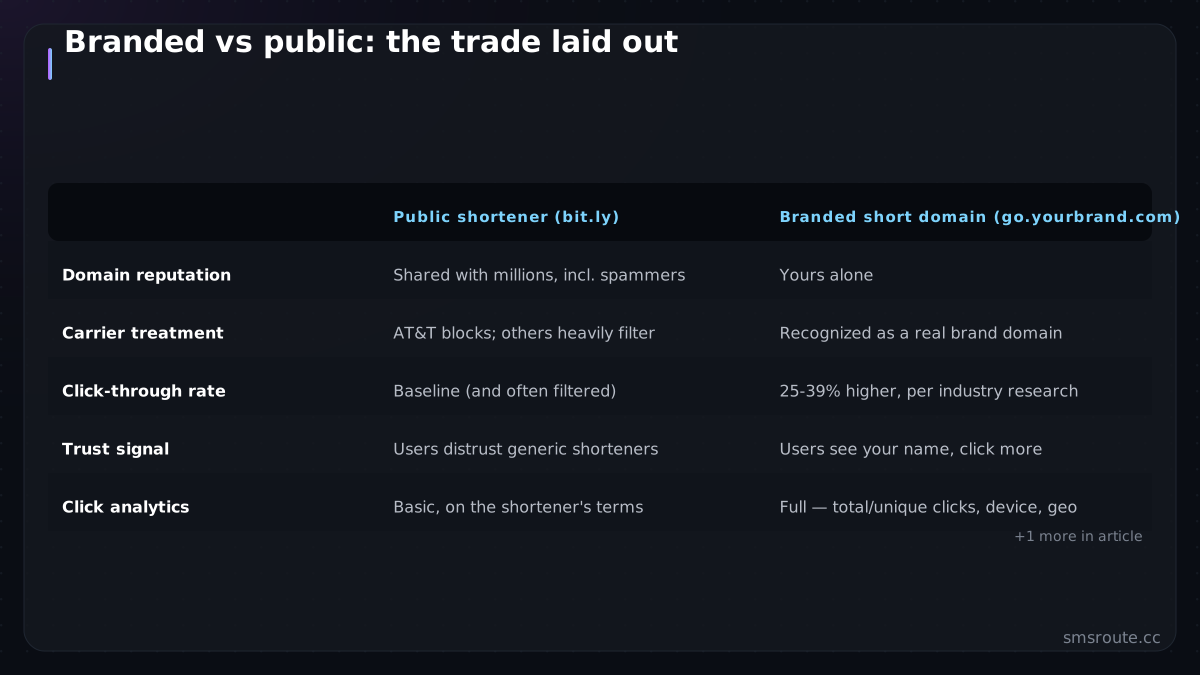
| Public shortener (bit.ly) | Branded short domain (go.yourbrand.com) | |
|---|---|---|
| Domain reputation | Shared with millions, incl. spammers | Yours alone |
| Carrier treatment | AT&T blocks; others heavily filter | Recognized as a real brand domain |
| Click-through rate | Baseline (and often filtered) | 25-39% higher, per industry research |
| Trust signal | Users distrust generic shorteners | Users see your name, click more |
| Click analytics | Basic, on the shortener's terms | Full — total/unique clicks, device, geo |
| Setup | None | A domain + a link service or self-host |
For reference, the CTIA's Messaging Principles and Best Practices (ctia.org) outline carrier expectations for sender reputation.
The one link you should never shorten — or include at all — is in an OTP. Links in verification messages train users to click in exactly the format phishers imitate, per our OTP best-practices guide. Link strategy is a marketing-SMS topic; transactional codes stay link-free.
Setting up branded short links
How do I set up branded short links for SMS campaigns?
To set up branded short links, register a custom domain, configure a redirect service (e.g., yourdomain.com/abc → target URL), and use that domain in your SMS messages. SMSRoute's API supports custom sender IDs and branded links, ensuring your messages look professional and avoid carrier spam filters.
- Register a short domainA brand-recognizable domain (go.yourbrand.com, or a short standalone like yb.co). Keep it clearly yours — the whole point is that recipients and carriers associate it with you.
- Point it at a link service or self-hostUse a branded-link provider or run your own redirector. Either way you control the domain reputation, which is the asset.
- Warm the domain graduallyA brand-new link domain has no reputation yet; ramp volume rather than blasting from cold, the same warm-up logic the firewall guide describes for numbers.
- Track and keep it cleanUse the click analytics (total, unique, device, geo), and never let the domain host anything spammy — one abuse incident poisons the reputation you built.
Also budget the characters: a link plus tracking can push a message over one segment, and a stray Unicode character in your copy compounds it — the character-limit math applies. And where you send matters: in strict regimes like India's DLT, link and template rules are enforced hard, so a shortened URL that works in the US may be scrubbed there. The Telecom Regulatory Authority of India (TRAI) provides guidelines on commercial SMS (trai.gov.in).
When to skip links entirely
When should I avoid using links in SMS messages?
Skip links when your message is purely informational (e.g., appointment reminders) or when carrier restrictions apply. For transactional or marketing SMS, branded links are safe. SMSRoute's adaptive routing automatically optimizes delivery, so you can focus on content while we handle deliverability.
- OTP and verification — never. Links here are a phishing-training liability, full stop.
- High-filtering destinations — where any link risks scrubbing, consider a linkless message that directs users to open your app or search your brand.
- Low-trust cold sends — a link to a recipient with no relationship to you is a spam signal regardless of domain; earn the relationship first.
- When a keyword reply works better — for opt-ins, a two-way SMS keyword ('reply YES') can beat a link, with no deliverability risk at all.
SMSRoute is a no-KYC SMS API with crypto billing (BTC, ETH, USDT, XMR, LTC, and SOL) — we deliver the message; the link inside it is your reputation to manage. The practical rule is simple: branded short domain for marketing links, no links in transactional, and always check that the whole message clears a single segment and the destination's content rules before you send at scale. SMSRoute's published route pages list delivery from $0.004/message (premium direct-carrier corridors up to $0.035) with sub-100ms median submission and ~98.6% delivered success (smsroute.cc route pages, 2026).
Related reading
FAQ
Do link shorteners hurt SMS deliverability?
Are branded short links better for SMS?
Should I put a link in an OTP message?
How do I set up a branded short link for SMS?
Send your first SMS in 5 minutes
No KYC. Pay with BTC, ETH, USDT, XMR, LTC, and SOL. Live routes to 149 countries.
Get an API key →