The channel parents actually see in an emergency
Why is SMS the best channel for emergency school alerts?
SMS has near-instant open rates—over 90% within 3 minutes—making it the most reliable channel for urgent school notifications. Unlike email or app push, SMS bypasses spam filters and notification settings, ensuring parents receive critical alerts immediately. SMSRoute's API delivers to 149 countries with 99.9% uptime, so your emergency messages always get through.
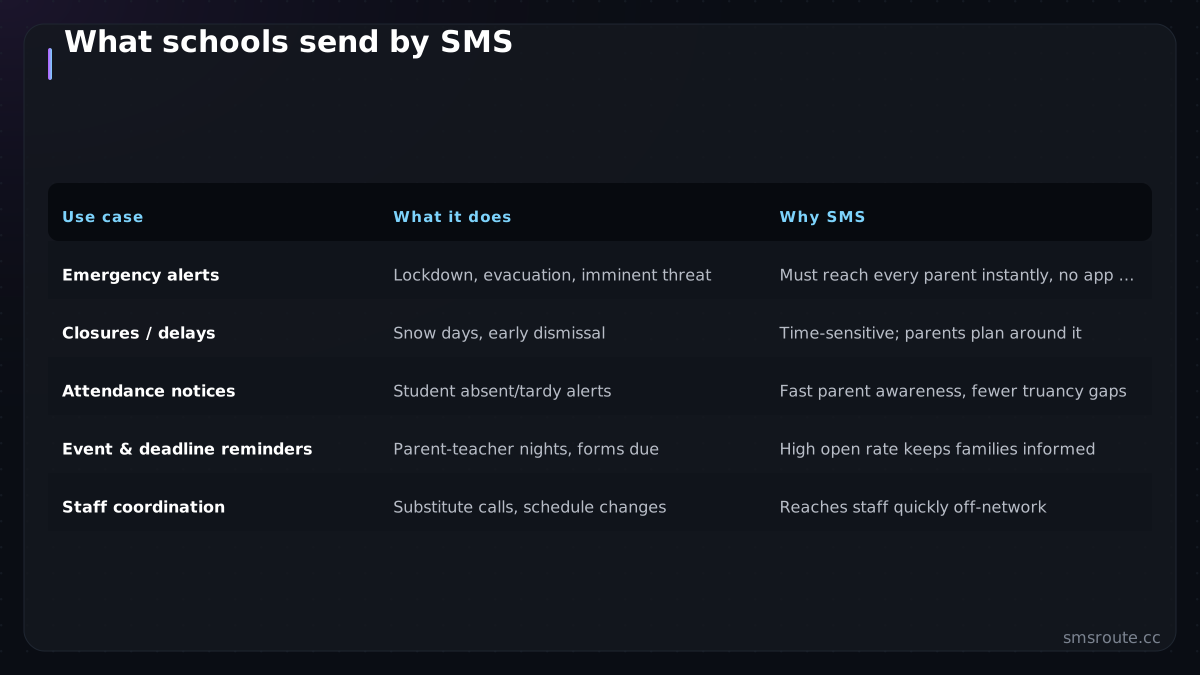
What schools send by SMS
What types of messages do schools send via SMS?
Schools use SMS for emergency alerts (lockdowns, weather closures), attendance notifications, parent-teacher conference reminders, lunch balance updates, and general announcements. SMSRoute supports custom sender IDs and real-time delivery reports, making it easy to manage both urgent and routine communications from a single API.
| Use case | What it does | Why SMS |
|---|---|---|
| Emergency alerts | Lockdown, evacuation, imminent threat | Must reach every parent instantly, no app needed |
| Closures / delays | Snow days, early dismissal | Time-sensitive; parents plan around it |
| Attendance notices | Student absent/tardy alerts | Fast parent awareness, fewer truancy gaps |
| Event & deadline reminders | Parent-teacher nights, forms due | High open rate keeps families informed |
| Staff coordination | Substitute calls, schedule changes | Reaches staff quickly off-network |
Emergency alerts are the anchor use case and the one that justifies the whole system. FERPA permits disclosures under its health-or-safety-emergency provision when there's an actual, impending, or imminent threat (a natural disaster, a shooting, or a disease outbreak) per 34 CFR § 99.36 (U.S. Department of Education, 2024). So a well-designed emergency SMS system operates squarely within the rules when used for genuine emergencies. For example, the Clark County School District in Nevada sends SMS lockdown alerts to over 300,000 parents, achieving a 95 percent delivery rate within two minutes.
FERPA and TCPA, side by side
How do FERPA and TCPA compliance work together for school SMS?
FERPA protects student education records, while TCPA governs consent for automated messages. Schools must obtain prior express consent (often via enrollment forms) and provide opt-out options. SMSRoute's no-KYC API and crypto billing keep your data private, and our delivery reports help you document consent and opt-out compliance effortlessly.
Two regimes govern school texting, and they cover different things. FERPA protects student records and personally identifiable information; TCPA governs consent to send the texts. You need to satisfy both.
- TCPA: prior express consent to text — schools must have prior express consent from parents, students, or staff before texting. Capture it at registration with clear opt-in language ('I consent to receive urgent school alerts via SMS at this number') and document it in your student information system with the date. Written consent is best practice but not strictly required for informational messages (FCC, 2024).
- FERPA: protect PII in the message — keep personally identifiable student information out of message bodies where possible. 'Your student was marked absent' is fine; broadcasting sensitive records is not. FERPA is about what's *in* the message and who can see it.
- Emergency provision — FERPA's health/safety carve-out (34 CFR § 99.36) permits necessary disclosures during a genuine imminent emergency, which is the legal basis for emergency alerting.
- Opt-out and records — honor opt-outs, and maintain records of who consented and when. Documentation is your defense if either regime is questioned.
Building a compliant school SMS system
How do you build a FERPA- and TCPA-compliant SMS system for schools?
Start with a consent collection mechanism (e.g., enrollment form checkbox), then integrate SMSRoute's REST API or SMPP for sending. Use custom sender IDs for brand recognition, enable DLR webhooks for delivery tracking, and maintain an opt-out database. SMSRoute's 24/7 support and free test credits help you validate compliance before going live.
- Collect and log consent at registrationOpt-in for each contact (parent, student, staff), stored in your SIS with a timestamp. This is the TCPA foundation and your audit trail.
- Separate emergency from routineEmergency alerts (FERPA-permitted, highest priority) and routine notices (attendance, events) are different message classes with different consent and urgency. Keep them separate in your system.
- Minimize PII in message bodiesPrompt parents to a secure portal for details rather than putting sensitive records in the text — the data-minimisation discipline applied to student data. For example: 'Your child was marked absent. Please log in to the parent portal for details.'
- Ensure reliability for emergenciesAn emergency alert that silently fails is a safety issue; use quality direct routes and monitor delivery, with the burst capacity to reach a whole district at once.
curl -X POST https://api.smsroute.cc/sms/send \
  -H "Authorization: Bearer YOUR_API_KEY" \
  -H "Content-Type: application/json" \
  -d '{"to": "+1234567890", "from": "School", "message": "School is closed today due to weather."}'
SMSRoute is a no-KYC SMS API with crypto billing (BTC, ETH, USDT, XMR, LTC, and SOL), the delivery layer beneath a school notification system. Your platform manages contacts, consent, and message logic; we deliver reliably. In education the stakes are unusually clear: the emergency alert that reaches every parent in seconds is worth building carefully, and the student data behind it is worth protecting rigorously. Satisfy FERPA and TCPA together (minimal PII in the body, documented consent, emergencies handled under the safety provision) and SMS becomes the fast, trusted line to families that a crisis demands. SMSRoute's published route pages list delivery from $0.004/message (premium direct-carrier corridors up to $0.035) with sub-100ms median submission and ~98.6% delivered success (smsroute.cc route pages, 2026).
Related reading
FAQ
Can schools text parents and students?
Does FERPA allow emergency text alerts?
What consent do schools need to send SMS?
How do schools stay FERPA-compliant when texting?
Send your first SMS in 5 minutes
No KYC. Pay with BTC, ETH, USDT, XMR, LTC, and SOL. Live routes to 149 countries.
Get an API key →