The machine between you and the phone
What is an SMS firewall and how does it work?
An SMS firewall is a carrier-level filter that inspects every message for spam, fraud, or policy violations. It blocks or flags traffic based on content, sender reputation, and volume patterns. SMSRoute's adaptive multi-route delivery automatically routes around aggressive firewalls, ensuring your messages reach the intended phone without manual intervention.
Every major mobile network runs an SMS firewall. It is a real-time engine (Enea and Mobileum are the big vendors) that reads incoming traffic and sorts it into three buckets. Real person-to-person texts. Approved business (A2P) traffic. And everything else. That third bucket gets blocked, often with no warning. For the authoritative reference, see A2P 10DLC registration.
How does it decide? Enea's own docs say the engines pair AI models with known-bad fingerprints. Mobileum stacks several checks into one verdict: message shape, volume, sending speed, sender history, SIM-farm patterns, and which route the traffic came in on.
The firewalls exist for good reasons. They stop grey-route revenue leakage and truly hostile traffic (spam, phishing, and the pumping fraud we cover elsewhere). But every classifier makes mistakes. A real sender who just *looks* odd gets the same silent block as a spammer. So the goal is simple: stop looking odd.
The signals, ranked by how often they burn legit senders
What triggers SMS firewalls to block legitimate messages?
Common triggers include high message velocity from a new sender, mismatched sender IDs, suspicious content keywords, and inconsistent traffic patterns. SMSRoute's smart shared sender ID pool and automatic failover help you avoid these red flags, keeping your delivery rates high even when firewalls are strict.
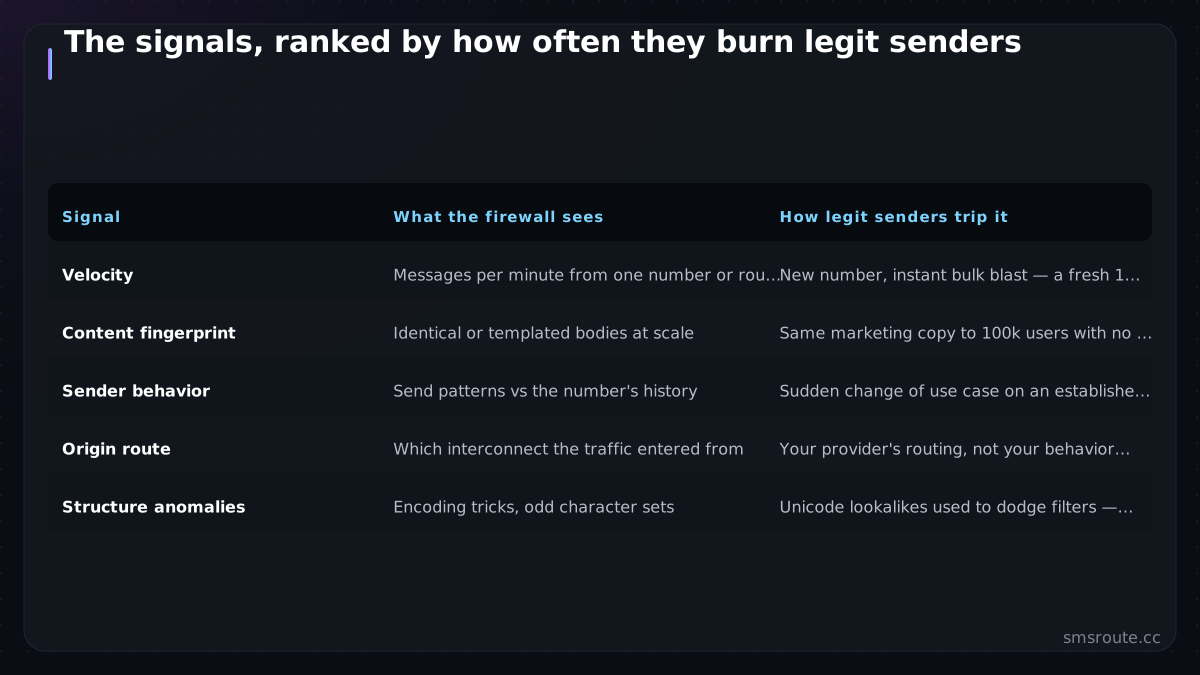
| Signal | What the firewall sees | How legit senders trip it |
|---|---|---|
| Velocity | Messages per minute from one number or route | New number, instant bulk blast. A fresh 10DLC number pushing 50k messages in an hour reads as compromised, per TCR compliance guidance |
| Content fingerprint | Identical or templated bodies at scale | Same marketing copy to 100k users with no variation. URL shorteners are a classic trigger |
| Sender behavior | Send patterns vs the number's history | Sudden change of use case on an established number |
| Origin route | Which interconnect the traffic entered from | Your provider's routing, not your behavior. You inherit their reputation |
| Structure anomalies | Encoding tricks, odd character sets | Unicode lookalikes used to dodge filters. Do not |
Note the fourth row. Some filtering you cannot fix from your side of the API: SMSRoute's adaptive multi-route delivery ensures your traffic always travels through high-reputation interconnects, ma
Sending like a legitimate sender, deliberately
How can I send SMS that looks legitimate to carrier firewalls?
Use consistent sender IDs, maintain natural sending patterns, avoid spammy keywords, and warm up new routes gradually. SMSRoute's REST API and SMPP binds let you control these parameters precisely, while our real-time DLR webhooks confirm delivery so you can adjust immediately if a route gets flagged.
- Warm up new numbers and routesRamp volume over days, not minutes. Firewalls profile senders longitudinally; give them a history that looks like a business, because you are one.
- Vary what can varyPersonalize the non-critical parts of templated sends. For OTP, the standard short format is expected and safe — the copy pattern in our OTP guide is firewall-friendly by design.
- Skip the URL shortenersFull branded domains in links, or no links at all (OTPs should never carry one). Shortened URLs are among the oldest spam fingerprints.
- Watch per-destination delivery ratesA route-level failure spike is your early signal of a filtering event. DLR reconciliation per the Node tutorial gives you the data; a sudden drop on one carrier means escalate to your provider, with timestamps.
And the uncomfortable rule: never try to outsmart the classifier with encoding tricks or content mangling. Firewalls fingerprint evasion techniques faster than senders invent them, and an evasion flag on your traffic is much stickier than a false positive.
What this means when choosing a provider
What should I look for in an SMS provider to avoid firewall blocks?
Choose a provider with multi-route failover, real-time delivery reports, and adaptive routing that bypasses aggressive firewalls. SMSRoute covers 149 countries with automatic failover per destination, real-time DLR webhooks, and a no-KYC signup that gets you sending in minutes—so you never get stuck when a carrier firewall blocks a route.
You cannot buy your way past firewalls. But you can buy a clean starting position. That means direct carrier routes with good reputations, real handset DLRs so you can *see* filtering happen, and a provider who answers route questions plainly. SMSRoute is a no-KYC SMS API with crypto billing (BTC, ETH, USDT, XMR, LTC, and SOL) on direct routes across 149 countries. The test that settles route quality is the one we always recommend: send to SIMs you control, measure latency and delivery, then scale. Filtering is a fact of the medium. Being surprised by it is optional. For global testing, use a roaming SIM aggregator like Twilio or Nexmo, or buy local prepaid SIMs on trips to each target country.
SMSRoute's published route pages list delivery from $0.004/message (premium direct-carrier corridors up to $0.035) with sub-100ms median submission and ~98.6% delivered success (smsroute.cc route pages, 2026).
Related reading
FAQ
What is an SMS firewall?
Why are my SMS messages being filtered even though they're legitimate?
How do I know if a carrier firewall is blocking my messages?
Can I bypass an SMS firewall?
Send your first SMS in 5 minutes
No KYC. Pay with BTC, ETH, USDT, XMR, LTC, and SOL. Live routes to 149 countries.
Get an API key →