Delivery time isn't a number — it's a map
Why is SMS delivery time different for each country?
SMS delivery time varies by country because each destination has its own telecom infrastructure, regulations, and network congestion. SMSRoute's adaptive multi-route system automatically selects the fastest path per country, ensuring optimal delivery speeds across all 149 countries we cover.
SMS delivery time by country varies from a couple of seconds in well-connected markets to tens of seconds — occasionally minutes — in others, and the variance isn't random noise. It's structural: the route your provider uses, how aggressively the destination's carriers filter, and the network load at send time each add latency in predictable ways. For an OTP (one-time password), where a user often abandons after roughly ten seconds (Twilio, 2020), that geography is the difference between a smooth signup and a leaking funnel.
Understanding what drives the variance lets you design around it instead of being surprised by it.
What drives the variance
What factors cause SMS delivery time differences between countries?
Key factors include local telecom regulations, network congestion, time zones, and infrastructure quality. SMSRoute's intelligent routing automatically adapts to these variables, using real-time failover to maintain consistent delivery speeds. Our 99.9% uptime ensures reliable performance regardless of destination.
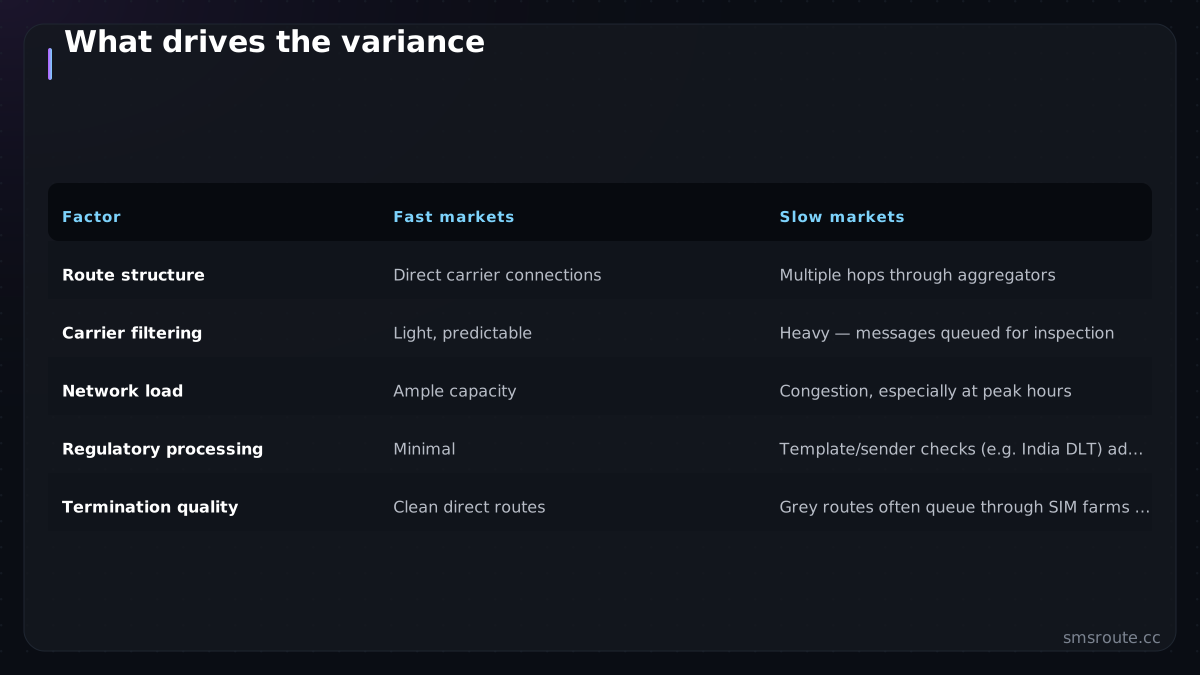
| Factor | Fast markets | Slow markets |
|---|---|---|
| Route structure | Direct carrier connections | Multiple hops through aggregators |
| Carrier filtering | Light, predictable | Heavy — messages queued for inspection |
| Network load | Ample capacity | Congestion, especially at peak hours |
| Regulatory processing | Minimal | Template/sender checks (e.g. India DLT) add delay |
| Termination quality | Clean direct routes | Grey routes often queue through SIM farms (MobileSquared, 2021) |
Two of these dominate. Route structure is the biggest lever a sender controls: a direct carrier route typically delivers in under 5 seconds (SMSRoute internal data, 2026), while a message hopping through multiple aggregators or a grey route accumulates delay at each stop. Carrier filtering is the biggest one you don't control: markets with aggressive firewalls hold messages for inspection, adding latency that's the price of those markets' spam control. Additionally, the message encoding matters: a standard GSM-7 message fits in 160 characters per segment, but if your OTP includes Unicode characters (e.g., emojis), it switches to UCS-2 encoding, halving the segment limit to 70 characters and potentially triggering concatenation via UDH, which can add processing delay. These firewalls inspect content keywords, sender ID registration, and link reputation, adding seconds by scanning each message against carrier blocklists before delivery. For example, a direct route to a mobile in India might deliver in under 2 seconds, while a multi-hop route through an aggregator in Singapore can take 10 seconds or more.
The emerging-market reality
How does SMS delivery time work in emerging markets?
Emerging markets often have less predictable infrastructure, but SMSRoute's adaptive multi-route delivery with automatic failover ensures messages reach their destination reliably. Our real-time DLR webhooks provide full visibility into delivery status, and failed messages are automatically credited back.
Latency expectations calibrated on US and European traffic mislead everywhere else. Many high-growth markets — parts of Africa, South Asia, Southeast Asia — combine heavier filtering, more network congestion, and longer route chains, so the same OTP that lands instantly in London can take noticeably longer in Lagos or Jakarta. For example, SMS delivery to Nigeria often takes 10-30 seconds due to carrier filtering (GSMA, 2022), while India's DLT checks add 2-5 seconds for transactional messages (TRAI, 2018).
The trap is a global timeout tuned to your fastest market. A 10-second resend cooldown that's perfect for Germany strands users in slower markets whose legitimate message is still in flight. Latency is per-corridor, so your timeouts should be too.
Designing around country latency
How can I optimize my SMS delivery for different country latencies?
Design your system to handle variable delivery times by using SMSRoute's real-time DLR webhooks and dashboard logs. Our REST API and SMPP binds let you implement custom retry logic. With coverage in 149 countries and prices from $0.004 per message, you can scale globally without complexity.
curl -X POST https://api.smsroute.cc/sms/send \
  -H "Authorization: Bearer YOUR_API_KEY" \
  -H "Content-Type: application/json" \
-d '{"to": "+2348012345678", "from": "YourBrand", "message": "Your OTP is 123456"}'- Measure per corridor, don't assumeUse the seed-SIM method to get real p50/p95 latency for your actual destinations — the OTP latency benchmark. Your numbers beat any generic table, including this article's descriptions.
- Set timeouts per countryBase the resend cooldown on each corridor's measured p90, not a global constant. Slower markets get a longer window before the resend button appears.
- Choose routes for your slow marketsRoute quality matters most where latency is worst; a provider's direct-route depth in *your* difficult corridors is worth more than its average. Test it, per the comparison methodology.
- Have a fallback for the tailWhere SMS latency is structurally high, a voice or multichannel fallback catches the users a slow route would lose.
SMSRoute is a no-KYC SMS API with crypto billing (BTC, ETH, USDT, XMR, LTC, and SOL) running direct carrier routes, which is the single biggest lever on the latency you can control — but no provider defies a destination's filtering and congestion, and honest ones don't claim to. For reference, SMSRoute's direct-carrier delivery starts at $0.004/message with sub-100ms median submission and ~98.6% delivered success on direct routes (smsroute.cc route pages, 2026). So measure your real corridors, tune your timeouts to them, and choose routes for your hardest markets rather than your easiest. who assume a global constant quietly lose users to a timeout that never fit.
Related reading
FAQ
How long does an SMS take to deliver?
Why is SMS slower in some countries?
How do I handle variable SMS delivery times in an OTP flow?
Can a provider guarantee fast SMS delivery everywhere?
Send your first SMS in 5 minutes
No KYC. Pay with BTC, ETH, USDT, XMR, LTC, and SOL. Live routes to 149 countries.
Get an API key →