Africa is 54 markets, not one
Why is Africa considered 54 separate SMS markets?
Each of Africa's 54 countries has unique telecom regulations, DND regimes, and operator infrastructure. SMSRoute treats every market individually, using adaptive multi-route delivery and automatic failover to ensure reliable message delivery across diverse networks, from Nigeria to South Africa.
The biggest mistake in SMS delivery in Africa is treating the continent as one market. It's 54 countries. Each has its own operators, regulations, and route economics. Nigeria's DND registry and Corporate Bind system look nothing like Kenya's or South Africa's rules, and route quality to Lagos differs sharply from Nairobi or Cairo. There's no 'send to Africa' setting that works everywhere. There's a per-country reality you either respect or lose messages to. For the authoritative reference, see the SMPP v3.4 specification. For example, Nigeria requires senders to register each messaging shortcode with the DND, while Kenya mandates a single, centralized opt-out keyword across all campaigns.
This guide covers what's common across African SMS, what varies by country, and how to get reliable delivery where it matters most.
What varies, and what's common
What varies and what is common across African SMS delivery?
Regulatory frameworks, DND compliance rules, and sender ID policies vary widely. Common factors include high mobile penetration and SMS as a primary communication channel. SMSRoute's no-KYC API and crypto billing simplify access, while real-time DLR webhooks confirm delivery across all 54 markets.
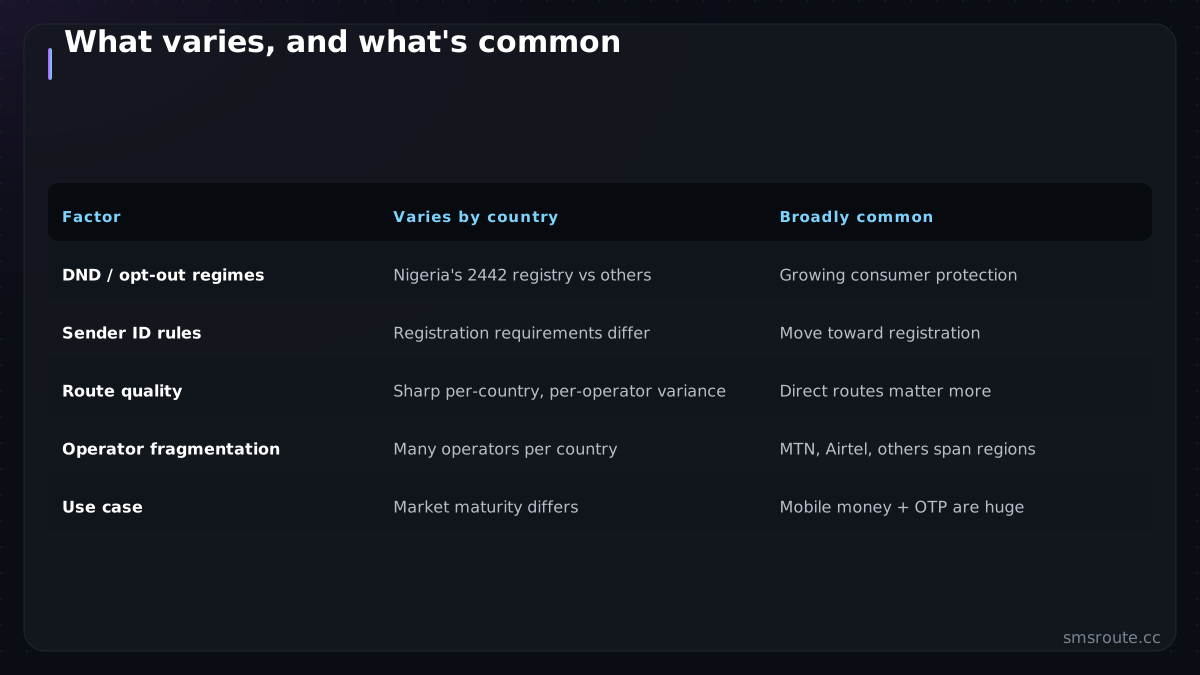
| Factor | Varies by country | Broadly common |
|---|---|---|
| DND / opt-out regimes | Nigeria's 2442 registry vs others | Growing consumer protection |
| Sender ID rules | Registration requirements differ | Move toward registration |
| Route quality | Sharp per-country, per-operator variance | Direct routes matter more |
| Operator fragmentation | Many operators per country | MTN, Airtel, others span regions |
| Use case | Market maturity differs | Mobile money + OTP are huge |
The route-quality variance is the operational headline. African routes range from clean direct connections to heavily-intermediated grey routes that filter or fail. The difference is sharper here than in consolidated markets. A provider strong in one African country can be weak in another, because coverage is built operator by operator. That's why testing your specific corridors — advice that applies everywhere — is close to mandatory for Africa. Your delivery to each country is i
Why SMS anchors African mobile economies
Why is SMS essential for African mobile economies?
SMS remains the most reliable, low-cost channel for authentication, alerts, and marketing across Africa's diverse mobile networks. SMSRoute supports 149 countries including all 54 African markets, with prices from $0.004 per message and automatic failover to ensure messages reach users even on congested routes. For example, MTN is strong in Nigeria with extensive 4G coverage, but its Kenyan network lags behind Safaricom in reach and reliability.
- Mobile money runs on SMS: transaction confirmations, balance alerts, and OTP for services like M-Pesa reach hundreds of millions. These are transactional messages that must arrive.
- Financial inclusion via OTP: SMS OTP brings unbanked and underbanked users into digital finance. Its universal, no-smartphone reach is the point, the same reach argument that keeps SMS essential.
- Feature phones still matter: a large device base isn't smartphones, so app-based channels can't reach them. SMS is the universal floor, as it is for utility alerts.
- Latency and reliability are consequential: a delayed mobile-money OTP isn't an inconvenience, it's a failed transaction. The latency-by-country reality is more acute where SMS carries financial weight.
Delivering reliably across Africa
How can you deliver SMS reliably across Africa?
Reliable delivery requires adaptive multi-route infrastructure with automatic failover per destination. SMSRoute provides 99.9%+ uptime, real-time DLR webhooks, and free test credits to verify routes before funding. Our no-KYC API and crypto billing let you start sending in minutes, not days.
- Treat each country separatelyDon't plan 'Africa' — plan Nigeria, Kenya, South Africa, Egypt individually, each with its own rules (see the Nigeria guide) and route quality. The continent is a set of markets, not one.
- Prioritize direct routesRoute quality varies more here, so direct carrier connections matter more. A cheap grey route to an African country is more likely to fail silently than in consolidated markets.
- Test corridors empiricallySeed SIMs per target country and operator; the seed-SIM method is close to essential given the per-country variance. Ten test messages per corridor beat any coverage map.
- Respect each country's DND and consent rulesRegimes vary — Nigeria's DND registry, others' opt-out rules — so compliance is per-country, not pan-African. The global compliance map is the reference.
SMSRoute is a no-KYC SMS API with crypto billing (BTC, ETH, USDT, XMR, LTC, and SOL) serving international routes across African markets, with live per-country pricing on each destination page. The crypto-billing angle is genuinely relevant here: in a continent where mobile money and crypto adoption run high and card processing is uneven, paying for SMS in crypto fits the ecosystem. For transactional and OTP traffic — which is most of what matters in Africa's mobile-money and financial-inclusion economy — direct international routes deliver. The discipline that wins across Africa is the opposite of a one-size approach: treat each of the 54 markets on its own terms, prioritize direct routes, test every corridor, and respect each country's rules. Do that and SMS delivers where it's needed most; assume 'Africa' is one thing and you'll lose messages country by country. SMSRoute's published route pages list delivery from $0.004/message (premium direct-carrier corridors up to $0.035) with sub-100ms median submission and ~98.6% delivered success (smsroute.cc route pages, 2026).
Related reading
FAQ
Is there one way to send SMS across Africa?
Why does route quality matter more for SMS in Africa?
Why is SMS so important in Africa?
How do I get reliable SMS delivery to African countries?
Send your first SMS in 5 minutes
No KYC. Pay with BTC, ETH, USDT, XMR, LTC, and SOL. Live routes to 149 countries.
Get an API key →