Two kinds of batch, one set of pitfalls
What are the two types of SMS batch sending and their common pitfalls?
SMS batch sending comes in two types: sending the same message to many recipients (broadcast) or sending unique personalized messages. Common pitfalls include hitting API rate limits, mismanaging partial failures where some messages fail while others succeed, and corrupting personalization tokens. SMSRoute's adaptive multi-route delivery and real-time DLR webhooks help you avoid these issues automatically.
An SMS batch send is any time you push many messages at once. This could be a campaign, a regional alert, or a segment notification. There are two flavors. The *same* message to many recipients (a broadcast). And *unique* messages personalized per recipient. Good SMS APIs support both: one message to a large list, or a collection of individualized messages, in a single batch. But both share the same three pitfalls. A batch that ignores them delivers unpredictably: partial failures vanish, throughput trips carrier limits, and personalization errors corrupt individual messages. For the authoritative reference, see the GSM 03.38 alphabet. For example, sending a single emoji like 😊 forces the message to use UCS-2 encoding, which halves the 160 character limit to 70 and doubles the per-message cost.
The partial-failure problem
How do you handle partial failures when sending bulk SMS messages?
Partial failures occur when some messages in a batch fail while others succeed. SMSRoute solves this with automatic failover per destination and real-time DLR webhooks, so you know exactly which messages failed. Failed messages are automatically credited back to your balance, and you can retry them instantly without manual intervention.
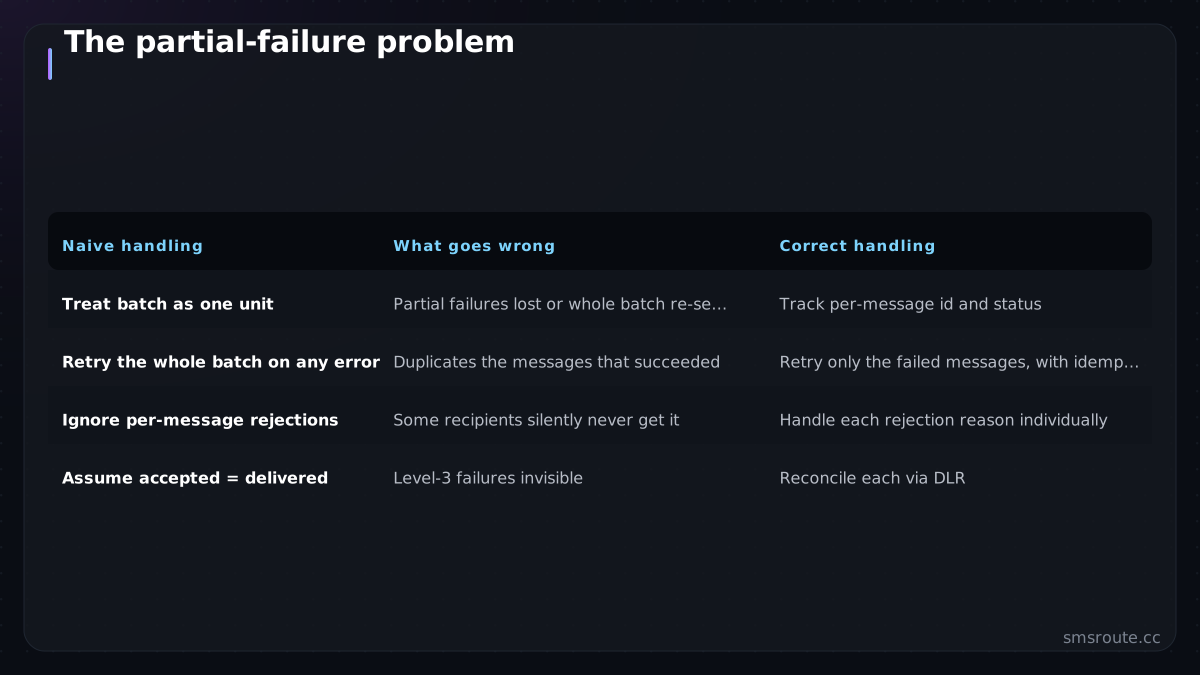
The single biggest batch pitfall: a batch is not atomic. Some messages succeed, some fail, and if you treat the batch as one pass/fail unit you either lose track of the failures or wrongly re-send everything. The response to a batch tells you the outcome *per message*, and you have to handle it that way.
| Naive handling | What goes wrong | Correct handling |
|---|---|---|
| Treat batch as one unit | Partial failures lost or whole batch re-sent | Track per-message id and status |
| Retry the whole batch on any error | Duplicates the messages that succeeded | Retry only the failed messages, with idempotency |
| Ignore per-message rejections | Some recipients silently never get it | Handle each rejection reason individually |
| Assume accepted = delivered | Level-3 failures invisible | Reconcile each via DLR |
The fix is to treat a batch as a collection of individual sends that happen to travel together: store each message's id, track its status through the three levels, retry only the ones that failed (with idempotency keys so retries can't duplicate the successes), and reconcile every one via delivery receipt. A batch is many messages, not one big message.
Throughput and pacing
What is SMS throughput and how should you pace your batch sends?
Throughput is the number of messages your API can send per second. Pacing prevents carrier throttling and ensures reliable delivery. SMSRoute's REST API and SMPP binds support high throughput with automatic pacing controls. You can send millions of messages daily across 149 countries without hitting rate limits, starting from just $0.004 per message.
- Don't fire the whole batch at once. A sudden spike trips provider rate limits (429s / SMPP throttling) and, worse, flags you to carrier firewalls as a spam burst. Feed the batch through a queue at or below the throughput ceiling.
- Warm cold numbers gradually. A large batch from a new number damages sender reputation; ramp volume rather than blasting from cold.
- Distribute over time where you can. Spreading a campaign across minutes rather than one spike improves both deliverability and your standing with carriers.
- Use SMPP for genuine high volume. REST batches work to a point; sustained high throughput is what SMPP binds are built for.
The throughput mindset: your batch's job isn't to send as fast as possible, it's to deliver reliably. Pacing under the limit and warming numbers delivers more messages than a hard blast that gets throttled and filtered.
Personalization without corruption
How do you personalize bulk SMS messages without corrupting the content?
Personalization uses merge tags (like {{name}} or {{order_id}})
that the API replaces with recipient-specific data. Corruption happens when tags are malformed or data contains
special characters. SMSRoute's API handles UTF-8 encoding and special character escaping automatically,
ensuring every personalized message arrives exactly as intended, even with custom alphanumeric sender IDs.
- Validate the whole list first. Normalize numbers to E.164 and validate before the batch — one invalid number shouldn't fail its neighbors, and dead numbers waste spend at scale.
- Bind content to the right recipient. For personalized batches, ensure each message's content maps to its correct recipient — a mismatch sends the wrong name or code to someone. Key content to the recipient id, not list position.
- Keep each message single-segment. Watch encoding and length per message; a stray Unicode character in one personalized message doubles its cost without you noticing across thousands.
- Track and reconcile every message. Per-message id, status, and DLR — the same discipline as a single send, applied across the batch. This is how you know the batch actually delivered rather than assuming it did.
SMSRoute is a no-KYC SMS API with crypto billing (BTC, ETH, USDT, XMR, LTC, and SOL) supporting batch sends over REST and high-throughput SMPP. The batch mindset that wor
Related reading
FAQ
How do I send a batch of SMS messages?
How do I handle partial failures in an SMS batch?
Why shouldn't I send a whole SMS batch at once?
What's the best way to send high-volume SMS?
Send your first SMS in 5 minutes
No KYC. Pay with BTC, ETH, USDT, XMR, LTC, and SOL. Live routes to 149 countries.
Get an API key →