Who DLT actually binds
Who is required to register under India's DLT regulations?
India's DLT registration applies to businesses sending promotional or transactional SMS using Indian telecom routes. However, international API providers like SMSRoute operate outside this mandate, allowing you to send messages to Indian numbers without DLT registration, using global routes that bypass local compliance.
You can send SMS to India through an SMS API without DLT registration. But only if your traffic travels an international route. India's DLT (Distributed Ledger Technology) regime under TRAI's TCCCPR 2018 (amended in 2025) rules binds *domestic* senders. Per Infobip's and Exotel's compliance documentation, every Indian principal entity (bank, e-commerce firm, hospital, startup) sending commercial SMS inside India must register itself, its headers, and its content templates on a carrier-operated DLT platform. Messages arriving from abroad on international long-distance routes are not subject to that registration. (See TRAI's TCCCPR regulations for the official framework.) For example, a US based SaaS sending OTPs to Indian users via a foreign aggregator does not need DLT registration.
An Indian company messaging Indian customers? DLT, no way around it. A foreign SaaS sending OTPs to Indian users from outside India? International route, no DLT registration required.
The catch: your sender ID gets overwritten
What happens to my sender ID when sending SMS to India without DLT?
When using international routes to India, your custom sender ID may be overwritten by the carrier. SMSRoute mitigates this by offering smart shared sender IDs that maintain high deliverability, and we can request custom alphanumeric sender IDs on supported routes, ensuring your brand identity remains intact.
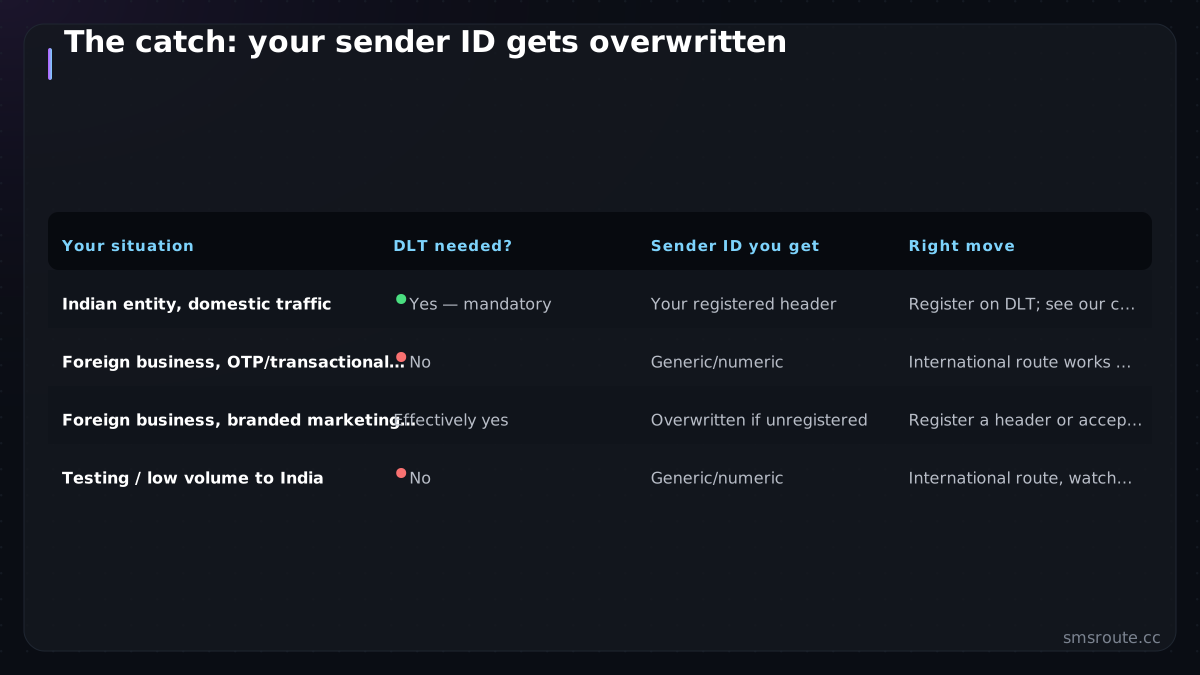
Indian networks do not let unregistered foreign A2P traffic display an arbitrary alphanumeric sender name. Without a registered Indian header, your message arrives with a generic or numeric origin assigned by the carrier — not your brand name. For a marketing blast, that hurts. For an OTP, it mostly does not: the user is waiting for the code, reads it, and moves on. For example, a message might appear from "SMS-INFO" or "123456" on the recipient's phone screen, showing no recognizable brand name.
| Your situation | DLT needed? | Sender ID you get | Right move |
|---|---|---|---|
| Indian entity, domestic traffic | Yes — mandatory | Your registered header | Register on DLT; see our category guide |
| Foreign business, OTP/transactional to India | No | Generic/numeric | International route works fine |
| Foreign business, branded marketing to India | Effectively yes | Overwritten if unregistered | Register a header or accept generic |
| Testing / low volume to India | No | Generic/numeric | International route, watch per-message cost |
Consent rules do not disappear just because DLT registration does — opt-out handling and quiet hours still apply on the international route.
Why teams choose the international route
Why do businesses choose international SMS routes over DLT registration?
Teams choose international routes to avoid DLT's lengthy registration, strict templates, and compliance costs. SMSRoute's no-KYC API, crypto billing, and 149-country coverage let you send to India instantly from $0.004/msg, with automatic failover and real-time DLRs. No paperwork, no delays.
DLT registration is slow and bureaucratic: entity verification, header approval, template approval, and re-approval every time your message copy changes. Per Message Central's 2026 India compliance guide, template mismatches remain a leading cause of silently dropped domestic messages. The international route trades all of that for a simpler deal: pay the international rate, accept a generic sender, and deliver.
- Zero registration lead time. First message in minutes, not the weeks a DLT entity + template approval cycle can take.
- No template lock-in. Change your OTP copy whenever you want; nothing to re-file.
- Predictable failure modes. Domestic DLT drops are opaque scrubbing decisions; international delivery failures show up as normal DLR statuses you can act on.
- One integration for 149 countries. India stops being a special case in your codebase.
The trade-offs are equally real: international rates to India run higher than registered domestic rates, and you give up branded sender ID. High-volume domestic marketing belongs on DLT. Cross-border OTP and trans
Sending to India without DLT, in practice
How can I send SMS to India without DLT registration?
Simply sign up at SMSRoute with just an email, fund your account with crypto (BTC, ETH, USDT, etc.), and use our REST API or SMPP to send messages to Indian numbers. You get free test credits on signup, and messages route through our global network with automatic failover for reliable delivery.
- Confirm you qualifyYour sending entity and infrastructure are outside India, and the traffic is transactional or consented. If you are an Indian entity, stop here and register. Our TRAI DLT category guide covers that path.
- Check the live India rateInternational routes to India price per message. The send SMS to India page shows the current rate before you commit. SMSRoute's published route pages list delivery from $0.004/message (premium direct-carrier corridors up to $0.035) with sub-100ms median submission and ~98.6% delivered success (smsroute.cc route pages, 2026).
- Send via the APISMSRoute is a no-KYC SMS API with crypto billing (BTC, ETH, USDT, XMR, LTC, and SOL). The same 5-line integration works for India as anywhere else.
- Design for a generic senderPut your app name in the message body ('YourApp: your code is 481902'), since the header will not carry your brand. Our OTP best-practices guide shows the copy pattern.
FAQ
Can I send SMS to India without DLT registration?
Will my brand name show as the sender without DLT?
Is skipping DLT legal?
Which is cheaper for India: DLT domestic or international?
Send your first SMS in 5 minutes
No KYC. Pay with BTC, ETH, USDT, XMR, LTC, and SOL. Live routes to 149 countries.
Get an API key →