Your integration outlives the API version it was built on
An SMS integration you write today will still be running when the provider changes their API. That's the reality SMS API versioning exists to manage. Providers evolve their APIs with new fields, changed behavior, and retired endpoints. They version those changes so existing integrations don't break the moment something changes.
Here's how API versioning works, how to read the signals, and how to migrate without dropping a send. For example, Twilio's 2010 API version changed the base URL from `/2010-04-01/Accounts` to include date-based routing, altering how developers accessed account resources.
How API versioning works
How does SMS API versioning work?
SMSRoute uses URL-based versioning (e.g., /v1/send) to ensure backward compatibility. Each version is independently maintained, so your existing integration continues working without changes. New features are added to newer versions, giving you full control over when to upgrade.
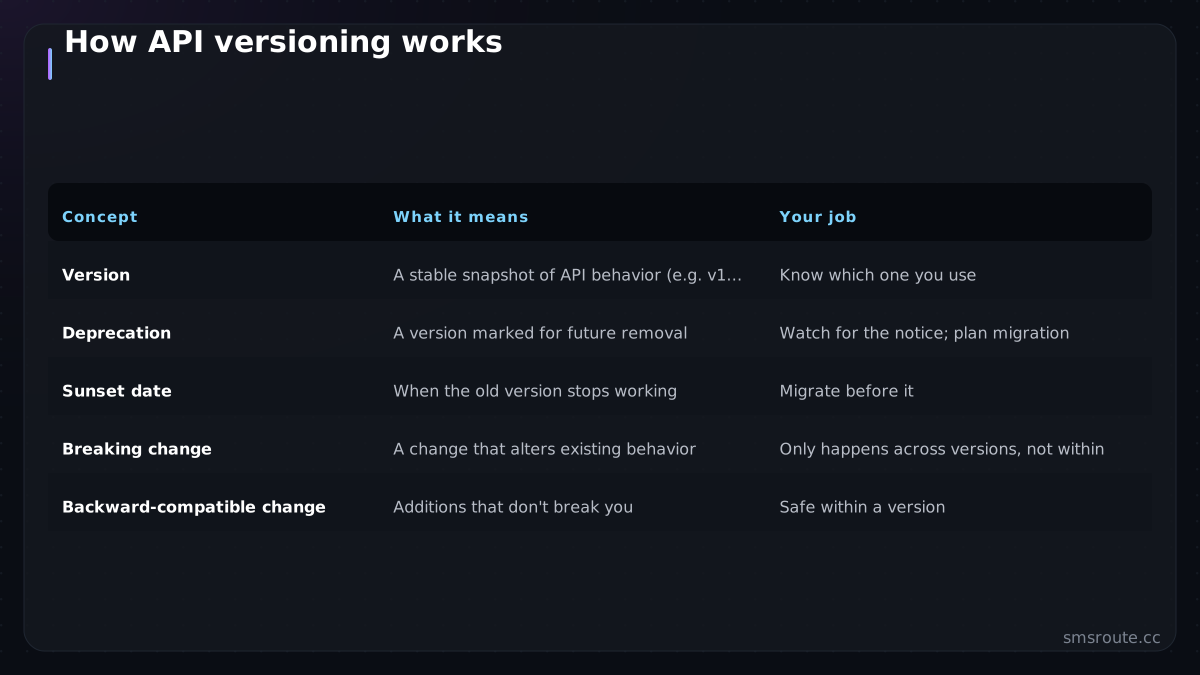
| Concept | What it means | Your job |
|---|---|---|
| Version | A stable snapshot of API behavior (e.g. v1, v2) | Know which one you use |
| Deprecation | A version marked for future removal | Watch for the notice; plan migration |
| Sunset date | When the old version stops working | Migrate before it |
| Breaking change | A change that alters existing behavior | Only happens across versions, not within |
| Backward-compatible change | Additions that don't break you | Safe within a version |
The core idea: within a version, changes are backward-compatible (new optional fields, added endpoints) so your code keeps working. Breaking changes — a renamed field, a changed response shape, a removed endpoint — go into a new version, and the old one is deprecated with a sunset date. Good providers give you a version identifier (in the URL like /v1/ or a header), a deprecation warning ahead of removal, and a migration guide. Your job is to know your version, notice deprecations, and migrate before the sunset.
Migrating without downtime
How can I migrate SMS API versions without downtime?
Migrate without downtime by running both old and new API versions in parallel. SMSRoute supports simultaneous use of multiple versions, so you can test the new version with a subset of traffic while your production sends remain on the stable version. Switch over gradually once validated.
- Know your current versionCheck whether you're pinned to a version (in the URL or a version header) and which one. An integration that doesn't know its own version can't plan a migration — this is step zero.
- Read the migration guide and diffWhen a new version ships, read what changed — new fields, renamed ones, altered response shapes. Map each change to where your code touches it.
- Test against the new version firstPoint a test environment at the new version and run your suite — the same test-with-fakes discipline plus a real smoke test — before touching production.
- Migrate gradually, then cut overWhere possible, run a small share of traffic on the new version, verify delivery and response handling, then shift the rest. Because idempotency keys and DLR reconciliation are version-independent, the send logic stays stable across the cut.
The migration failure mode is silence: an integration that never watches for deprecation notices works perfectly right up until the sunset date, then
Building a version-resilient integration
How do I build a version-resilient SMS API integration?
Build a version-resilient integration by pinning your API version in the request URL and handling response fields flexibly. SMSRoute’s consistent JSON structure across versions means your code adapts easily. Use our SDKs (Python, PHP, Go, Node) which automatically manage version compatibility.
- Pin your version explicitly — don't rely on an unversioned default that could shift under you; specify the version so changes are a deliberate migration, not a surprise.
- Isolate the API layer — keep provider-specific request/response handling behind one interface (the integration-patterns discipline), so a version migration touches one place, not your whole codebase.
- Assert on shape, not exact values — tests pinned to exact response formats break on benign changes; assert on the fields you use, so backward-compatible additions don't cause false failures.
- Keep provider-agnostic where you can — an integration abstracted enough to migrate versions cleanly is often abstracted enough to switch providers too, which is its own resilience.
SMSRoute is a no-KYC SMS API with crypto billing (BTC, ETH, USDT, XMR, LTC, and SOL), and version resilience is one of those things that's invisible until a deprecation notice lands. The disciplines are simple: pin your version, isolate the API layer behind an interface, test against new v
FAQ
What is SMS API versioning?
How do I migrate to a new SMS API version without downtime?
What's the difference between a breaking and backward-compatible API change?
How do I avoid my SMS integration breaking when the API changes?
Send your first SMS in 5 minutes
How can I send my first SMS in 5 minutes?
Sign up with just an email (no KYC), fund your account with crypto (BTC, ETH, USDT, XMR, LTC, SOL), get your API key, and use our REST API or SMPP to send. With coverage in 149 countries and prices from $0.004 per message, your first SMS is minutes away.
No KYC. Pay with BTC, ETH, USDT, XMR, LTC, and SOL. Live routes to 149 countries.
Get an API key →