The US blocks first and asks questions later
An SMS API in the USA runs into the most registration-heavy A2P regime of any major market. It is also the least anonymous. To send application-to-person (A2P) SMS to US mobile numbers on a standard 10-digit long code, you must register both your business and each messaging campaign in The Campaign Registry (TCR), the industry database carriers use to vet traffic (TCR, 2026). This is not a soft rule. Since February 2025, all major US carriers block SMS and MMS from unregistered 10DLC numbers entirely — not filtered, not throttled, blocked (CTIA Messaging Principles, 2026). Brand registration requires your legal business name, EIN, and contact details; campaign registration describes your use case and opt-in flow. So the US pairs the world's largest messaging volume with mandatory, identity-linked registration.
That has a direct consequence for a no-KYC, crypto-billed route like ours, and we'll be honest about it below. First, the regime itself. SMSRoute's published route page for United States lists direct-carrier delivery via AT&T, Verizon, T-Mobile from $0.008/message, with 87ms median submission and 99.1% delivered success (smsroute.cc route pages, 2026). For example, a crypto exchange uses this route to deliver 2FA codes to US users, bypassing KYC restrictions on short-code SMS.
The US A2P rules
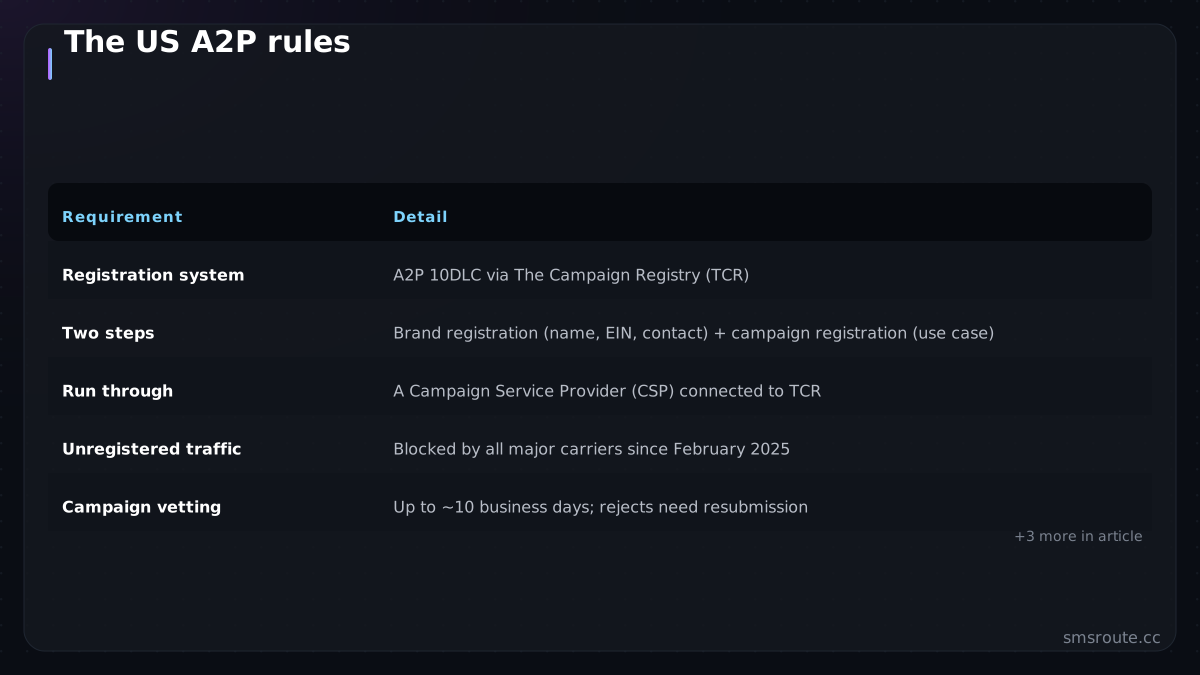
| Requirement | Detail |
|---|---|
| Registration system | A2P 10DLC via The Campaign Registry (TCR) |
| Two steps | Brand registration (name, EIN, contact) + campaign registration (use case) |
| Run through | A Campaign Service Provider (CSP) connected to TCR |
| Unregistered traffic | Blocked by all major carriers since February 2025 |
| Campaign vetting | Up to ~10 business days; rejects need resubmission |
| Toll-free alternative | 800/833/844/855/866/877/888 — separate carrier verification, not TCR |
| Governing body | Carrier/industry-led (CTIA Messaging Principles), not a government regulator |
| Consent | Prior express consent; CTIA opt-in/opt-out and content rules |
Two things make the US distinctive. First, it is industry-governed, not state-governed: there is no ACMA or CNMC here. The carriers (via the CTIA Messaging Principles) and TCR set and enforce the rules, and message throughput is assigned by the carriers based on your vetted brand and campaign — unlike the government-run sender-ID registries of Australia or Spain. Second, registration is identity-bound: an EIN and a real business behind it. Toll-free numbers dodge 10DLC but carry their own verification through individual carrier portals, with 2026 tightening the business-verification fields required. The number-type choice — 10DLC, toll-free, or short code — is the first decision, covered in the long-code vs toll-free guide.
Sending compliantly in the USA
- Register your brand in TCRThrough a CSP, submit your legal business name, EIN, and contact details. Vetting scores your brand and affects the throughput carriers grant you.
- Register each campaignDeclare the use case (2FA, marketing, notifications), message samples, and opt-in flow. Mismatched or vague campaigns get rejected and must be resubmitted — budget up to ~10 business days.
- Get prior express consentUS consent is strict: prior express consent for marketing, clear opt-in, and honored STOP/HELP keywords, per the CTIA rules and the opt-in/opt-out basics.
- Or use toll-free, verifiedIf 10DLC's brand registration doesn't fit, a verified toll-free number is the alternative — but complete its separate carrier verification first, or it's throttled and eventually blocked.
In markets like Italy an unregistered branded sender still delivers under a generic ID; in the US since February 2025, unregistered 10DLC traffic simply does not arrive. Registration isn't optimization here — it's the on-switch.
The honest boundary for a no-KYC route
Here's where we're straight with you. SMSRoute is a no-KYC SMS API with crypto billing (BTC, ETH, USDT, XMR, LTC, and SOL), and the US A2P 10DLC regime is built on exactly the identity registration we don't require. For compliant, branded A2P campaigns to US mobile numbers, you need a TCR-registered brand and campaign through a US CSP — a KYC, EIN-bound setup that a no-KYC provider by definition does not replace. We won't pretend otherwise; the US is the one major market where our model is least applicable to branded domestic A2P. This is the same Twilio-style 10DLC path most US senders take, and for that lane it's the right tool. You can still use SMSRoute for non-branded transactional alerts or international-to-US messaging, where 10DLC registration is not required.
Where an international, no-KYC route does fit: international-origin and transactional traffic, testing, and reaching non-US destinations without US-style registration overhead — the many markets mapped in the global SMS compliance guide where a domestic registry isn't the gate. The honest summary: if your job is branded A2P into the US, register in TCR through a CSP; if it's international, OTP, or crypto-billed traffic elsewhere, that's our lane. Knowing which side of that line you're on is the whole decision — and see the US/EU/UK/AU compliance checklist before you send.
Related reading
FAQ
Do I need to register to send SMS in the USA?
What is A2P 10DLC?
How long does 10DLC registration take?
Can I use a no-KYC SMS API for the US?
Send your first SMS in 5 minutes
No KYC. Pay with BTC, ETH, USDT, XMR, LTC, and SOL. Live routes to 149 countries.
Get an API key →