Uptime and delivery are not the same thing
What is the difference between SMS API uptime and delivery success?
Uptime measures whether the API is reachable, while delivery success tracks whether messages reach the recipient's handset. SMSRoute guarantees 99.9%+ uptime and uses adaptive multi-route delivery with automatic failover per destination, ensuring high delivery rates without requiring you to manage multiple providers.
Here's the reliability trap: an SMS API can report 100% uptime while a chunk of your messages never reach a handset. SMS API uptime measures whether the endpoint accepts your requests. Delivery measures whether messages actually arrive. They are different systems with different failure modes — the API can be perfectly available while a carrier route degrades, a firewall filters your traffic, or DLRs stop flowing. A status page glowing green tells you the front door is open; it says nothing about whether the packages got delivered.
So the reliability you actually care about isn't on the provider's status page. It's in your own delivery data. This guide covers what an SLA genuinely promises, what it doesn't, and how to monitor the reliability that reaches your users.
What an SMS SLA actually covers
What should an SMS SLA cover for reliable messaging?
A strong SMS SLA should cover API uptime, delivery success rates, and refund policies for failures. SMSRoute provides 99.9%+ uptime, real-time DLR webhooks, and automatic credit for undelivered messages. Unused balance is refundable to your wallet on request, giving you full financial protection.
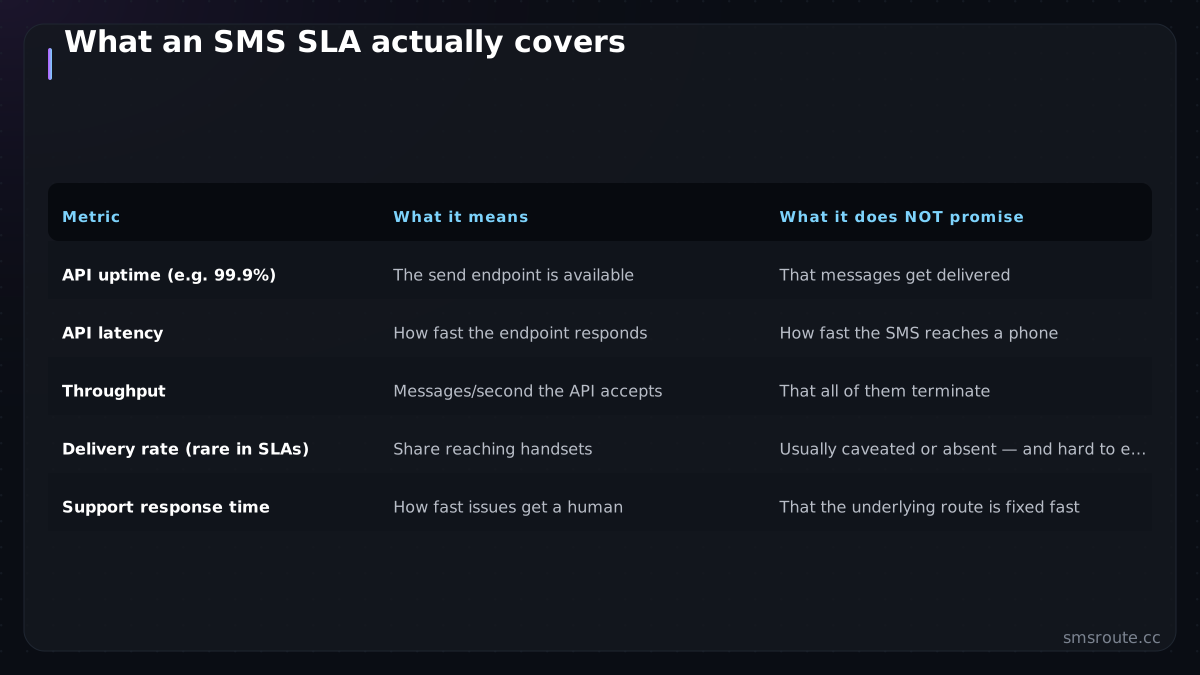
| Metric | What it means | What it does NOT promise |
|---|---|---|
| API uptime (e.g. 99.9%) | The send endpoint is available | That messages get delivered |
| API latency | How fast the endpoint responds | How fast the SMS reaches a phone |
| Throughput | Messages/second the API accepts | That all of them terminate |
| Delivery rate (rare in SLAs) | Share reaching handsets | Usually caveated or absent — and hard to enforce |
| Support response time | How fast issues get a human | That the underlying route is fixed fast |
Notice what's almost never in an SLA: a delivery-rate guarantee. That's not necessarily dishonest — delivery depends on carriers, number quality, and destinations outside any provider's full control, so a hard guarantee is genuinely hard to make. But it means the SLA protects the part the provider controls (the API) and leaves the part you care about most (delivery) to their route quality and your monitoring. Read an SLA for what it doesn't say as much as what it does. For example, the GSMA sets standards for mobile network interoperability, but even those don't guarantee delivery rates across all routes.
Monitoring the reliability that matters
How can I monitor SMS API reliability effectively?
Monitor API uptime via status endpoints and delivery success via real-time DLR webhooks and dashboard logs. SMSRoute offers both, plus free test credits on signup to verify routes before funding. This lets you confirm reliability for your specific destinations without upfront commitment.
- Watch your delivery rate, not their status pageReconcile delivery receipts continuously and alert on drops per destination. A falling delivery rate on one route is your real outage, and it won't show on any status page.
- Run synthetic sends to seed SIMsPeriodic timestamped sends to SIMs you control catch silent filtering and latency creep before users report them — the benchmark method applied continuously, not just at evaluation time.
- Alert on the right signalsDelivery-rate drop per country, latency p95 shift, DLR flow stopping, and error-rate spikes. Single failures are noise; trends are outages. This is the operational side of the latency method.
- Plan for provider failoverFor critical traffic, a second provider you can route to turns a route outage from an incident into a shrug. Keep the integration provider-agnostic — the integration patterns make this cheap.
The reliability metric that matters is end-to-end delivered rate to your actual destinations, measured by you, over time. Everything on a provider's status page is upstream of that. Trust your data over their dashboard.
Choosing for reliability
How do I choose an SMS API for maximum reliability?
Choose an API with proven uptime, multi-route failover, transparent delivery reports, and a refund policy for failures. SMSRoute delivers 99.9%+ uptime, adaptive routing per destination, real-time DLRs, and automatic credits for undelivered messages—all with crypto billing and no KYC, so you start reliably in minutes.
- Auditable DLRs over a delivery guarantee — a provider that gives you real, verifiable receipts is worth more than one promising a number you can't check. Test for fake DLRs.
- Route transparency — a provider that explains how it terminates traffic is signaling the route quality that actually drives delivery, per the comparison methodology.
- Responsive support — when a route degrades, you need a human who can act. Test support responsiveness before you depend on it.
- Redundancy-friendly — a provider that makes it easy to run alongside a backup is one confident in being kept, not locked into.
SMSRoute is a no-KYC SMS API with crypto billing (BTC, ETH, USDT, XMR, LTC, and SOL), and our take on reliability is the one this guide argues: uptime is table stakes, but delivery is the real metric, and you should measure it yourself rather than trust anyone's dashboard — ours included. We give you auditable handset DLRs precisely so your monitoring reflects reality. Build the delivery-rate alerting, run the synthetic sends, keep a failover option for critical traffic, and your SMS reliability stops depending on a status page and starts depending on data you control. SMSRoute's published route pages list delivery from $0.004/message (premium direct-carrier corridors up to $0.035) with sub-100ms median submission and ~98.6% delivered success (smsroute.cc route pages, 2026).
FAQ
Does SMS API uptime guarantee message delivery?
What does an SMS API SLA cover?
How do I monitor SMS delivery reliability?
Should I use a backup SMS provider?
Send your first SMS in 5 minutes
No KYC. Pay with BTC, ETH, USDT, XMR, LTC, and SOL. Live routes to 149 countries.
Get an API key →