Thailand tightened its SMS rules hard
How did Thailand tighten its SMS rules in 2026?
Thailand's NBTC enforced strict SMS regulations in 2026, requiring sender name registration and limiting marketing messages to one per day per recipient. SMSRoute's adaptive multi-route delivery ensures compliance with these rules automatically, so you can send reliably without manual adjustments.
An SMS API in Thailand now operates under notably strict rules. The NBTC (the National Broadcasting and Telecommunications Commission) requires every A2P sender to register a unique Sender Name before dispatching any message, per NBTC guidance (NBTC). The PDPA, Thailand's data-protection law, governs consent and data handling. Recent anti-fraud measures tightened the regime further: as of August 2025, the NBTC blocks unregistered Sender IDs outright, adding to rules on SIMs, SMS, and messaging (NBTC, 2025). One rule stands out: promotional messages are limited to one per recipient per day.
Here's what NBTC and PDPA require, the one-per-day limit, and how to send compliant SMS in Thailand.
SMSRoute's published route page for Thailand lists direct-carrier delivery via AIS, TrueMove, dtac from $0.021/message, with 103ms median submission and 97.9% delivered success (smsroute.cc route pages, 2026).
The NBTC and PDPA rules
What are the NBTC and PDPA rules for SMS in Thailand?
The NBTC mandates sender ID registration and a one-per-day cap on marketing SMS, while the PDPA requires consent and data protection. SMSRoute's no-KYC API and real-time DLR webhooks help you comply effortlessly, with automatic failover to compliant routes across 149 countries.
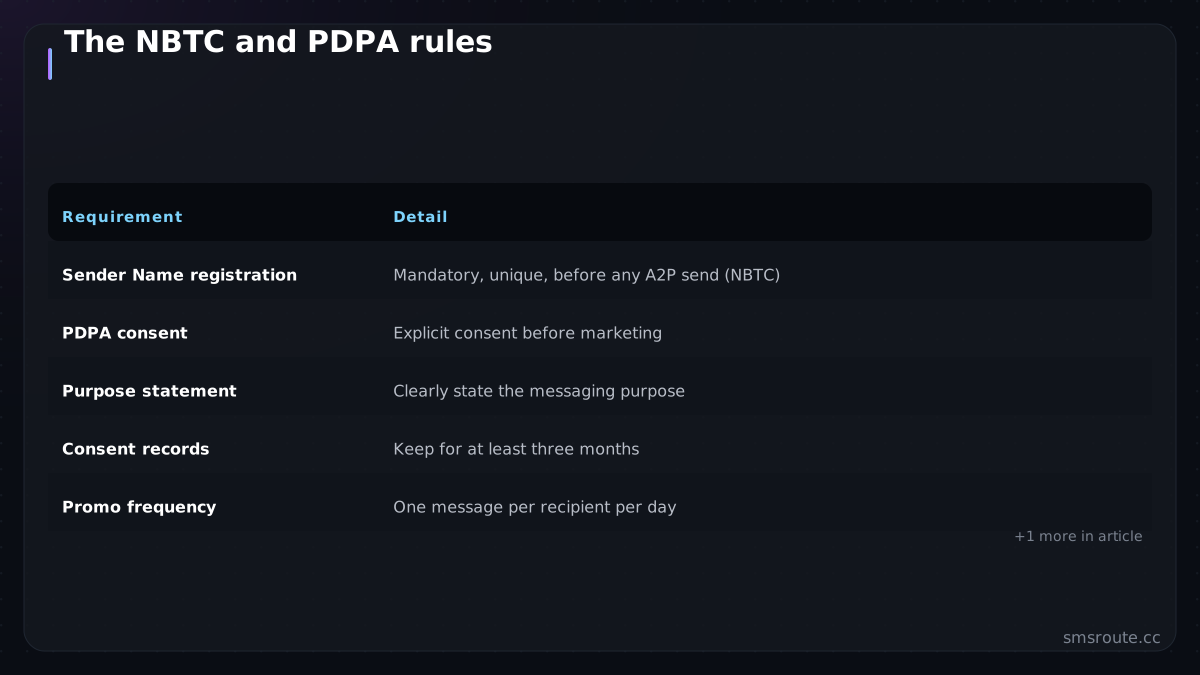
| Requirement | Detail |
|---|---|
| Sender Name registration | Mandatory, unique, before any A2P send (NBTC) |
| PDPA consent | Explicit consent before marketing |
| Purpose statement | Clearly state the messaging purpose |
| Consent records | Keep for at least three months |
| Promo frequency | One message per recipient per day |
| Quiet hours | No promo 9pm-9am |
Two things define Thailand. First, the mandatory unique Sender Name: every A2P sender registers one with the NBTC before sending, part of the country's anti-fraud push. Second, the one-promo-per-day limit: you cannot send a recipient more than one promotional message per day, an unusually specific cap. On the data side, PDPA (Thailand's GDPR-equivalent) requires explicit consent before marketing, a clear statement of purpose, and consent records kept at least three months. Add quiet hours of 9pm-9am, and Thailand restrains marketing tightly. For example, a signup form must include an unchecked checkbox for marketing consent and a sentence like "We will send you promotional offers via email."
Sending compliantly in Thailand
How can I send SMS compliantly in Thailand?
To send compliantly in Thailand, register your sender name with the NBTC and limit marketing to one message per day per recipient. SMSRoute supports custom sender IDs on request and provides real-time delivery reports, ensuring your messages meet local regulations without extra hassle.
- Register a Sender Name with NBTCMandatory before any A2P send. The unique Sender Name is part of Thailand's anti-fraud framework, so registration isn't optional.
- Get PDPA consent and state purposeExplicit consent before marketing, a clear statement of what you'll send, and consent records kept at least three months. PDPA mirrors GDPR consent.
- Respect the one-per-day promo capNo more than one promotional message per recipient per day. Enforce this as a hard rate limit per recipient, and observe 9pm-9am quiet hours.
- Handle Thai script as UnicodeThai message bodies are UCS-2, so the segment limit is 70 characters — plan copy around the encoding reality.
The one-per-day limit is Thailand's distinctive catch. Most markets cap frequency loosely or via harassment presumptions; Thailand sets a hard one-promotional-message-per-recipient-per-day rule. Build it into your sending as a per-recipient daily cap, because exceeding it is a specific violation, not a judgment call.
Sending to Thailand in practice
SMSRoute is a no-KYC SMS API with crypto billing (BTC, ETH, USDT, XMR, LTC, and SOL) serving the international route to Thailand, with live pricing on the send SMS to Thailand page. For transactional and OTP traffic, the international route delivers to Thai users. Thai OTP content sends as Unicode, so keep it within the 70-character segment limit, and put your app name in the body.
The honest boundary: a registered NBTC Sender Name for branded sending is a domestic process, part of Thailand's anti-fraud regime. Pair us for transactional traffic with an NBTC-registration path for branded campaigns. Thailand has tightened its rules significantly: mandatory sender registration, a hard one-per-day promo cap, PDPA consent, quiet hours. The discipline is both administrative and operational. Register the Sender Name, get PDPA consent, enforce the daily cap, and Thailand delivers. For how this market fits the wider picture, see the global SMS compliance map.
Related reading
FAQ
Do I need to register a Sender Name to send SMS in Thailand?
How many promotional SMS can I send in Thailand?
What consent is required for SMS in Thailand?
How does Thai script affect SMS in Thailand?
Send your first SMS in 5 minutes
How do I send my first SMS in 5 minutes?
Sign up with just an email on SMSRoute, fund your account with crypto (BTC, ETH, USDT, XMR, LTC, SOL), get your API key, and send your first SMS to Thailand in minutes. Our REST API and code examples in Python/PHP/Go/Node make integration instant.
No KYC. Pay with BTC, ETH, USDT, XMR, LTC, and SOL. Live routes to 149 countries.
Get an API key →