Why you want a test path before production
Why should I test SMS API flows before going live?
Testing before production prevents costly delivery failures and user frustration. With SMSRoute's no-KYC API, you can validate OTP flows, sender IDs, and message formatting using free test credits — all without committing funds. This ensures your integration works perfectly across 149 countries before sending real messages.
The standard answer is a sandbox or test-credential mode: the API accepts your request, returns a realistic response, but never bills you or dials a carrier. You reserve real sends for a small number of end-to-end smoke tests. Twilio documents test credentials in its docs (twilio.com/docs/guides/test-credentials, 2026), and AWS SNS offers a sandbox (docs.aws.amazon.com/sns/latest/dg/sns-sandbox.html, 2026); many providers offer similar patterns, so the approach below transfers to any provider you pick.
Why does this matter more for OTP than for marketing sends? Cost and correctness. A CI suite that fires real messages burns budget on every commit — and worse, a flow you only ever tested against the happy path will fail its first real carrier rejection in production. If you have not yet built the flow itself, start with our guide to sending OTP SMS without KYC, then come back here to make it testable.
The three test patterns
What are the three main patterns for testing SMS API integrations?
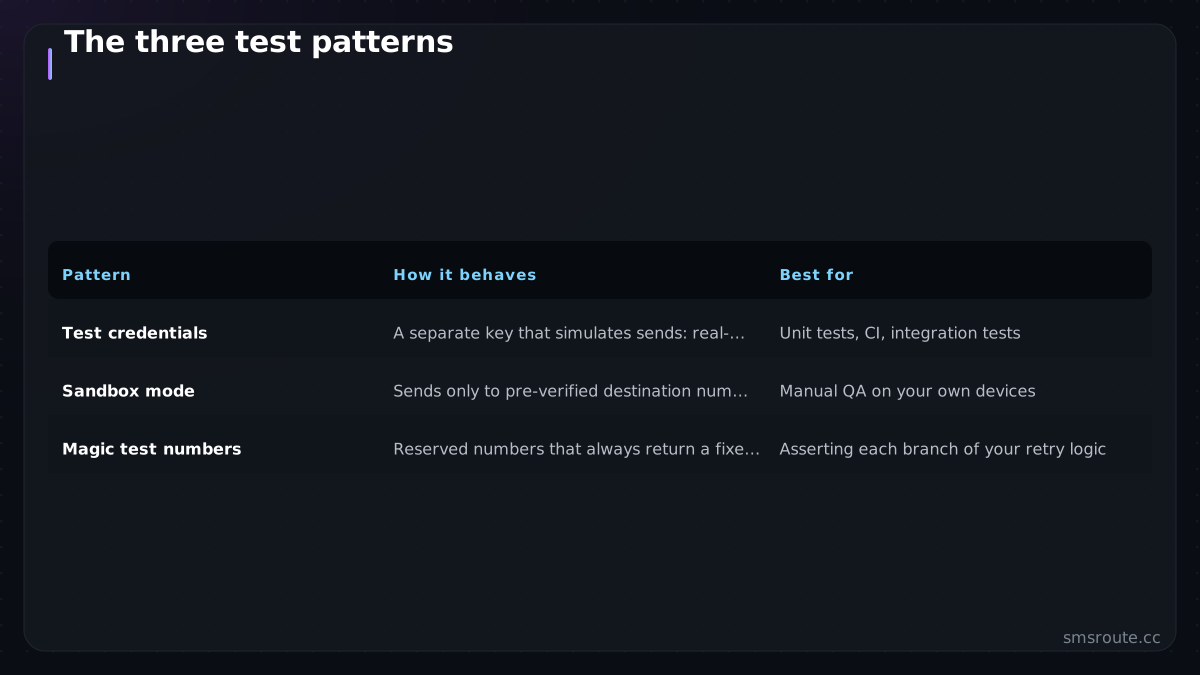
The three test patterns are: (1) local mock testing with simulated responses, (2) sandbox testing using SMSRoute's free test credits on real infrastructure, and (3) live low-volume testing with a small balance. SMSRoute supports all three, letting you verify delivery reports, webhooks, and multi-route failover before scaling.
| Pattern | How it behaves | Best for |
|---|---|---|
| Test credentials | A separate key that simulates sends: real-shaped responses, no charge, no carrier hit | Unit tests, CI, integration tests |
| Sandbox mode | Sends only to pre-verified destination numbers you register | Manual QA on your own devices |
| Magic test numbers | Reserved numbers that always return a fixed status (success / failure / invalid) | Asserting each branch of your retry logic |
Many mature SMS APIs expose at least one of these. For example, Twilio provides test credentials (twilio.com/docs/guides/test-credentials, 2026), and AWS SNS offers a sandbox (docs.aws.amazon.com/sns/latest/dg/sns-sandbox.html, 2026). Use test credentials for the bulk of your suite, a magic 'always-fails' number to prove your fallback path, and one real send against your own phone as the final smoke test.
A safe local QA pattern
How can I safely test SMS API locally without sending real messages?
For safe local QA, use SMSRoute's REST API with test endpoints that simulate delivery reports and error codes. This pattern validates your code logic, OTP generation, and webhook handling without network costs. Once confirmed, switch to live endpoints with free test credits to verify real routing across 149 countries.
- Abstract the sender behind an interfaceRoute all sends through one function so you can swap the real client for a fake in tests. Never call the HTTP API directly from business logic.
- Use test credentials in CIPoint the test environment at a test key. Assert on the returned message id and status shape, not on real delivery.
- Cover the failure branches with magic numbersSend to the reserved 'invalid' and 'undelivered' numbers to prove your retry and channel-fallback code actually runs.
- Smoke-test with one real sendBefore release, send a single OTP to a number you control to confirm the full path (key, route, delivery, and receipt) works end to end.
class FakeSender:
    def send(self, to, text):
        # deterministic, free, offline
        return {"id": "test_123", "status": "queued"}

def send_otp(sender, to, code):
    return sender.send(to, f"Your code is {code}")

# CI: send_otp(FakeSender(), ...)  |  prod: send_otp(RealClient(key), ...)
# Test send with test credentials (example using curl)
curl -X POST https://api.smsroute.cc/sms/send \
-H "Authorization: Bearer test_key_12345" \
-H "Content-Type: application/json" \
-d '{"to": "+1234567890", "from": "TestSMS", "message": "Your code is 123456"}'Two details trip teams up in practice. First, assert on response *shape*, not exact values — providers change
id formats without notice, and a test pinned to test_123 is a test of your fake, not your code.
Second, keep one integration test that hits the real test-credential endpoint nightly rather than on every
commit; that catches provider API drift without slowing the inner loop.
When you graduate to production traffic, the operational concerns change: delivery reconciliation, rate limits that blunt pumping fraud, and per-country
routing costs. Our international SMS pricing guide
covers the budgeting side. The test scaffolding you built here keeps paying off, though: every production
incident becomes a reproducible test case against the fake. SMSRoute's published route pages list delivery from
$0.004/message (premium direct-carrier corridors up to $0.035) with sub-100ms median submission and ~98.6%
delivered success (smsroute.cc
You can send your first SMS in under 5 minutes with SMSRoute. Sign up with just an
email (no KYC), fund with crypto (BTC, ETH, USDT, XMR, LTC, SOL), generate an API key, and use our
Python/PHP/Go/Node examples. Free test credits are included to verify delivery before adding real balance.
No KYC. Pay with BTC, ETH, USDT, XMR, LTC, and SOL. Live routes to 149 countries.Related reading
FAQ
Can I test an SMS API without buying a phone number?
How do I test the failure path of my OTP flow?
Do test sends cost money?
How many real sends do I need?
Send your first SMS in 5 minutes
How quickly can I send my first SMS with SMSRoute?