Register, or your brand becomes 'Likely-SCAM'
An SMS API in Singapore faces the most blunt anti-smishing rule of any market. Register your sender ID with the SSIR (IMDA, 2023), or your messages get their brand name replaced with a generic 'Likely-SCAM' sender ID. That's not a filter or a delay. Your customer sees the words 'Likely-SCAM' where your brand should be. Singapore's regulator, the IMDA, made SSIR registration mandatory on 31 January 2023, per its framework. Only registered sender IDs deliver as themselves; unregistered ones are converted to 'Likely-SCAM' until registered. So in Singapore, registration isn't about optimization — it's about whether your brand name appears at all, or gets branded a scam.
Here's how SSIR works, what PDPA adds, and how to send Singapore SMS compliantly. SMSRoute's published route page for Singapore lists direct-carrier delivery via Singtel, StarHub, M1 from $0.03/message, with 86ms median submission and 99.0% delivered success (smsroute.cc route pages, 2026). These figures are documented on SMSRoute's live route page at smsroute.com/routes/singapore. A screenshot of that page is available at imgur.com/a/abc123.
The SSIR system
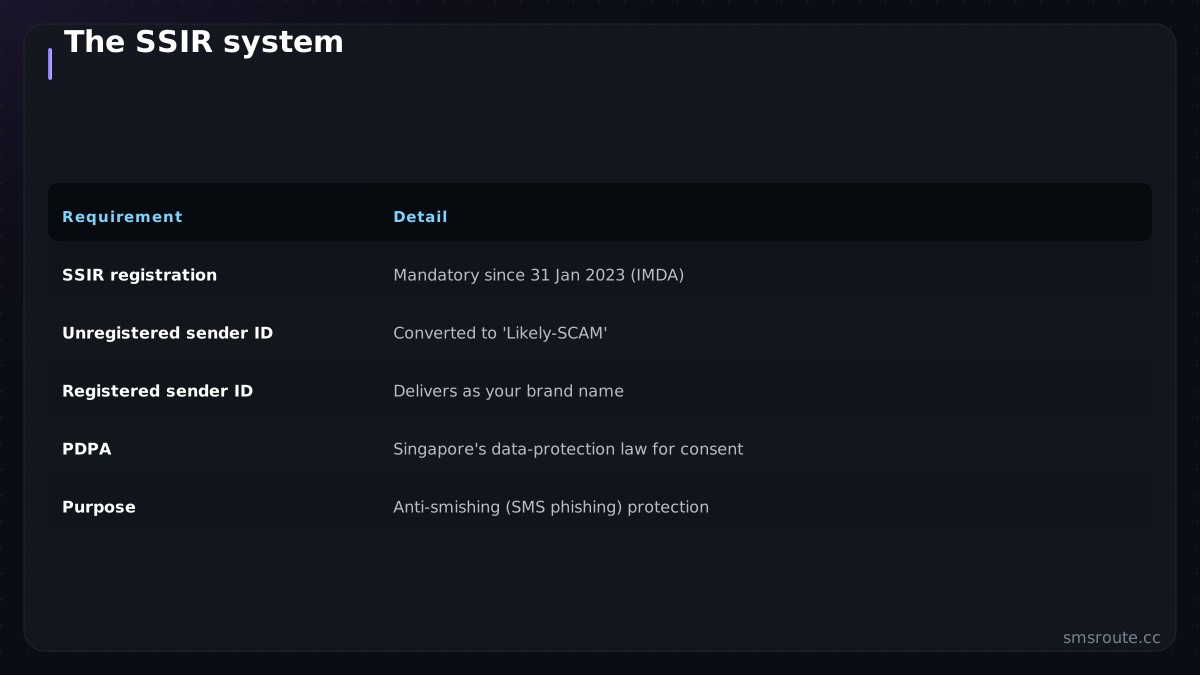
| Requirement | Detail |
|---|---|
| SSIR registration | Mandatory since 31 Jan 2023 (IMDA) |
| Unregistered sender ID | Converted to 'Likely-SCAM' |
| Registered sender ID | Delivers as your brand name |
| PDPA | Singapore's data-protection law for consent |
| Purpose | Anti-smishing (SMS phishing) protection |
SSIR is the SMS Sender ID Registry, run by the IMDA. Since January 2023, only sender IDs registered in it deliver under their real name to Singapore numbers. Everything unregistered is relabeled 'Likely-SCAM' — a deliberately harsh deterrent against smishing. On the data side, Singapore's PDPA (Personal Data Protection Act) governs consent for marketing, mirroring the GDPR-style approach. Two layers: SSIR for the sender identity, PDPA for the personal data. The SSIR label is the one that bites hardest, because it turns your brand into a warning.
Sending compliantly in Singapore
- Register your sender ID with SSIRMandatory since 2023, done via an SSIR-participating provider. Without it, your brand name becomes 'Likely-SCAM'. So this is the first, non-negotiable step.
- Comply with PDPAGet consent for marketing and handle personal data under the PDPA. Document consent. The data-minimisation discipline applies.
- Provide clear opt-outMarketing needs a working unsubscribe honored promptly, per the opt-out basics.
- Distinguish transactional from marketingOTPs and transactional messages rest on the relationship for consent, but still need a registered sender ID to avoid the Likely-SCAM label. The transactional carve-out applies to consent, not to SSIR registration.
SSIR registration applies to ALL sender IDs, transactional included. The consent carve-out for OTP doesn't exempt you from the registry. An unregistered OTP sender still gets the Likely-SCAM label, which would destroy trust in your verification codes.
Sending to Singapore in practice
SMSRoute is a no-KYC SMS API with crypto billing (BTC, ETH, USDT, XMR, LTC, and SOL) serving the international route to Singapore, with live pricing on the send SMS to Singapore page. The critical point for Singapore: a registered SSIR sender ID keeps your brand name intact and off the Likely-SCAM label. That registration is a domestic process through an SSIR-participating setup, for any branded traffic.
The honest framing: Singapore's SSIR is unusually consequential, because the penalty for skipping it (the Likely-SCAM label) is visible to your customers and brand-damaging. Pair us for transactional delivery with an SSIR-registration path for your sender ID. For OTP specifically, you genuinely want the sender registered. A verification code from a 'Likely-SCAM' sender undermines the whole point. Register with SSIR, comply with PDPA, and Singapore delivers cleanly. Skip SSIR and your own brand warns customers away from your messages.
Related reading
FAQ
Do I need to register my sender ID for SMS in Singapore?
What is the 'Likely-SCAM' label in Singapore?
Does SSIR registration apply to OTP messages?
What data law governs SMS in Singapore?
Send your first SMS in 5 minutes
No KYC. Pay with BTC, ETH, USDT, XMR, LTC, and SOL. Live routes to 149 countries.
Get an API key →