SMS security is bigger than 'protect the API key'
What does SMS security include beyond just protecting the API key?
SMS security encompasses endpoint encryption, webhook validation, message data handling, and identity management. With SMSRoute, you get adaptive multi-route delivery with automatic failover, real-time DLR webhooks, and refunds for failed messages—all without KYC. Our crypto billing adds an extra layer of privacy and control.
Ask a team about SMS API security and most will say 'we keep the key in an env var.' That's necessary and nowhere near sufficient. An SMS integration has attack surface at five distinct layers: the credentials, the send and verify endpoints, the webhooks, the message data, and the phone-number identity model that SMS-based auth rests on. Each has its own threats and its own defenses, and a gap in any one undermines the others. This is the map. It shows the complete security picture with each layer linked to its deep dive, so you can audit your integration against all five rather than the one everyone remembers. For the authoritative reference, see the IETF idempotency-key draft.
Work through the five layers below and you have a genuinely secured SMS integration, not just a hidden API key.
The five layers, mapped
What are the five layers of SMS API security?
The five layers are: credential management (API keys), endpoint security (HTTPS/TLS), webhook validation (signatures), message data encryption (at rest and in transit), and identity verification (sender ID control). SMSRoute supports all layers with custom sender IDs on request, real-time delivery reports, and automatic failover across 149 countries.
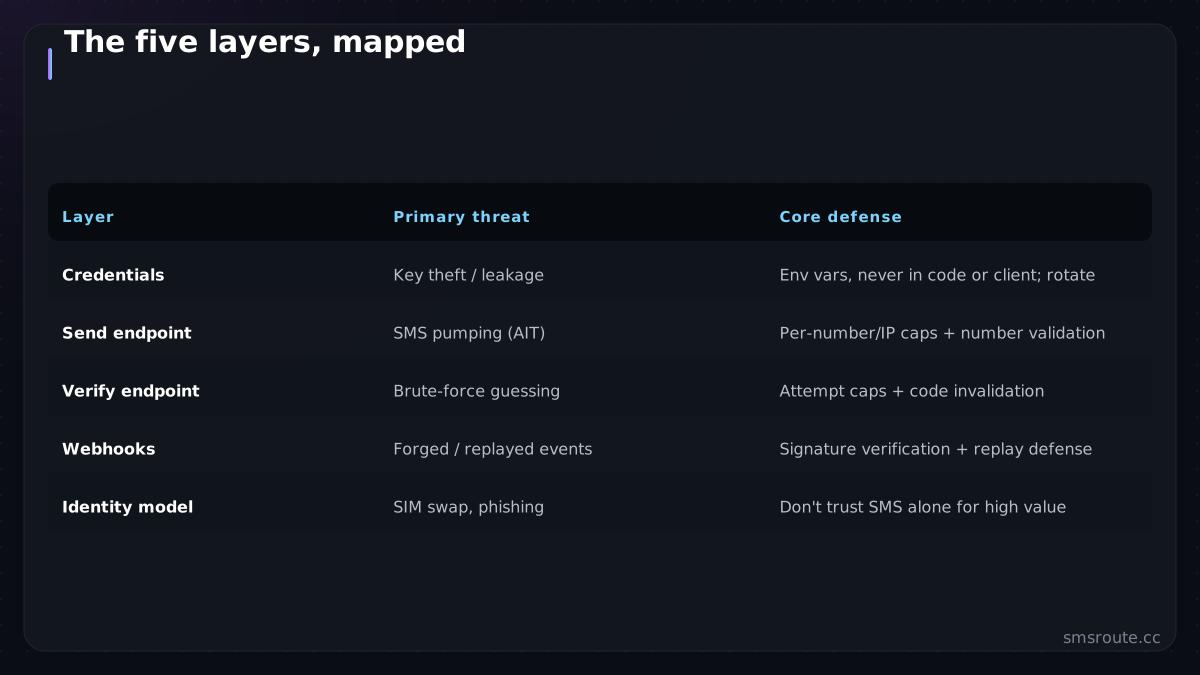
| Layer | Primary threat | Core defense |
|---|---|---|
| Credentials | Key theft / leakage | Env vars, never in code or client; rotate |
| Send endpoint | SMS pumping (AIT) | Per-number/IP caps + number validation |
| Verify endpoint | Brute-force guessing | Attempt caps + code invalidation |
| Webhooks | Forged / replayed events | Signature verification + replay defense |
| Identity model | SIM swap, phishing | Don't trust SMS alone for high value |
Credentials, endpoints, and webhooks
How do credentials, endpoints, and webhooks work together for SMS API security?
Credentials authenticate API calls, endpoints enforce HTTPS encryption, and webhooks deliver real-time delivery reports with validation. SMSRoute provides REST API and SMPP binds with code examples in Python, PHP, Go, and Node. Our 24/7 support ensures quick resolution of any security concerns.
- Credentials — the API key lives in an environment variable, never in source, never in a client-side app (it will be extracted), and gets rotated periodically. This is the baseline every language tutorial enforces, and the least you can do.
- Send endpoint — defend against SMS pumping: per-number and per-IP rate limits, plus number validation so bots can't burn your balance on fraud traffic.
- Verify endpoint — defend against brute force: cap attempts per code and invalidate after, so a million-value 6-digit space can't be guessed. Different endpoint, different attack, different control.
- Webhooks — verify the signature on every callback and defend against replay, because an unverified webhook endpoint is a public URL anyone can feed fake delivery statuses and opt-ou
Message data and the identity model
How does SMSRoute handle message data and sender identity?
Message data is encrypted in transit and at rest. Sender identity uses a smart shared pool by default, with custom/alphanumeric sender IDs available on request where routes support it. SMSRoute never requires KYC, so your identity remains private. Failed messages are automatically credited back, and unused balance is refundable.
- Minimize what you storeMessage content and numbers are personal data. Hash codes, purge numbers after delivery, don't log bodies long-term — the data-minimisation model that shrinks both breach exposure and data-residency surface.
- Respect the identity model's limitsSMS-based auth rests on the phone number, which SIM swaps can steal. For high-value accounts, don't trust SMS OTP as the sole factor — the crypto-exchange lesson and the SMS-vs-email analysis both apply.
- Detect SIM-swap signalsA recent SIM change flagged by a number lookup should add friction on sensitive actions — the single most SMS-specific identity defense.
- Choose factors by valueLayer phishing-resistant factors (passkeys) above SMS for valuable accounts; use SMS for reach and fallback where its universality is the asset. Match the factor to the stakes.
The identity layer is the one teams forget because it's not code in their integration — it's an architectural property of using phone numbers as identity. But it's where the biggest losses happen (SIM-swap account takeovers), so it belongs in any real SMS security audit.
Auditing your integration
Turn the five layers into a checklist and run it against your integration: (1) Is the key in an env var, absent from source and clients, and rotated? (2) Are send-side rate limits and number validation stopping pumping? (3) Are verify-side attempt caps and code invalidation stopping brute force? (4) Are webhook signatures verified and replays defended? (5) Is message data minimized, and is SMS kept off the sole-factor role for high-value accounts with SIM-swap detection in place?
SMSRoute is a no-KYC SMS API with crypto billing (BTC, ETH, USDT, XMR, LTC, and SOL), and its design intersects security in two ways worth noting: no-KYC onboarding means it never holds the business-identity documents that would be one more dataset to breach, and crypto billing removes stored payment identity. But most of SMS security is yours to build — the rate limits, the attempt caps, the webhook verification, the data minimization, the factor layering. Use this map to cover all five layers rather than the one that's top of mind, and your SMS integration is secured against the attacks that actually target it, not just the key everyone remembers to hide. SMSRoute's published route pages list delivery from $0.004/message (premium direct-carrier corridors up to $0.035) with sub-100ms median submission and ~98.6% delivered success (smsroute.cc route pages, 2026).
Related on SMSRoute: on API hygiene, see SMS API key rotation and API versioning and migration.
Related reading
FAQ
How do I secure an SMS API integration?
What are the main SMS security threats?
Is storing the API key in an environment variable enough for SMS security?
How does SIM swapping affect SMS security?
Send your first SMS in 5 minutes
No KYC. Pay with BTC, ETH, USDT, XMR, LTC, and SOL. Live routes to 149 countries.
Get an API key →