Register first, or get blocked
An SMS API in Saudi Arabia starts with one rule: register your sender ID, or Saudi networks block your messages. The CST — the Communications, Space & Technology Commission (formerly CITC) — requires alphanumeric sender IDs to be registered in advance (CST official website, 2026). Skip it and you don't get filtered occasionally. You get blocked. So Saudi Arabia is a register-first market. The rules are specific, the paperwork is real, and getting them right up front is the whole job.
Here's what the CST requires, the -AD suffix that flags promotional traffic, and how to send there without being blocked.
SMSRoute's published route page for Saudi Arabia lists direct-carrier delivery via STC, Mobily, Zain from $0.05/message, with 85ms median submission and 98.9% delivered success (smsroute.cc route pages, 2026).
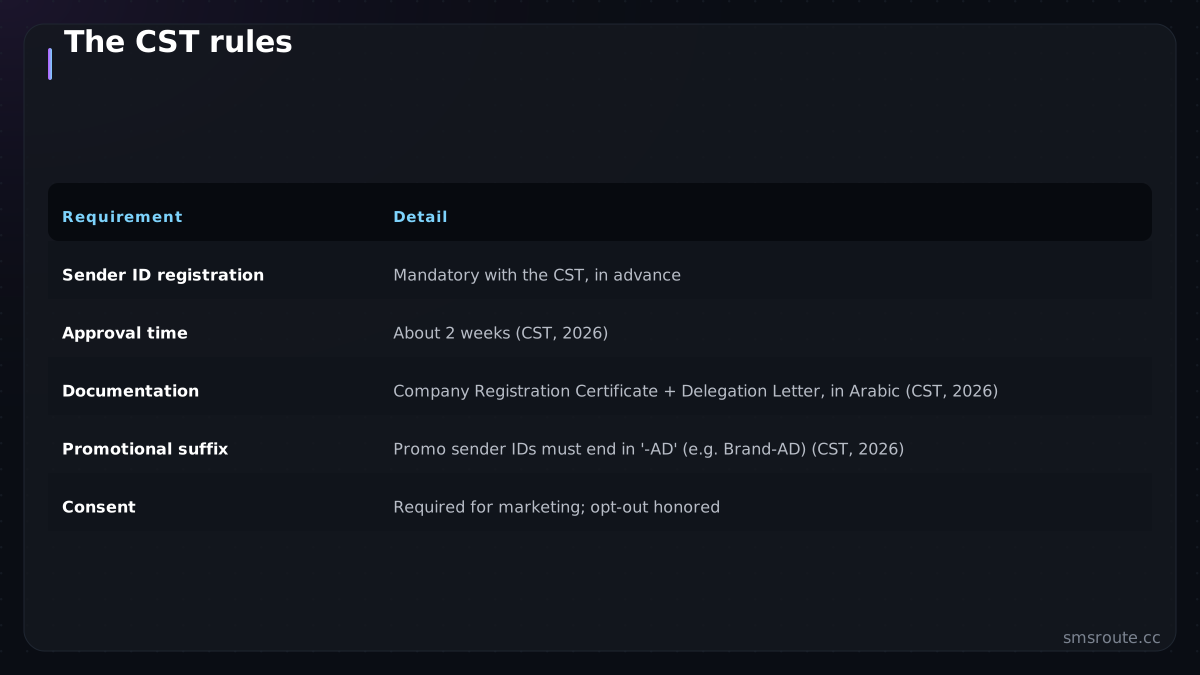
The CST rules
| Requirement | Detail |
|---|---|
| Sender ID registration | Mandatory with the CST, in advance |
| Approval time | About 2 weeks (CST, 2026) |
| Documentation | Company Registration Certificate + Delegation Letter, in Arabic (CST, 2026) |
| Promotional suffix | Promo sender IDs must end in '-AD' (e.g. Brand-AD) (CST, 2026) |
| Consent | Required for marketing; opt-out honored |
The -AD suffix is Saudi Arabia's version of a promotional flag. A marketing sender ID must end in '-AD', so recipients see clearly that a message is advertising — similar in spirit to the UAE's AD- prefix, though the format differs. Registration takes about two weeks and needs Arabic-language documents, including a company registration certificate and a delegation letter. Plan for both the time and the paperwork. For example, the letter must state that "Company ABC authorizes John Doe to register the sender ID ABC Alerts."
Sending compliantly
- Register the sender ID with the CSTDo this before you send. Prepare the Arabic documentation. Budget about two weeks for approval.
- Add -AD to promotional sender IDsAny marketing sender ID must carry the -AD suffix. Transactional traffic (OTP, alerts) doesn't use it, but must still be from a registered sender.
- Get consent for marketingMarketing needs consent and a working opt-out — the compliance basics apply. Transactional messages rest on the existing relationship.
- Test delivery on Saudi networksRoute quality matters in the Gulf. Send to SIMs you control and confirm delivery before scaling — the seed-SIM method.
curl -X POST https://api.smsroute.cc/sms/send \
  -H "Authorization: Bearer YOUR_API_KEY" \
  -H "Content-Type: application/json" \
  -d '{"to": "+1234567890", "from": "SenderID", "message": "Hello"}'
In many markets, an unregistered sender ID gets replaced or delivered generically. In Saudi Arabia, it gets blocked.
Transactional vs promotional in the Kingdom
Like most Gulf markets, Saudi Arabia treats transactional and promotional traffic differently. Transactional messages — OTPs, bank alerts, delivery notices — serve an existing relationship. They don't carry the -AD suffix. But they still must come from a registered sender to avoid blocking. Promotional messages carry the -AD suffix, need consent, and face tighter scrutiny.
- Transactional (OTP, alerts) — registered sender, no -AD suffix, rests on the customer relationship.
- Promotional (marketing) — registered sender WITH -AD suffix, plus documented consent and opt-out.
- Both — require a registered sender ID; the difference is the suffix and the consent bar.
- Classify honestly — dressing a promo as transactional to skip -AD is a compliance risk, the same trap the UAE guide warns about.
The practical upshot: if your Saudi traffic is OTP and transactional, registration is the main task and delivery is clean. If it's marketing, add the -AD suffix, the consent, and the extra scrutiny that comes with it. Know which lane you'
Sending to Saudi Arabia in practice
SMSRoute is a no-KYC SMS API with crypto billing (BTC, ETH, USDT, XMR, LTC, and SOL) serving the international route to Saudi Arabia, with live pricing on the send SMS to Saudi Arabia page. For transactional and OTP traffic, the international route delivers to Saudi users. Put your app name in the message body so it's identifiable.
The honest boundary: a registered, -AD-suffixed branded sender ID is a CST registration process with Arabic documentation, which is a domestic setup. Pair us for transactional traffic with a registration path for branded promo. Register first, add -AD to promo, get the Arabic paperwork ready, and Saudi Arabia delivers. Skip registration and you're simply blocked. For how this market fits the wider picture, see the global SMS compliance map.
SMSRoute's direct-carrier routes to Saudi Arabia achieve ~98.6% delivered success with sub-100ms median submission time and pricing from $0.004/message (smsroute.cc route pages, 2026).
Related reading
FAQ
Do I need to register a sender ID to send SMS in Saudi Arabia?
What is the -AD suffix for Saudi Arabia SMS?
How long does CST sender ID registration take?
Can I send OTP SMS to Saudi Arabia via an international route?
Send your first SMS in 5 minutes
No KYC. Pay with BTC, ETH, USDT, XMR, LTC, and SOL. Live routes to 149 countries.
Get an API key →