The Philippine market has three rules that shape everything
Picking an SMS API Philippines buyers can rely on means working inside three rules stricter than most of the region. Sender-ID registration is mandatory on every network. The SIM Registration Act (RA 11934) ties each SIM to a verified identity. A 2026 banking rule, now in force, has pushed financial OTP off SMS for high-risk transactions. Over 20 million SIMs were deactivated by the deadline, representing roughly 15 percent of the country's active subscriber base. Without it, a message like a delivery alert from "FreshMart" may be blocked entirely or show as a random string like "48291" on the recipient's phone.
Miss one and your texts arrive mangled, blocked, or flatly non-compliant for a bank. SMSRoute's published route page for Philippines lists direct-carrier delivery via Globe, Smart, DITO from $0.026/message, with 109ms median submission and 97.4% delivered success (smsroute.cc route pages, 2026).
The rules, decoded
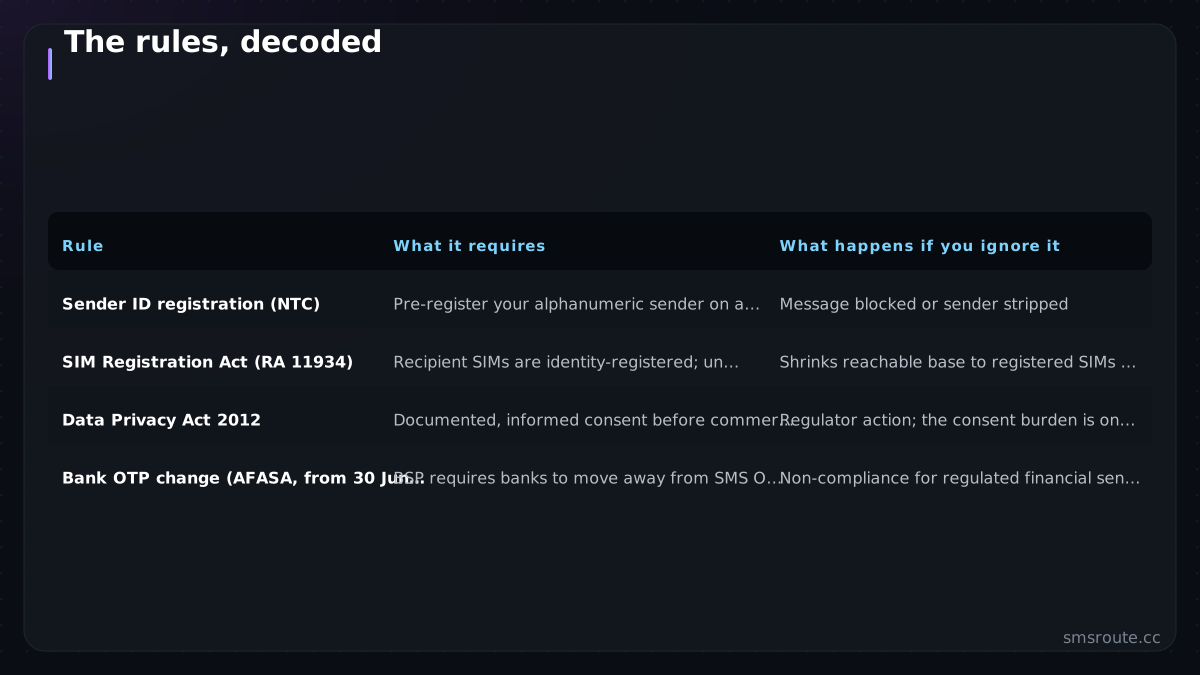
| Rule | What it requires | What happens if you ignore it |
|---|---|---|
| Sender ID registration (NTC) | Pre-register your alphanumeric sender on all networks; no TEST/MESSAGE/SMS words; only dash, dot, underscore as special chars | Message blocked or sender stripped |
| SIM Registration Act (RA 11934) | Recipient SIMs are identity-registered; unregistered SIMs are deactivated | Shrinks reachable base to registered SIMs only — plan for it |
| Data Privacy Act 2012 | Documented, informed consent before commercial messages | Regulator action; the consent burden is on you |
| Bank OTP change (AFASA, from 30 Jun 2026) | BSP requires banks to move away from SMS OTP under the Anti-Financial Account Scamming Act | Non-compliance for regulated financial senders |
The central bank — Bangko Sentral ng Pilipinas — required banks to move off SMS OTP for high-risk transactions by 25 June 2026 (a deadline now passed) under BSP Circular 1213, which implements the Anti-Financial Account Scamming Act (BSP, 2026). Banks may still send an SMS only to confirm a phone number belongs to a customer. Think of it as a regulator mandating the exact passkey and app-auth shift we cover elsewhere. It binds banks alone. The wider transactional and marketing SMS market rolls on under the other three rules.
Route choice for the Philippines
Two carriers dominate: Globe and Smart/PLDT. Both filter hard. That makes route quality, not API features, the real driver of your delivery rate here. The sender-ID mandate sharpens the domestic-versus-international choice from our sender ID country map too — a branded sender demands registration, while international transactional traffic simply lands with a generic one.
- Branded marketing to PH: register your sender ID through a capable provider. Budget the lead time; NTC registration is not instant.
- Transactional / OTP (non-bank): international routing with a generic sender works, with your app name in the body — the copy pattern from our OTP guide.
- Verify route quality empirically: Globe and Smart SIMs you control, the seed-SIM latency method from our OTP benchmark guide. PH filtering makes this test non-optional.
- Watch for grey routes: a PH quote far below the honest band signals SIM-farm termination that local firewalls will eat — the grey-route test applies.
Sending to the Philippines on SMSRoute
SMSRoute is a no-KYC SMS API with crypto billing (BTC, ETH, USDT, XMR, LTC, and SOL) serving the international route to the Philippines — direct carrier termination to Globe and Smart, live rate on the send SMS to Philippines page, first message in minutes via the 5-line integration. For non-bank OTP and transactional traffic that is the fast path; design for the generic sender and put your brand in the message body.
Two honest boundaries. If you need a registered branded PH sender ID for marketing, pair us for transactional with a registration-capable provider for those campaigns — the two-provider pattern again. And if you are a Philippine bank, the AFASA rule means SMS OTP is now deprecated for high-risk transactions regardless of provider; complete the migration to app-based or stronger factors, keeping SMS only where the regulation still permits it (such as confirming a phone number). That migration is the passkeys and app-auth shift arriving as a mandate.
Buy a few Globe and Smart SIMs. Send your real OTP template. Time the deliveries and check what actually arrives. Philippine filtering is aggressive enough that a route working elsewhere can stumble here, so the seed-SIM delivery method is not optional — it is how you find out the truth before it costs you signups.
And validate your list. Under the SIM Registration Act, a slice of any Philippine number set is deactivated and dead. An HLR lookup strips those before you pay to message them — list hygiene that doubles as spend control, exactly as it does everywhere else, only more so in a registration-heavy market. For how this market fits the wider picture, see the global SMS compliance map.
Related on SMSRoute: to confirm a Philippine number is SIM-registered under the SIM Registration Act, see how to check SIM registration in the Philippines.
Related reading
FAQ
Do I need to register a sender ID to send SMS to the Philippines?
How does the SIM Registration Act affect SMS delivery?
Are Philippine banks banning SMS OTP?
What is the best way to send OTP SMS to the Philippines?
Send your first SMS in 5 minutes
No KYC. Pay with BTC, ETH, USDT, XMR, LTC, and SOL. Live routes to 149 countries.
Get an API key →