Users are the worst monitoring system
This is the operational complement to the uptime-vs-delivery distinction: a provider's status page can be green while your delivery quietly falls apart, so you monitor the delivery that reaches your users, measured by you. Here's what to watch and how to alert on it. For the authoritative reference, see A2P 10DLC registration.
The metrics that matter
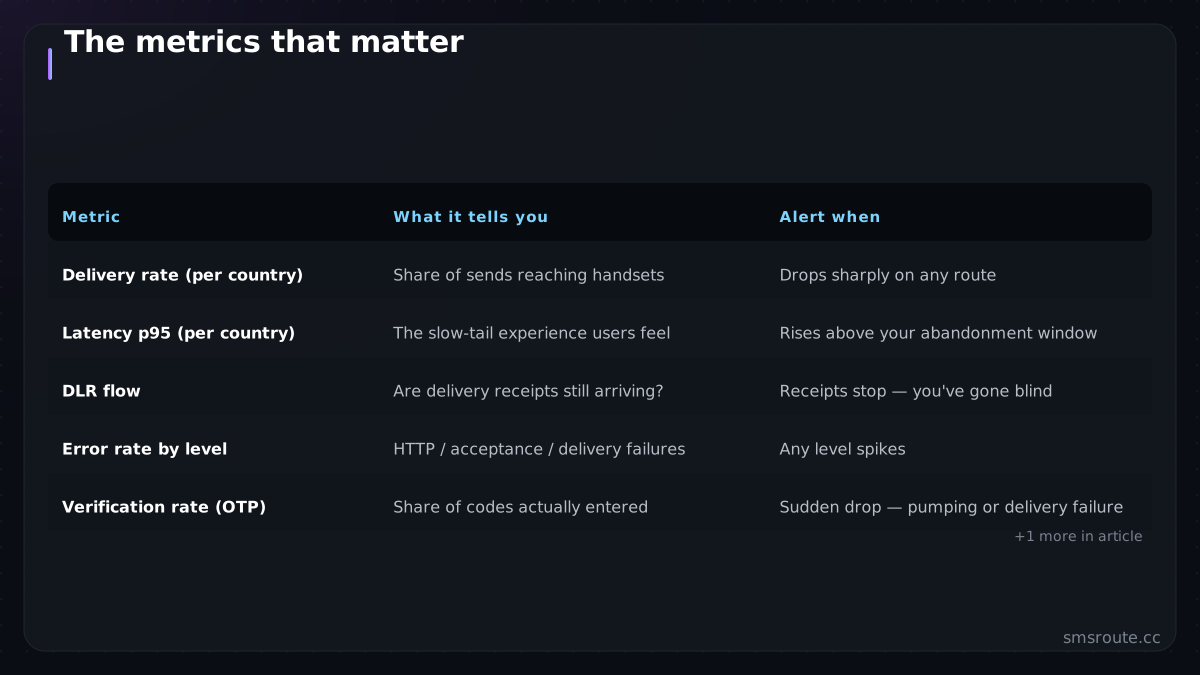
| Metric | What it tells you | Alert when |
|---|---|---|
| Delivery rate (per country) | Share of sends reaching handsets | Drops sharply on any route |
| Latency p95 (per country) | The slow-tail experience users feel | Rises above your abandonment window |
| DLR flow | Are delivery receipts still arriving? | Receipts stop — you've gone blind |
| Error rate by level | HTTP / acceptance / delivery failures | Any level spikes |
| Verification rate (OTP) | Share of codes actually entered | Sudden drop — pumping or delivery failure |
| Send volume | Traffic anomalies | Unexpected spike (fraud) or drop (outage) |
Two of these deserve emphasis. Per-country granularity is essential: a healthy 95% global average can hide a 40% failure in one market, so aggregate metrics lie. And DLR flow itself is a metric: if delivery receipts stop arriving, you've lost your ground truth and every other delivery number becomes a guess. Monitor the monitoring.
Alert on trends, not single events
The discipline that makes monitoring useful rather than noisy: single failures are normal, trends are outages. One undelivered message means nothing; a delivery-rate drop on one route over an hour means a route problem you need to act on. Tune alerts to catch the second without drowning in the first.
- Compare against a baseline: alert on deviation from each route's normal delivery rate and latency, not absolute thresholds that don't fit every corridor.
- Window it: a drop sustained over minutes or an hour is a signal; a one-minute dip is noise. Alert on the trend.
- Segment by route and destination: a global alert misses a single-country failure; the delivery benchmark method applies continuously here.
- Cross-check business metrics: an OTP verification-rate drop that isn't matched by a delivery-rate drop points to pumping rather than a route issue; the combination tells you which.
Building an SMS SLO
- Define what 'healthy' means for youSet target delivery rate and latency p95 per key corridor — your SLO. Base it on measured baselines, not a vendor's marketing number, per the comparison methodology.
- Instrument the whole pipelineLog send ids, acceptance, DLR outcomes, and latency. Reconcile delivery receipts continuously so the metrics reflect reality, not the send response.
- Run synthetic checksPeriodic timestamped sends to seed SIMs in key markets catch silent filtering before real users do — active monitoring, not just passive metrics.
- Have a runbookWhen an alert fires: check which route/country, escalate to the provider with timestamps, and fail over to a backup provider for critical traffic if the degradation persists. Monitoring without a response plan just tells you you're losing.
SMSRoute is a no-KYC SMS API with crypto billing (BTC, ETH, USDT, XMR, LTC, and SOL) that returns auditable handset delivery receipts — the raw material your monitoring needs to reflect reality rather than a dashboard
Related reading
FAQ
What SMS metrics should I monitor?
How do I know if my SMS delivery is failing?
How should I set up SMS delivery alerts?
What is an SMS SLO?
Send your first SMS in 5 minutes
No KYC. Pay with BTC, ETH, USDT, XMR, LTC, and SOL. Live routes to 149 countries.
Get an API key →