Monero takes billing privacy a step further
Paying for an SMS API with Monero is a niche but real option for privacy-focused senders. Bitcoin billing already removes the bank-identity link from your messaging spend, but Bitcoin's ledger is public, so amounts and addresses are visible. Monero (XMR) is different. It's private by design: sender, receiver, and amount are obscured at the protocol level. So for someone whose reason to pay in crypto is privacy rather than just avoiding a card, Monero goes further than Bitcoin. It's a small slice of the market, and the demand is genuine. 'Anonymous SMS payment' and 'privacy coin SMS' are things people search for a real reason. For instance, ring signatures mix a user's spend key with decoys, making it computationally infeasible to identify the true sender.
Here's what Monero billing actually gets you, how it works, and the honest limits. Privacy has boundaries, and overselling them helps no one.
What Monero adds over Bitcoin billing
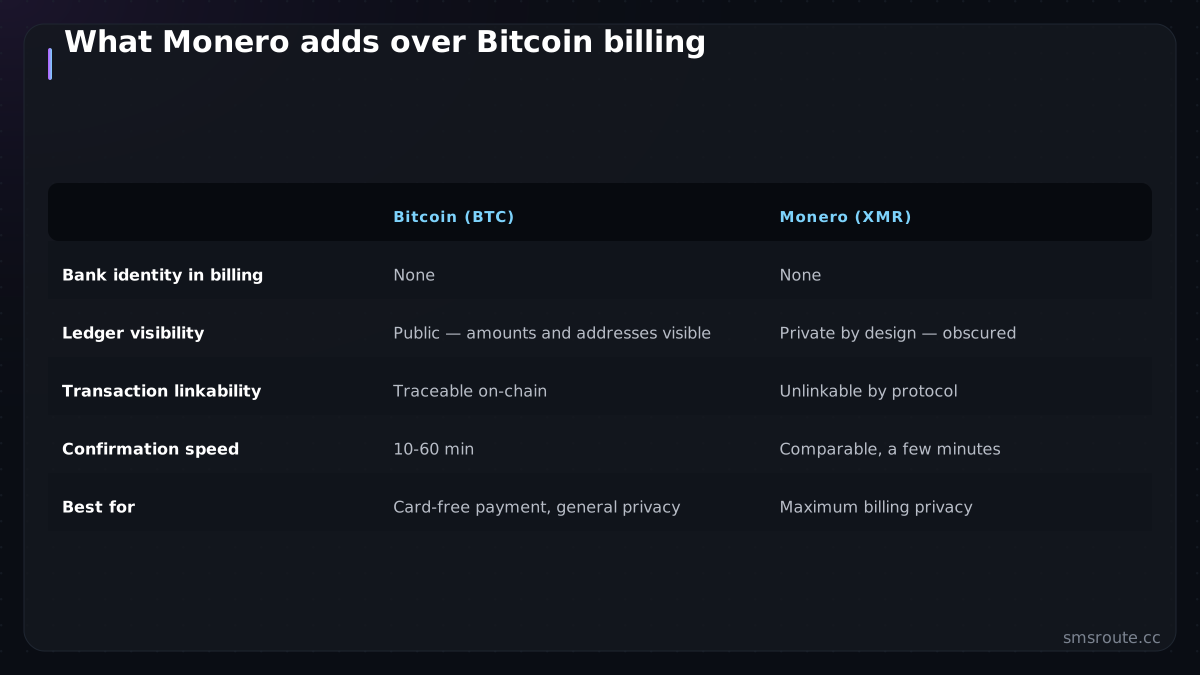
| Bitcoin (BTC) | Monero (XMR) | |
|---|---|---|
| Bank identity in billing | None | None |
| Ledger visibility | Public — amounts and addresses visible | Private by design — obscured |
| Transaction linkability | Traceable on-chain | Unlinkable by protocol |
| Confirmation speed | 10-60 min | Comparable, a few minutes |
| Best for | Card-free payment, general privacy | Maximum billing privacy |
The difference is ledger privacy. Both remove the bank from the picture. That's the crypto-billing benefit any coin provides. But Bitcoin's blockchain is public, so a determined observer can trace amounts and addresses. Monero hides them by protocol. For most senders, Bitcoin or a stablecoin like USDT (often on ERC-20 or TRC-20) is plenty. For the privacy-maximalist who specifically wants the payment itself unlinkable, Monero is the coin that delivers it. It's the difference between 'no bank knows' and 'the ledger doesn't show it either.'
The honest limits
Privacy at the billing layer is real, but it's one layer — and pretending it's more than that is where this topic attracts dishonest claims. Here's what Monero billing does not do.
- It doesn't make your SMS anonymous — the message still travels carrier routes, the recipient sees a sender, and the provider processes the send. Billing privacy ≠ message privacy, the same distinction our anonymous SMS guide draws.
- It doesn't exempt you from law — consent, content, and destination-country rules (like TCPA in the US or GDPR in Europe) apply regardless of how you paid. Private billing is not a shield for unlawful sending. (See FCC TCPA rules for US requirements.)
- It doesn't hide you from the provider — a no-KYC provider holds no identity documents, but it still processes your API calls (typically via REST with JSON payloads); Monero covers the payment, not the traffic.
- Availability varies — fewer providers accept XMR than BTC, and some networks/exchanges restrict it, so it's a narrower option than mainstream coins.
Where it fits on SMSRoute
SMSRoute is a no-KYC SMS API with crypto billing, and privacy-focused billing is core to how it works. No KYC documents held, payment via crypto rather than a bank-linked card. For senders whose priority is maximum billing privacy, a privacy coin extends that further than transparent-ledger coins like BTC. The honest pitch is precise: no-KYC onboarding plus privacy-coin billing means neither identity documents nor a traceable payment ledger sits in the picture. That's the strongest billing-privacy posture available, and genuinely useful for the niche that wants it.
Your traffic still travels real routes under real rules. If your reason for crypto billing is simply avoiding a card, BTC or USDT is simpler and more widely supported. If it's specifically making the payment unlinkable, a privacy coin is the tool. Use it honestly, for what it actually is: the private way to pay for SMS, on infrastructure that still plays by the rules everywhere it delivers.
SMSRoute's published route pages list direct-carrie
Related reading
FAQ
Can I pay for an SMS API with Monero?
What does Monero add over Bitcoin for SMS billing?
Does paying with Monero make my SMS anonymous?
Is paying for SMS with a privacy coin legal?
Send your first SMS in 5 minutes
No KYC. Pay with BTC, ETH, USDT, XMR, LTC, and SOL. Live routes to 149 countries.
Get an API key →