The key you never rotate is the one that leaks
An API key is a credential, and credentials that live forever eventually leak. Committed to a repo. Logged somewhere. Exposed in a breach. Left with a departed employee. SMS API key rotation — periodically replacing the key with a new one — limits that exposure. A leaked key that gets rotated out stops working, so rotation caps how long any single leak stays dangerous. It's basic credential hygiene, part of the SMS security picture. Swap the key naively and any service still using the old one breaks. But that fear is solved by a simple pattern — the dual-key window — that makes rotation a non-event instead of a risky cutover. For the authoritative reference, see the IETF idempotency-key draft.
Here's why to rotate, the zero-downtime pattern, and how to detect a leak that means rotating *now* rather than on schedule.
Why and when to rotate
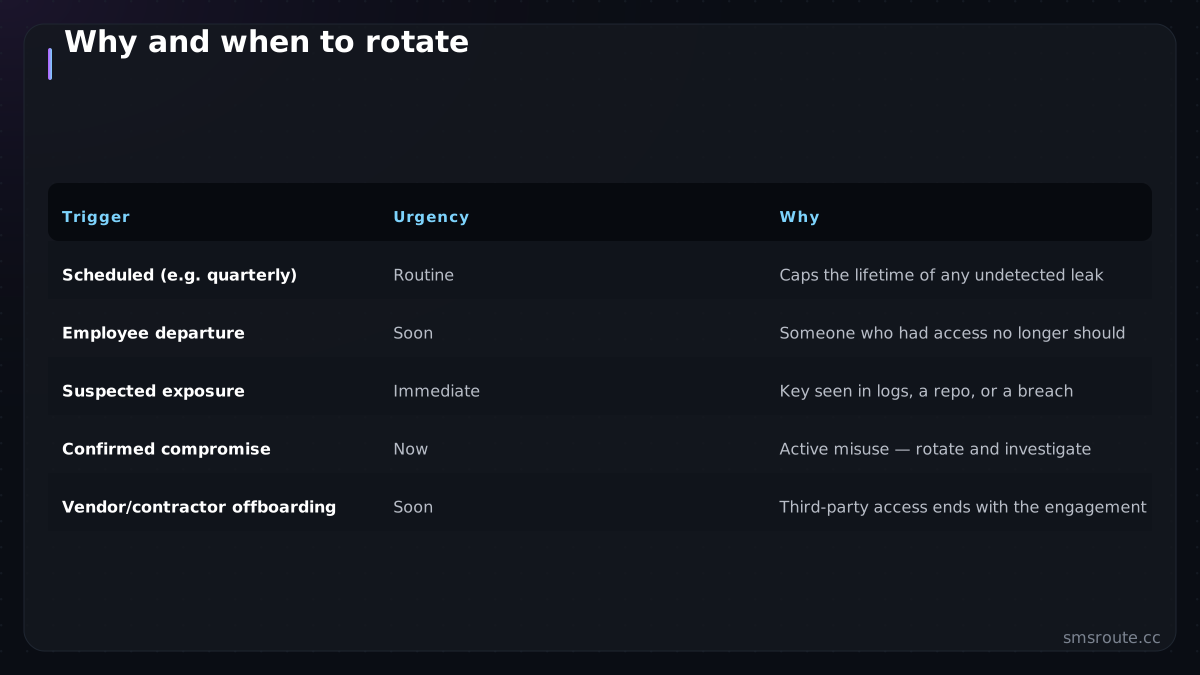
| Trigger | Urgency | Why |
|---|---|---|
| Scheduled (e.g. quarterly) | Routine | Caps the lifetime of any undetected leak |
| Employee departure | Soon | Someone who had access no longer should |
| Suspected exposure | Immediate | Key seen in logs, a repo, or a breach |
| Confirmed compromise | Now | Active misuse — rotate and investigate |
| Vendor/contractor offboarding | Soon | Third-party access ends with the engagement |
Scheduled rotation is the baseline — even with no known leak, rotating on a cadence means any leak you *didn't* know about has a bounded lifetime. The event-driven triggers (a departure, a suspected exposure) are when you rotate off-schedule. The most urgent, confirmed compromise, is where the dual-key window doesn't apply — you revoke the compromised key immediately and accept the brief disruption, because an actively-misused key costs more than a moment of downtime.
The dual-key window: zero-downtime rotation
The pattern that removes the risk: for a routine rotation, have *two* valid keys active during an overlap window, so you migrate services from old to new without a moment where neither works.
- Generate the new keyCreate a second key while the old one still works. Now both are valid — the provider accepts either. This is the property that makes zero-downtime rotation possible.
- Roll out the new key graduallyUpdate your services to use the new key — deploy by deploy, environment by environment. Because the old key still works, anything not yet updated keeps sending. No coordinated cutover required.
- Verify nothing uses the old keyMonitor usage of the old key. When it drops to zero, every service has migrated. If something's still using it, you find that *before* revoking, not after an outage.
- Revoke the old keyOnce nothing uses it, revoke the old key. The rotation is complete, and at no point did sending stop. The leaked-key exposure is now closed.
# Send a message via SMSRoute API
curl -X POST https://api.smsroute.cc/sms/send \
  -H "Authorization: Bearer YOUR_API_KEY" \
  -H "Content-Type: application/json" \
  -d '{"to": "+1234567890", "from": "SenderID", "message": "Hello from SMSRoute!"}'

# Check account balance
curl -X GET https://api.smsroute.cc/account/balance \
  -H "Authorization: Bearer YOUR_API_KEY"
The whole trick is the overlap: two valid keys at once means there's never a gap where a service is stuck with a dead key. Without it, rotation is a scary synchronized swap; with it, rotation is a gradual, monitored, reversible migration — which is why it should be routine, not feared.
Detecting leaks and building it in
- Watch for anomalous usage — a spike in sends, traffic from unexpected sources, or messages you didn't originate can signal a leaked key in use; your monitoring should flag it.
- Scan for exposed keys — check that keys aren't in source control, client-side code, or logs; a key in a public repo is compromised the moment it's pushed.
- Keep keys out of code always — environment variables, never literals, is the baseline every integration follows; a key that's only ever in env vars is far harder to leak.
- Make rotation routine, not heroic — a documented, low-drama rotation process means you'll actually do it on schedule and can execute an emergency rotation calmly when needed.
SMSRoute provides direct-carrier delivery from $0.004/message, sub-100ms median submission, and ~98.6% delivered success on direct routes (smsroute.cc route pages, 2026). Key handling is the one security layer entirely in your hands — the provider issues the key; keeping it safe and rotating it is your discipline. Rotate on a schedule to cap unknown-leak lifetime, rotate off-schedule on departures and suspected exposure, use the dual-key overlap window so routine rotation never drops a message, and revoke immediately on confirmed compromise. It's a small, well-understood process that closes the slow leak every long-lived credential eventually springs — and because the dual-key window removes the downtime fear, there's no good reason not to make it routine. For how this market fits the wider picture, see the global SMS compliance map.
Related reading
FAQ
Why should I rotate my SMS API key?
How do I rotate an API key without downtime?
When should I rotate my SMS API key immediately?
How do I know if my SMS API key has leaked?
Send your first SMS in 5 minutes
No KYC. Pay with BTC, ETH, USDT, XMR, LTC, and SOL. Live routes to 149 countries.
Get an API key →