
What Are the Legal Requirements for an SMS API in Kenya?
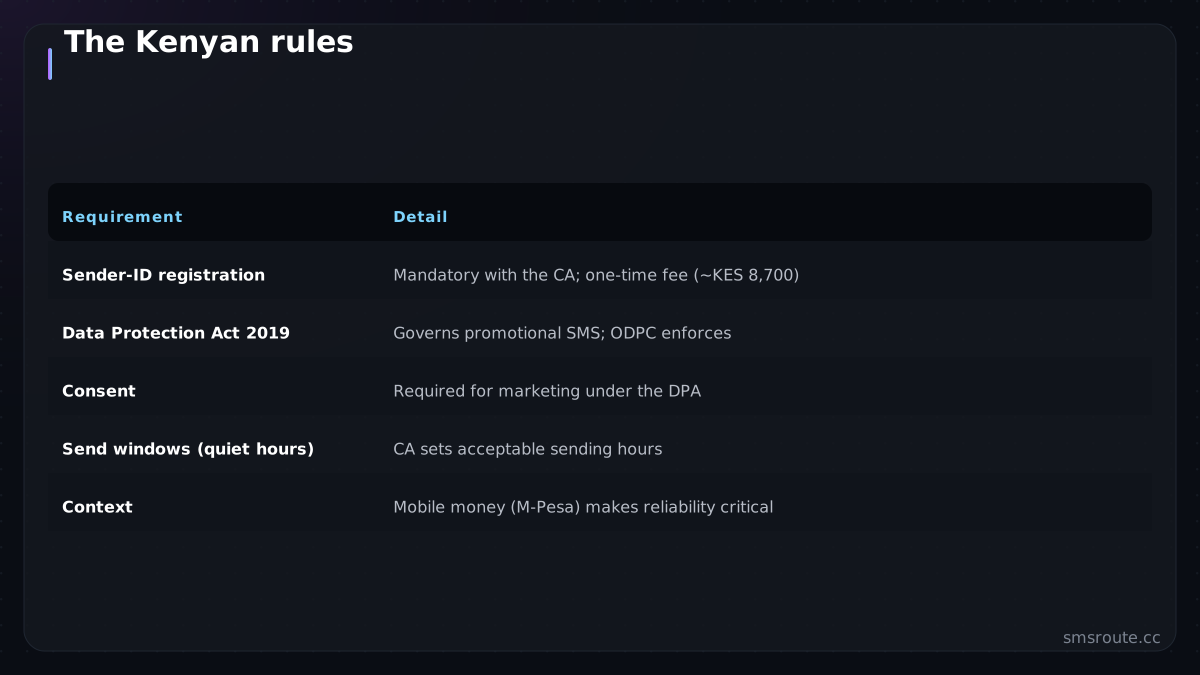
Kenya regulates SMS under two parallel frameworks: the Communications Authority of Kenya (CA) controls sender identification and sending hours, while the Data Protection Act 2019 (enforced by the ODPC) governs consent for promotional messaging. Missing either means your messages risk being blocked or your business falling foul of data-protection rules.
The CA requires any business running SMS campaigns to register their sender ID — a one-time process with a fee of approximately KES 8,700. This applies to branded sending where your business name appears as the sender. Separately, the Data Protection Act 2019, modeled on the GDPR, requires documented opt-in consent for marketing messages and sets rules for how personal data is collected and used. The CA also enforces quiet hours, restricting when promotional messages can be delivered. And beneath all of this: Kenya's mobile-money infrastructure means that a failed transactional SMS — an OTP, a payment confirmation — can stall a real financial transaction.
| Requirement | Detail |
|---|---|
| Sender-ID registration | Mandatory with the CA for branded SMS campaigns; one-time fee ~KES 8,700 |
| Data Protection Act 2019 | Governs promotional SMS; enforced by ODPC; requires opt-in consent |
| Quiet hours (send windows) | CA sets acceptable sending hours for promotional traffic |
| Transactional vs. promotional | OTP and transactional traffic can use international routes with app-name identification; branded campaigns need CA registration |
| Context | Mobile-money economy makes delivery reliability operationally critical |
SMSRoute's published route data for Kenya shows direct-carrier delivery via Safaricom, Airtel, and Telkom from $0.014 per message, with a median submission latency of 118ms and a 96.9% delivered success rate (send SMS to Kenya route page). These are live measurements, not estimates.
How Much Does Sender ID Registration Cost in Kenya?
The Communications Authority of Kenya charges a one-time fee of approximately KES 8,700 for sender ID registration. This is a regulatory requirement for any business that wants to send branded SMS campaigns to Kenyan numbers. The fee covers the registration and approval process for your chosen sender ID (your business name or brand identifier).
For transactional traffic — OTP codes, balance alerts, payment confirmations — the international route is an alternative. These messages can be sent with your app name or a short identifier in the message body, without needing a CA-registered sender ID. This distinction matters: you can route time-sensitive transactional traffic through an SMS API immediately while your CA registration processes for branded campaigns.
How to Send Compliant SMS to Kenya
Follow these five steps to send SMS to Kenya that meets both CA and ODPC requirements while maintaining high delivery reliability:
- Register your sender ID with the CA File your sender ID application with the Communications Authority of Kenya. Budget for the one-time fee (~KES 8,700) and allow processing time before launching branded campaigns.
- Obtain opt-in consent under the Data Protection Act Collect documented consent from recipients before sending promotional messages. Follow the GDPR consent template approach — Kenya's DPA mirrors GDPR requirements for opt-in, data-minimisation, and purpose limitation.
- Respect CA quiet hours The CA sets restricted sending windows for promotional SMS. Enforce timing by Kenyan local time using SMS scheduling to stay within allowed hours.
- Choose a provider with direct carrier connections Use an SMS API provider with direct routes to Safaricom, Airtel, and Telkom. Direct connections mean lower latency and higher delivery rates than aggregator pass-through. Compare pricing per destination and check route quality metrics.
- Monitor delivery with DLR Every message should generate a delivery receipt (DLR). Track success rates, latency, and failure reasons. For OTP and transaction confirmations, real-time DLR monitoring catches issues before they reach users. See the DLR monitoring guide for setup.
SMSRoute provides a no-KYC SMS API with crypto billing (BTC, ETH, USDT, XMR, LTC, SOL) serving 149 countries including Kenya. For the Kenya route, we connect directly to Safaricom, Airtel, and Telkom. Transactional and OTP traffic can start immediately via the international route with your app name in the message body. Branded campaigns require CA sender ID registration — a one-time process.
Why Does SMS Delivery Reliability Matter in Kenya?
Kenya is not a market where "best effort" delivery is acceptable. M-Pesa, the mobile-money platform, processes tens of billions of KES in transactions monthly. Every single transaction — send, receive, withdraw, pay — depends on an SMS confirmation reaching the user's phone. A failed OTP means a stuck withdrawal. A delayed payment alert can cascade into a missed business obligation.
This is why route quality metrics matter more in Kenya than in markets where SMS is used primarily for marketing. SMSRoute's Kenya route delivers with a 96.9% success rate and a median submission latency of 118ms. These numbers come from live production traffic, not lab tests. Direct carrier connections mean your message travels from our platform to Safaricom's SMSC — not through a chain of intermediaries where each hop adds latency and failure risk. For a broader view of how Africa's SMS landscape works, read the SMS delivery in Africa guide.
| Metric | Value |
|---|---|
| Price per SMS | $0.014 |
| Median submission latency | 118ms |
| Delivery success rate | 96.9% |
| Carriers | Safaricom, Airtel, Telkom |
| Billing | BTC, ETH, USDT, XMR, LTC, SOL |
| KYC required | No |
What Is Kenya's Data Protection Act for SMS Marketing?
The Data Protection Act of 2019, enforced by the Office of the Data Protection Commissioner (ODPC), governs every promotional SMS sent to a Kenyan number. It is modeled closely on the GDPR and introduces the same core requirements: opt-in consent for marketing messages, transparent data-handling practices, purpose limitation, and data minimisation. Businesses must be able to demonstrate that consent was freely given, specific, informed, and unambiguous — a double opt-in process is the safest approach.
The DPA works alongside the CA's sender-ID registration and quiet hours rules. Together they create a compliance framework that is stricter than most African markets. For a full breakdown of how this fits into global SMS regulation, see the global SMS compliance map 2026.
Practical steps: document consent at the point of collection, maintain an opt-out mechanism in every message, minimise the data you store to what is necessary for sending, and respect subscriber preferences. The same data-minimisation discipline that applies under GDPR applies here.
Frequently Asked Questions
Do I need to register a sender ID to send SMS in Kenya?
Yes. The Communications Authority of Kenya (CA) requires sender-ID registration for businesses running SMS campaigns, with a one-time fee of around KES 8,700. Registration is mandatory for branded sending. Transactional traffic like OTPs can be sent via the international route without branded ID registration — your app name identifies the sender in the message body.
How much does sender ID registration cost in Kenya?
Approximately KES 8,700 as a one-time fee, per industry guidance, paid to register your sender ID with the Communications Authority of Kenya for SMS campaigns. This applies to branded sending; transactional traffic like OTPs can use an international route with app-name identification, separate from the branded-sender registration.
What is Kenya's Data Protection Act for SMS?
The Data Protection Act of 2019, enforced by the Office of the Data Protection Commissioner (ODPC), governs every promotional SMS sent to a Kenyan number. Modeled on GDPR, it requires proper opt-in consent for marketing and lawful handling of personal data. It works alongside the Communications Authority's sender-ID registration and quiet hours rules.
Why is SMS delivery reliability important in Kenya?
Because Kenya's economy runs on mobile money like M-Pesa, which depends on SMS for transaction confirmations, balance alerts, and OTPs. A failed or delayed SMS can mean a stuck financial transaction. Route quality and delivery monitoring via DLR matter more in Kenya than the compliance rules alone suggest.
What carriers does SMSRoute reach in Kenya?
SMSRoute connects directly to Safaricom, Airtel, and Telkom Kenya. Delivery starts at $0.014 per message with a 96.9% success rate and 118ms median submission latency. No KYC required. See the Kenya route page for live pricing.
Related reading
Send your first SMS in 5 minutes
No KYC. Pay with BTC, ETH, USDT, XMR, LTC, and SOL. Direct routes to 149 countries including Kenya.
Get an API key →