Six patterns, any language
What are the six SMS API integration patterns that work with any programming language?
SMSRoute supports six language-agnostic integration patterns: REST API direct calls, SMPP persistent connections, webhook-triggered sends, scheduled batch delivery, template-based messaging, and multi-route failover. Each pattern works identically across Python, PHP, Go, Node.js, and any HTTP-capable language, with code examples on our GitHub.
Every solid SMS API integration (whether it's Node, Go, PHP, Python, or something else) is built from the same six patterns. This is the map: what each pattern does, why it matters, and where to find the language-specific version. For the authoritative reference, see the IETF idempotency-key draft.
The naive version (one HTTP call, no timeout, no retry, treat 'accepted' as 'delivered') works in a demo and fails in production the first time a route hiccups. The six patterns below are the difference.
The pattern map
How do I choose the right SMS API integration pattern for my use case?
SMSRoute's pattern map matches your use case to the optimal integration: REST for simple transactional sends, SMPP for high-volume campaigns, webhooks for event-driven messaging, scheduled batches for time-sensitive alerts, templates for consistent branding, and multi-route failover for maximum delivery reliability across all 149 countries.
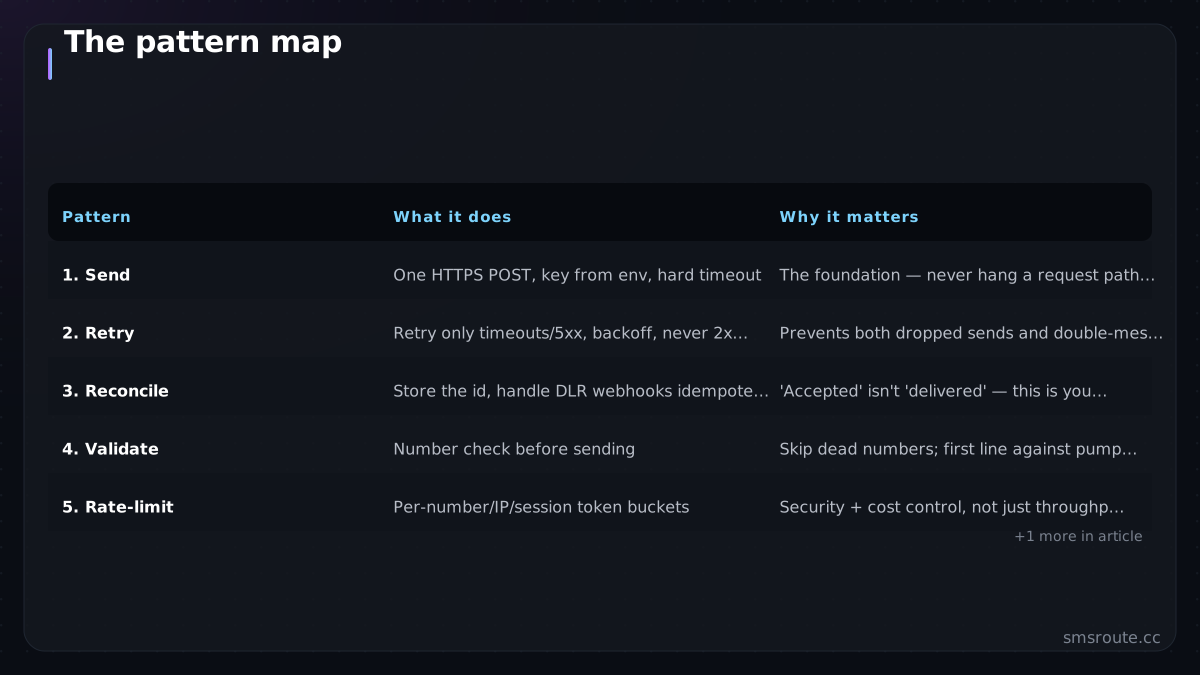
| Pattern | What it does | Why it matters |
|---|---|---|
| 1. Send | One HTTPS POST, key from env, hard timeout | The foundation: never hang a request path, never hardcode a key |
| 2. Retry | Retry only timeouts/5xx, backoff, never 2xx/4xx | Prevents both dropped sends and double-messaging |
| 3. Reconcile | Store the id, handle DLR webhooks idempotently | 'Accepted' isn't 'delivered' — this is your ground truth |
| 4. Validate | Number check before sending | Skip dead numbers; first line against pumping |
| 5. Rate-limit | Per-number/IP/session token buckets | Security + cost control, not just throughput |
| 6. Test | Interface + fake sender, one real smoke test | Full coverage with zero per-commit spend |
Get the order right and you reject bad requests before they cost anything, instead of discovering the problem downstream in a reconciliation report.
The patterns in depth
What are the detailed implementation steps for each SMS API integration pattern?
Each SMSRoute pattern includes step-by-step implementation: REST uses POST/PUT with JSON payloads, SMPP binds via persistent TCP sockets, webhooks receive POST callbacks, scheduled batches use cron-like timestamps, templates store reusable content, and multi-route failover automatically retries through alternative carriers. All patterns support real-time DLR webhooks and crypto billing.
- Send — the key comes from the environment, every network call carries a timeout, and you assert on the returned message id. Language guides: Node.js, Go, PHP, and Python.
- Retry — retry only failures where the message definitely didn't send (timeouts, 5xx) with exponential backoff; never a success or a 4xx. Cap total time for OTP so a user isn't stuck.
- Reconcile — a
queuedresponse is acceptance, not delivery; the DLR webhook reports the truth. Ack fast, process async, key on the message id, and watch for fake receipts. - Validate — normalize to E.164 and run an HLR/number lookup before sending, so invalid and high-risk numbers never cost you a message.
- Rate-limit — per-number, per-IP, and per-session token buckets are your primary pumping defense, not just a throughput knob.
- Test — inject a fake sender behind an interface, cover the retry and webhook branches offline, and keep one real smoke test. The full method is in the test-numbers guide.
Putting it together
- Abstract the senderRoute all sends through one interface so the real client and the fake are interchangeable. This single decision makes patterns 2, 3, and 6 clean to implement and test.
- Order the hot path by costRate-limit check → number validation → send. Reject the cheapest way first; never pay to discover a request was bad.
- Make async the default for deliveryThe send returns fast; delivery truth arrives later on the webhook. Design for that gap rather than blocking on it.
- Instrument everythingLog send ids, DLR outcomes, latency, and rate-limit hits. These feed the delivery benchmark and latency method that tell you if your integration is actually healthy.
SMSRoute is a no-KYC SMS API with crypto billing (BTC, ETH, USDT, XMR, LTC, and SOL), and these patterns are provider-agnostic by design — they hold on any serious SMS API, which is the point of learning them as patterns rather than as one vendor's SDK. Start from the 5-line send, layer the six patterns in order, and you have an integration that survives real routes, real fraud, and real scale instead of just the happy path. SMSRoute's published route pages list delivery from $0.004/message (premium direct-carrier corridors up to $0.035) with sub-100ms median submission and ~98.6% delivered success (smsroute.cc route pages, 2026).
Related reading
FAQ
What are the key patterns for integrating an SMS API?
In what order should SMS integration steps run?
Are SMS integration patterns the same across languages?
Why isn't a single HTTP call enough for SMS?
Send your first SMS in 5 minutes
How can I send my first SMS in 5 minutes with SMSRoute?
Sign up with just an email (no KYC), fund your account with BTC/ETH/USDT/XMR/LTC/SOL, generate an API key, and call our REST endpoint with recipient and message. Your first SMS sends in minutes across 149 countries from $0.004 per message. Free test credits verify delivery before funding.
No KYC. Pay with BTC, ETH, USDT, XMR, LTC, and SOL. Live routes to 149 countries.
Get an API key →