The bug that sends the same code twice
What causes duplicate SMS messages to be sent?
Duplicate messages typically occur when network timeouts or retries cause the same API request to be processed multiple times. SMSRoute's idempotency key system prevents this by ensuring each unique key is processed only once, even if the request is repeated. This eliminates double charges and user confusion.
You send an OTP, the network drops before you get a response, so your retry logic sends it again. But the *first* request actually succeeded, and now the user gets two codes. Confusing at best; at scale, it's double-billing and eroded trust. An SMS API idempotency key solves it cleanly: you attach a unique key to the request, and the provider guarantees that key sends exactly once, no matter how many times you retry. Same key, same result, one message.
Retries are mandatory for handling transient failures. But retries without idempotency are how you turn one dropped connection into a duplicate-message incident.
How idempotency keys work
How do idempotency keys prevent duplicate SMS?
Idempotency keys are unique tokens you include in each API request. SMSRoute's system checks the key before processing: if the same key is received again, it returns the original response without sending a duplicate message. This guarantees exactly-once delivery even during network retries, saving you money and maintaining message integrity.
The mechanism is simple and the guarantee is strong. You generate a unique key per logical send and pass it
with the request (usually an Idempotency-Key header). The provider records it. If a request with
that key already succeeded, the provider returns the *original* result instead of sending again. The provider
stores the key in a database or in-memory cache. It typically expires after a set period, such as 24 hours or 30
days.
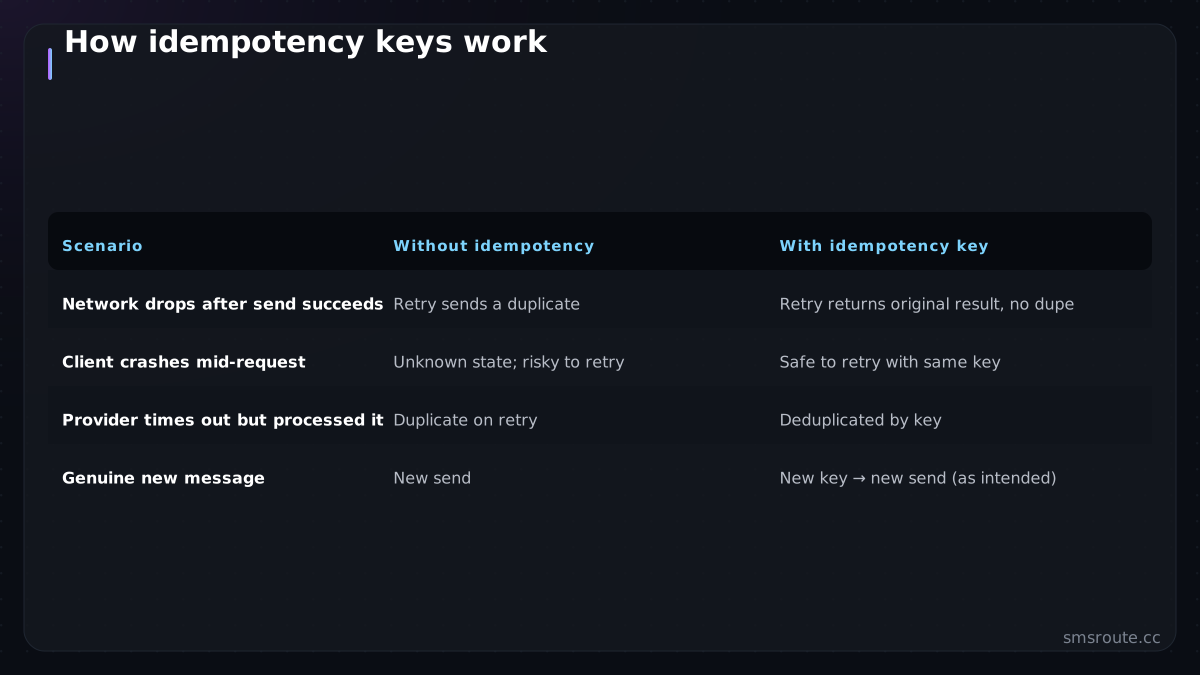
| Scenario | Without idempotency | With idempotency key |
|---|---|---|
| Network drops after send succeeds | Retry sends a duplicate | Retry returns original result, no dupe |
| Client crashes mid-request | Unknown state; risky to retry | Safe to retry with same key |
| Provider times out but processed it | Duplicate on retry | Deduplicated by key |
| Genuine new message | New send | New key → new send (as intended) |
The guarantee is per key: the same key never sends twice; a different key always sends. So the whole design reduces to one question — how do you generate a key that's stable across retries of the same logical send but unique across different sends?
Generating and scoping keys correctly
How should I generate and scope idempotency keys for SMS?
Generate keys using a cryptographically random UUID or a hash of the message content plus timestamp. Scope each key to a single message attempt—never reuse keys across different messages. SMSRoute accepts keys up to 64 characters. This approach ensures reliable deduplication without collisions.
- One key per logical send, generated before the first attemptCreate the key when you decide to send (e.g. a UUID), then reuse that exact key across all retries of that send. Generating a fresh key on each retry defeats the entire purpose.
- Tie it to the business event where naturalFor an OTP, a key derived from the verification session (not the code) is stable across retries but unique per session. So a legitimate resend, which is a new logical send, correctly gets a new key.
- Store the key with the send recordPersist it alongside your message record before sending, so a crashed-and-restarted process retries with the same key rather than minting a new one.
- Mind the key retention windowProviders remember keys for a limited window (often 24 hours). Within it, retries deduplicate; a much later reuse of the same key may send again. Scope your retries to that window.
The subtle case is resends. If a user clicks 'resend code', that's a *new* logical send and should get a *new* key. You genuinely want a second message. Idempotency prevents *accidental* duplicates from retries, not *intentional* resends. K
Where it fits in a reliable integration
Where do idempotency keys fit in a reliable SMS integration?
Idempotency keys are essential in any production SMS workflow. Place them in your API call alongside the message content and recipient. SMSRoute's REST API supports them natively, complementing our automatic failover and real-time DLR webhooks. Together, these features create a robust, zero-duplicate messaging pipeline.
The retry pattern says 'retry timeouts and 5xx with backoff'; the idempotency key is what makes those retries safe. Together they mean a transient failure gets recovered without a duplicate. That's exactly the behavior an OTP flow needs, since the three levels of error handling all involve deciding whether to retry. The IETF RFC 7231 defines idempotent methods, and Stripe's API documentation provides a practical implementation pattern.
SMSRoute is a no-KYC SMS API with crypto billing (BTC, ETH, USDT, XMR, LTC, and SOL), and idempotency is the kind of feature that's invisible until the night a flaky network turns your retry loop into a duplicate-message storm. Generate a stable key per send, reuse it across retries, mint a new one for intentional resends, and store it before sending. It's a few lines that convert your retry logic from a liability into the reliability feature it's supposed to be.
Related reading
FAQ
What is an idempotency key in an SMS API?
Why do I need idempotency keys for SMS?
How do I generate an idempotency key?
Do idempotency keys prevent intentional resends?
Send your first SMS in 5 minutes
No KYC. Pay with BTC, ETH, USDT, XMR, LTC, and SOL. Live routes to 149 countries.
Get an API key →