Why 'it returned 200' isn't the end of the story
Why isn't a 200 OK response the end of the story for SMS API error handling?
A 200 OK only confirms your HTTP request reached the server. It doesn't guarantee the message was delivered to the carrier or the recipient's phone. With SMSRoute, you get real-time DLR webhooks that reveal the true delivery status, so you never rely on a single status code alone.
The most common SMS integration mistake is treating the API like a simple fire-and-forget HTTP call: send, get a 200, assume done. But a 200 OK from an SMS gateway means only that the gateway *received your request* — not that a carrier accepted it, and certainly not that a phone got the text. SMS API error handling done right recognizes that failures happen at three distinct levels, and an integration that only checks the first (did the HTTP call work?) will watch messages silently vanish at the other two.
Here are the three levels, what fails at each, and how to handle them. Because a message can pass level one perfectly and still never reach anyone.
The three levels of failure
What are the three levels of failure in SMS API error handling?
The three levels are: HTTP-level errors (e.g., 4xx/5xx), API-level errors (e.g., invalid parameters or insufficient balance), and delivery-level failures (e.g., carrier reject or handset off). SMSRoute provides clear error codes for each level plus automatic refunds for undelivered messages, so you always know what went wrong.
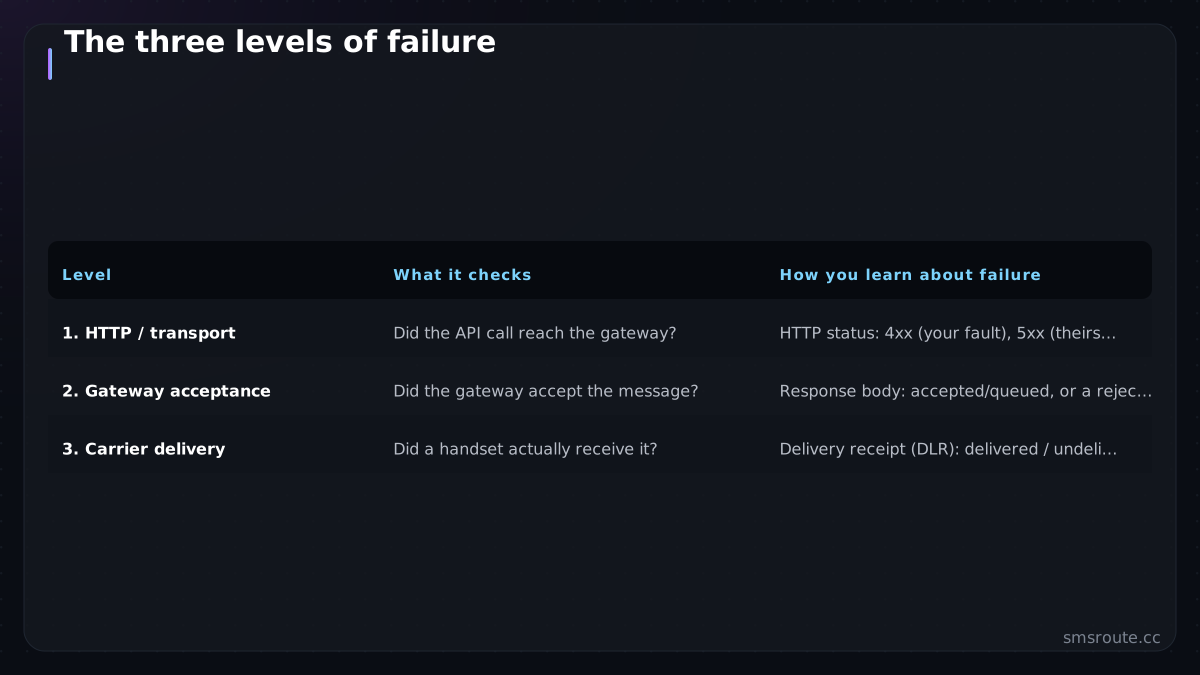
| Level | What it checks | How you learn about failure |
|---|---|---|
| 1. HTTP / transport | Did the API call reach the gateway? | HTTP status: 4xx (your fault), 5xx (theirs), timeout |
| 2. Gateway acceptance | Did the gateway accept the message? | Response body: accepted/queued, or a rejection reason |
| 3. Carrier delivery | Did a handset actually receive it? | Delivery receipt (DLR): delivered / undelivered / expired |
Each level has its own failure modes and its own response. A 4xx at level one is a bug in your request: bad number (not in E.164 format), missing auth, insufficient balance. Retrying won't fix that. A 5xx or timeout is transient, so you retry with backoff and an idempotency key. Level two rejections (invalid number format, blocked content, carrier filtering) come back in the response body and need per-reason handling. And level three, the one everyone forgets, only arrives later via a delivery receipt webhook. That's the only plac
Handling each level correctly
How do you handle each level of SMS API failure correctly?
For HTTP errors, retry with exponential backoff. For API errors, validate your request parameters and check your balance. For delivery failures, use SMSRoute's real-time DLR webhooks to trigger fallback routes or notify users. Our adaptive multi-route delivery automatically retries via alternative carriers, minimizing manual intervention.
- Level 1 — classify the HTTP result2xx: proceed to check the body. 4xx: fix the request, don't retry (it'll fail identically). 5xx/timeout: retry with exponential backoff and an idempotency key so the retry can't duplicate.
- Level 2 — read the response bodyA 200 with a 'queued' status and a message id is acceptance; a 200 wrapping a rejection is not. Parse the body, store the message id for reconciliation, and handle rejection reasons (validate the number, top up balance) specifically.
- Level 3 — reconcile delivery receiptsTrack the message id against incoming DLRs. 'delivered' is success; 'undelivered'/'failed'/'expired' means the accepted message didn't land. Trigger a resend, alternate channel, or number validation (HLR lookup) depending on the reason.
- Alert on trends, not singlesOne failure at any level is noise; a cluster (5xx spike, rejection surge, DLR failures on one route) is a signal. Feed all three levels into monitoring.
The mental model that fixes most integrations: validate before you send, retry only what's actually retryable, and reconcile against delivery receipts afterward.
Building it in
How do you build robust SMS API error handling into your application?
Integrate SMSRoute's REST API with our code examples in Python, PHP, Go, or Node. Implement retry logic for HTTP errors, validate API responses, and subscribe to DLR webhooks for delivery status. Our 99.9% uptime and automatic failover ensure your error handling is minimal—focus on your app, not on debugging SMS.
The three levels map cleanly onto the integration patterns: level one is send-and-retry, level two is parse-and-store, level three is reconcile-via-webhook. Wire all three from the start and your error handling is production-grade; skip level three and you'll believe a 96% 'sent' rate while a chunk of it never arrived — the exact trap the delivery benchmark warns about. For authoritative guidance on SMS error handling, the IETF RFC 5724 defines the SMS submission and delivery notification framework, and the GSMA's SMS guidelines provide industry standards for message delivery.
SMSRoute is a no-KYC SMS API with crypto billing (BTC, ETH, USDT, XMR, LTC, and SOL), and it returns what all three levels need: honest HTTP statuses, clear acceptance/rejection response bodies, and auditable handset delivery receipts. The API does its part; the three-level handling is yours to build, and it's what turns 'the call returned 200' into 'the user actually got their code'. Treat every send as three facts, not one, and the silent failures that quietly break OTP flows (like 2FA or TOTP) become visible, handled events instead. SMSRoute's published route pages list delivery from $0.004/message (premium direct-carrier corridors up to $0.035) with sub-100ms median submission and ~98.6% delivered success (smsroute.cc route pages, 2026).
Related reading
FAQ
Does a 200 OK mean my SMS was delivered?
What are the three levels of SMS error handling?
Should I retry a failed SMS send?
How do I know if an accepted SMS actually failed to deliver?
Send your first SMS in 5 minutes
No KYC. Pay with BTC, ETH, USDT, XMR, LTC, and SOL. Live routes to 149 countries.
Get an API key →