Brazil is a short-code, consent-first market
An SMS API in Brazil means adapting to two structural facts most markets don't share. First, there are no long codes for A2P traffic. Everything routes through short codes, and for A2P the sender ID gets changed to a short code to ensure delivery (ANATEL, 2026). Second, consent is strict. Brazil's LGPD data law, the Consumer Defense Code, and ANATEL's rules together demand prior, documented opt-in for any commercial SMS, with the ANPD data authority enforcing it. Registration takes roughly 10 weeks. Fines reach 2% of revenue, capped at R$50 million per infraction. This involves submitting company documents like your EIN and business license to each carrier individually, then waiting for their separate approval. In 2023, Telekall Infoservice was fined R$ 1.5 million for sending SMS without consent. The penalty was reduced on appeal.
Here's what Brazil requires: the short-code reality, the consent regime, and the timing rules. And how to send there compliantly.
SMSRoute's published route page for Brazil lists direct-carrier delivery via Vivo, Claro, TIM from $0.018/message, with 104ms median submission and 98.1% delivered success (smsroute.cc route pages, 2026).
The rules that define Brazilian SMS
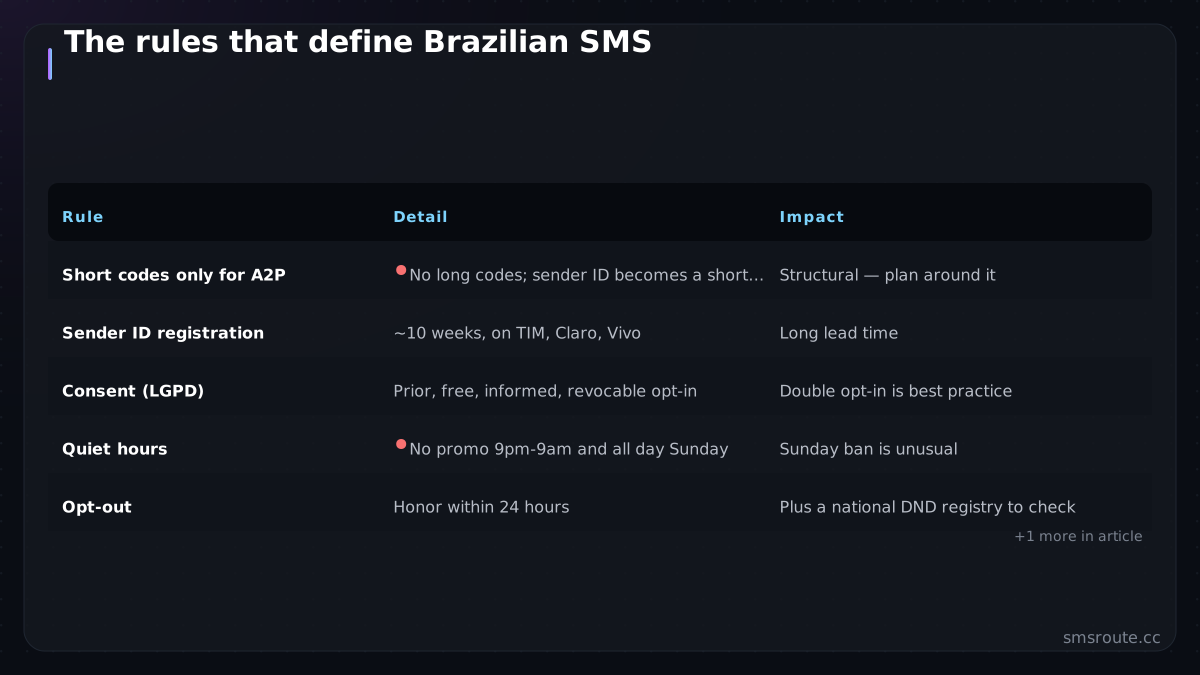
| Rule | Detail | Impact |
|---|---|---|
| Short codes only for A2P | No long codes; sender ID becomes a short code | Structural — plan around it |
| Sender ID registration | ~10 weeks, on TIM, Claro, Vivo | Long lead time |
| Consent (LGPD) | Prior, free, informed, revocable opt-in | Double opt-in is best practice |
| Quiet hours | No promo 9pm-9am and all day Sunday | Sunday ban is unusual |
| Opt-out | Honor within 24 hours | Plus a national DND registry to check |
| Fines | Up to 2% revenue, capped R$50M/infraction | LGPD enforcement is real |
Two rules surprise senders. The all-day-Sunday promo ban, on top of 9pm-9am daily quiet hours, is stricter than most markets. And the national DND registry means that even with valid opt-in, you must check the do-not-disturb list before each campaign. Consent alone isn't enough. On the data side, LGPD wants prior, free, informed, revocable consent. Double opt-in is best practice, with detailed records kept, because ANPD investigations and Procon claims follow unsolicited sending.
Sending to Brazil compliantly
- Plan the registration lead timeAlphanumeric sender-ID registration takes ~10 weeks on TIM, Claro, and Vivo. Like Indonesia, this is the critical-path item. Start well before launch.
- Get LGPD consent rightPrior, free, informed, revocable opt-in (double opt-in as best practice) with documented records. Brazil's data regime has real enforcement teeth; the consent discipline mirrors GDPR.
- Respect quiet hours AND SundaysNo promo 9pm-9am, and none at all on Sundays. Enforce it in scheduling by Brazilian local time. The Sunday rule is easy to miss.
- Check the DND registry each campaignEven opted-in contacts must be scrubbed against the national do-not-disturb list before every send, and opt-outs honored within 24 hours.
Content restrictions are strict too: adult, cannabis, controlled substances, contests/sweepstakes, and telecom-service promotions are prohibited. Combined with the short-code-only structure and LGPD consent, Brazil is a market where t
Sending to Brazil in practice
SMSRoute is a no-KYC SMS API with crypto billing (BTC, ETH, USDT, XMR, LTC, and SOL) serving the international route to Brazil, with live pricing on the send SMS to Brazil page. For transactional and OTP traffic, the international route delivers to Brazilian users. This is the workable path that doesn't wait on the ~10-week branded-short-code registration. The short-code-only A2P structure means your sender presentation follows Brazil's routing rules regardless of provider.
The honest framing for Brazil: transactional and OTP via the international route now; branded promotional short-code campaigns require the long registration and LGPD-compliant consent infrastructure, which is a domestic setup. Pair us for transactional with a Brazil-registration path for marketing. Get the LGPD consent rigorous, respect the quiet hours and the Sunday ban, scrub against the DND registry every campaign, and plan the 10-week registration early. Brazil is a substantial, reachable market. But one where, more than most, the compliance groundwork is the project, and the sending is the easy part once it's in place. For how this market fits the wider picture, see the global overview.
Related reading
FAQ
Does Brazil use long codes or short codes for SMS?
What consent is required for SMS marketing in Brazil?
How long does SMS sender ID registration take in Brazil?
When can't I send marketing SMS in Brazil?
Send your first SMS in 5 minutes
No KYC. Pay with BTC, ETH, USDT, XMR, LTC, and SOL. Live routes to 149 countries.
Get an API key →