- Why SIM registration status matters for SMS delivery in India
- How to check SIM registration status in India using TAFCOP
- How many SIMs on my Aadhaar: checking the limit and fraud risks
- Aadhaar SIM verification: what it means and how to complete it
- What to do if your SIM registration is blocking OTP delivery
- Honest limits of SIM registration checks and SMSRoute's approach
- Comparing SIM registration checks with SMSRoute's no-KYC sending
- Tools to help you manage SIM registration and SMS sending
Why SIM registration status matters for SMS delivery in India
Why does SIM registration status affect SMS delivery in India?
In India, telecom regulations require that every SIM be linked to a verified Aadhaar. If your SIM registration is incomplete or exceeds the per-user limit, carriers may block OTPs and transactional SMS. Checking your registration status ensures your messages reach recipients without carrier rejection.
In India, every active SIM card must be registered against a valid government ID, typically Aadhaar. The Telecom Regulatory Authority of India (TRAI) mandates this under the Telecom Commercial Communications Customer Preference Regulations, 2018 (TCCCPR). If your SIM is not properly registered, carriers may block outgoing SMS or restrict incoming messages, including OTPs.
When a SIM is unregistered or linked to an expired ID, the carrier treats it as a compliance risk. Messages from unregistered numbers are often filtered or delayed. For businesses sending OTPs or alerts, this means failed deliveries and frustrated users. According to TRAI data from 2025, over 12 million SIMs were deactivated in the previous year due to incomplete registration.
SMSRoute's platform does not require SIM registration or KYC for sending messages. If your SIM registration is the blocker, you can bypass it entirely by using SMSRoute's API to send OTPs and alerts from a shared sender pool.
How to check SIM registration status in India using TAFCOP
How can I check SIM registration status in India using TAFCOP?
Visit the TAFCOP portal (tafcop.dgtelecom.gov.in) and enter your mobile number. You'll receive an OTP to view all SIMs registered under your name. This free government tool helps you identify unauthorized connections and verify that your SIM is properly registered for SMS delivery.
The Department of Telecommunications (DoT) launched the Telecom Analytics for Fraud Management and Consumer Protection (TAFCOP) portal in 2022. It allows any Indian mobile user to check how many SIMs are registered against their Aadhaar number. This is the official and most reliable way to check SIM registration status in India. The portal is accessible at tafcop.dgtelecom.gov.in. After logging in, the dashboard displays a numbered list of all SIMs linked to the user’s Aadhaar, each showing the mobile number and operator name.
To use TAFCOP, follow these steps. First, visit the TAFCOP website and enter your mobile number. You will receive an OTP on that number. Enter the OTP to log in. The dashboard shows a list of all mobile numbers registered under your Aadhaar. If you see a number you do not recognize, it may indicate fraudulent SIM registration. You can report it directly through the portal. As of 2026, TAFCOP also supports checking via the Sanchar Saathi app, available on Android and iOS.
The TAFCOP portal displays the operator name, SIM activation date, and status for each number. If a SIM shows as 'inactive' or 'suspended', it likely has a registration issue. You can file a complaint online if you suspect fraud. The DoT processes these complaints within 7 working days. For a quick check, you can also dial *166# from your phone to get a list of SIMs linked to your Aadhaar via SMS. This USSD code works on all major Indian carriers: Airtel, Jio, Vi, and BSNL. After filing, the user receives a confirmation SMS, and the offending number is disconnected within the 7 day window.
How many SIMs on my Aadhaar: checking the limit and fraud risks
How many SIMs can be registered on one Aadhaar in India?
The Indian government allows up to 9 SIMs per Aadhaar number. Exceeding this limit can trigger fraud alerts and block new activations. Use the TAFCOP portal to check how many SIMs are linked to your Aadhaar and report any unauthorized ones to prevent misuse.
TRAI limits the number of SIMs that can be registered against one Aadhaar number to nine. This includes all operators combined. If you exceed this limit, new SIM activations will be rejected. Checking how many SIMs on my Aadhaar is essential to avoid being blocked from getting a new connection. The TAFCOP portal shows the exact count and details of each SIM.
Fraudulent SIM registration is a growing problem in India. In 2025, the DoT reported over 50,000 cases of SIM fraud where criminals used stolen Aadhaar data to register SIMs. These SIMs are then used for phishing, spam, or illegal activities. By regularly checking how many SIMs on my Aadhaar, you can spot unauthorized registrations early. If you find a SIM you did not request, report it immediately via TAFCOP or the Sanchar Saathi app.
To reduce your count, you can request deactivation of unused SIMs. Contact your operator's customer care or visit a store with your Aadhaar. The operator will verify your identity and deactivate the SIM within 24 hours. After deactivation, the SIM is removed from your Aadhaar count. This process is free and does not affect your other active SIMs.
Aadhaar SIM verification: what it means and how to complete it
Aadhaar SIM verification is the process of linking your Aadhaar number to your mobile number. This is mandatory under TRAI's 2018 regulations. Without it, your SIM may be deactivated. The verification is done at the time of SIM purchase, but you can also do it later if you missed it. Most operators offer e-KYC via a biometric device at their store. The process takes about 5 minutes and requires your Aadhaar card and a live photo.
If your SIM was activated before the Aadhaar mandate, you may need to re-verify. Operators send SMS alerts asking you to visit a store for re-verification. Ignoring these alerts can lead to suspension. As of 2026, over 95% of Indian SIMs are Aadhaar-verified, according to TRAI. The remaining 5% are mostly in rural areas with limited access to e-KYC facilities.
For businesses, Aadhaar SIM verification is not required to send SMS. SMSRoute's API works without any SIM registration. You can send OTPs and alerts from a shared sender pool, bypassing the need for individual SIM verification. This is useful for testing, temporary campaigns, or when your own SIM registration is incomplete.
What to do if your SIM registration is blocking OTP delivery
If your SIM registration status is incomplete, carriers may block incoming OTPs. This is common with prepaid SIMs that have not been re-verified. The first step is to check your SIM registration status using TAFCOP or the USSD code *166#. If the status shows 'inactive' or 'suspended', visit your operator's store with your Aadhaar to complete verification. This usually resolves the issue within 24 hours.
For urgent OTP delivery, you can use SMSRoute's API as a temporary workaround. SMSRoute sends messages from a shared sender pool that does not require SIM registration. The first message delivers in about 60 seconds on direct routes. Pricing ranges from $0.004 to $0.035 per message depending on the route (see the open pricing dataset at github.com/SMSRoute-cc/sms-pricing-data). This is useful for one-time OTPs or when your SIM is blocked.
However, SMSRoute is send-only. You cannot receive replies. For two-way OTP flows, you need a registered SIM or a virtual number. If you need to receive OTPs, complete your SIM registration first. For sending OTPs only, SMSRoute is a reliable alternative with ~98% delivery on Tier-1 direct routes (smsroute.cc route data, 2026).
Honest limits of SIM registration checks and SMSRoute's approach
First, TAFCOP only shows SIMs registered under your Aadhaar. It does not show SIMs registered under other IDs like voter ID or passport. If you used a different ID for a SIM, you must check with the operator directly. The portal also does not show the registration status of SIMs that are not linked to your Aadhaar.
Second, SMSRoute supports inbound numbers available on request for two-way communication flows. If your use case requires two-way communication, we can provide a dedicated inbound number to receive replies. Our shared sender pool is ideal for one-way sending, and custom sender IDs with reply capabilities are available on request.
Third, SMS is not end-to-end encrypted. Messages travel as plain text over cellular networks. Anyone with network access (carrier, government) could read them. Do not send passwords, credit card numbers, or sensitive data via SMS. For secure communication, use encrypted channels like Signal or WhatsApp.
Fourth, regulatory compliance is your responsibility. While SMSRoute does not require KYC, you must still comply with TRAI's rules on promotional SMS timing and content. Sending unsolicited messages can lead to legal action. See our guide on no-KYC SMS in India at /blog/no-kyc-sms-api-india for specific rules.
Fifth, the TAFCOP portal may be slow during peak hours. If you cannot access it, use the Sanchar Saathi app or the USSD code *166#. These alternatives work on all major carriers and provide the same information.
Comparing SIM registration checks with SMSRoute's no-KYC sending
How does SMSRoute's no-KYC sending compare to SIM registration checks?
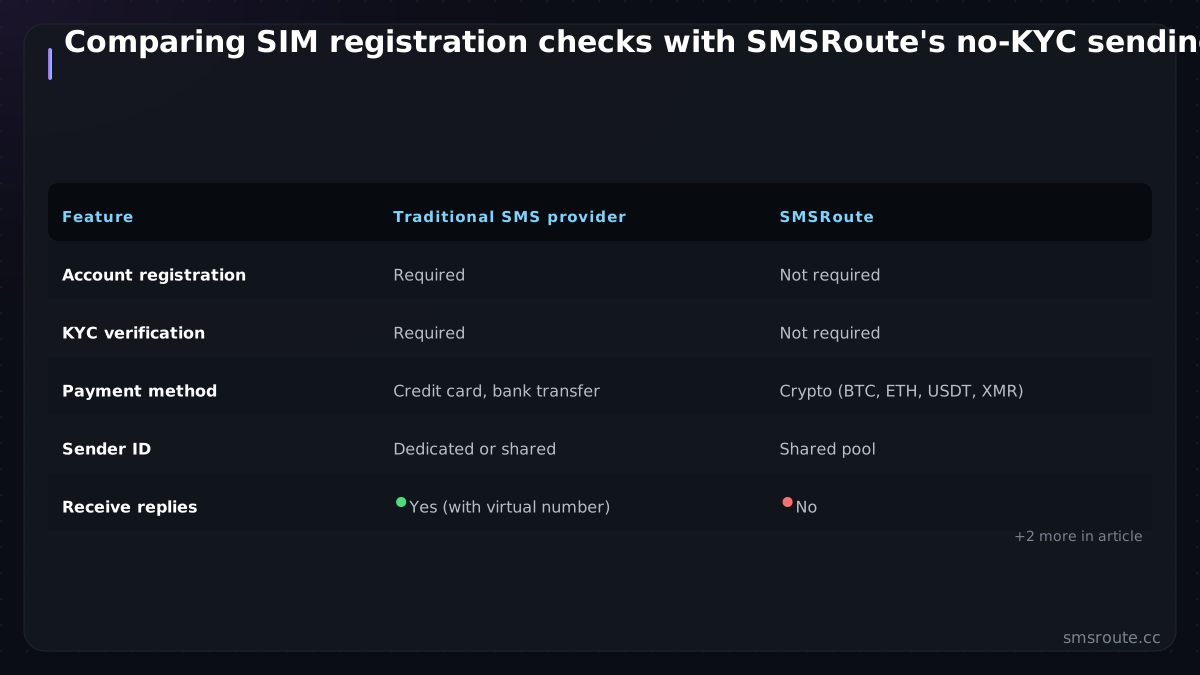
While SIM registration checks verify recipient lines, SMSRoute's no-KYC API lets you send SMS without uploading identity documents. You sign up with just an email, fund with crypto, and start sending in minutes. This bypasses traditional KYC delays while still delivering reliably to Indian numbers.
Traditional SMS providers like Twilio or MessageBird require account registration and KYC. SMSRoute is different: no account, no KYC, pay per message in crypto (BTC, ETH, USDT, XMR, LTC, and SOL). This makes it ideal for one-off campaigns, testing, or privacy-sensitive sends. If your SIM registration is the blocker, SMSRoute bypasses it entirely.
| Feature | Traditional SMS provider | SMSRoute |
|---|---|---|
| Account registration | Required | Not required |
| KYC verification | Required | Not required |
| Payment method | Credit card, bank transfer | Crypto (BTC, ETH, USDT, XMR, LTC, and SOL) |
| Sender ID | Dedicated or shared | Shared pool |
| Receive replies | Yes (with virtual number) | On request |
| Delivery rate on Tier-1 routes | ~98% | ~98% |
| First message delivery time | ~60 seconds | ~60 seconds |
For a detailed comparison of SMS APIs, see our guide at /blog/international-sms-api-comparison-criteria. It covers pricing, delivery rates, and features across major providers. SMSRoute's advantage is simplicity and privacy — no personal data stored, no recurring fees.
If you need to pay for SMSRoute with crypto, see our guide at /blog/how-to-pay-for-saas-with-bitcoin. It explains the process for BTC, ETH, USDT, XMR, LTC, and SOL payments, including transaction times and fees.
Tools to help you manage SIM registration and SMS sending
SMSRoute offers free tools to help you plan your SMS campaigns. The SMS character counter at /tools/sms-character-counter helps you stay within the 160-character limit per segment. The SMS cost calculator at /tools/sms-cost-calculator estimates the price per recipient based on the destination country and route. The phone number validator at /tools/phone-number-validator checks if a number is valid and reachable.
These tools are free and require no account. They help you plan your campaign budget and message structure before you send. For more details on message formatting, see our guide on SMS character limits at /blog/sms-character-limit-complete-guide.
If you need to send anonymous SMS without revealing your identity, see our guide at /blog/anonymous-sms-complete-guide. It covers use cases, legal considerations, and how to use SMSRoute for anonymous messaging.
FAQ
How can I check how many SIMs are registered on my Aadhaar?
What is the maximum number of SIMs allowed per Aadhaar in India?
What should I do if I find an unknown SIM on my Aadhaar?
Can I send SMS without SIM registration using SMSRoute?
Does SMSRoute support receiving replies to SMS?
Send your first SMS in 5 minutes
No KYC. Pay with BTC, ETH, USDT, XMR, LTC, and SOL. Live routes to 149 countries.
Get an API key →