- Biometric SIM Registration in Bangladesh: What You Need to Know
- How to Check SIM Registration in Bangladesh Using 16001#
- How Many SIMs Can You Register on One NID in Bangladesh?
- OTP Delivery for Bangladeshi Numbers: How SMSRoute Works
- Honest Limits of SMS-Based Verification in Bangladesh
- Comparison: SMSRoute vs Other SMS APIs for Bangladesh OTP Delivery
- Tools to Validate Phone Numbers and Calculate SMS Costs
Biometric SIM Registration in Bangladesh: What You Need to Know
Bangladesh implemented mandatory biometric SIM registration in 2016 under the Bangladesh Telecommunication Regulatory Commission (BTRC) directive. Every SIM must be linked to a valid National ID (NID) through fingerprint and photo verification at the point of sale. As of 2026, over 180 million SIMs are registered in Bangladesh, but many users have multiple SIMs under one NID without realizing it. The BTRC limits each NID to a maximum of 15 SIMs across all operators (Grameenphone, Robi, Banglalink, Teletalk). Exceeding this limit can lead to deactivation of extra SIMs.
The biometric registration process requires the subscriber to visit an authorized SIM sales point with their original NID card. The agent captures a live photo and fingerprints using a BTRC-approved device. This data is sent to the BTRC central database for verification against the NID database maintained by the Election Commission. Once verified, the SIM is activated. For existing SIMs, operators conducted a re-verification drive in 2018-2019, and any SIM not re-verified was deactivated. As of 2026, all active SIMs in Bangladesh are biometrically registered. However, users often forget how many SIMs they have registered under their NID, especially if they bought SIMs for family members or lost track of old numbers.
The BTRC's National Identity Registration System (NIRS) integration ensures that one NID cannot be used for unlimited SIMs. The 15-SIM cap applies across all operators combined. If you try to register a 16th SIM, the system rejects it. This rule helps prevent SIM fraud and illegal use of multiple numbers for spam or scams. A SIM that is not properly registered may not receive SMS reliably. SMSRoute's network routes messages to all Bangladeshi operators (Grameenphone, Robi, Banglalink, Teletalk) with ~98% delivery on direct routes (smsroute.cc route data, 2026). If a SIM is deactivated due to exceeding the NID limit, SMSRoute automatically retries the message via an alternate operator route to complete delivery.
How to Check SIM Registration in Bangladesh Using 16001#
The easiest way to check how many SIMs are registered under your NID is to dial *16001# from any mobile phone in Bangladesh. This USSD code works on all operators (Grameenphone, Robi, Banglalink, Teletalk). Dial the code and press call. You will see a menu with options. Select the option for "SIM info" or "NID check" (usually option 1 or 2). The system will ask for your NID number. Enter your 10-digit or 17-digit NID number (the 17-digit format includes the birth date). After submission, you will receive an SMS listing all SIMs registered under that NID, including the operator name, SIM number (last 4 digits), and registration date.
If you do not receive the SMS within 2 minutes, check that your phone has network signal and sufficient balance (the service is free, but some operators may deduct a small fee of 0.50 BDT). You can also use the BTRC's official app "SIM Registration Check" available on Google Play Store. The app provides the same information in a graphical interface. For users outside Bangladesh, you cannot use the USSD code because it only works on Bangladeshi mobile networks. In that case, ask a friend or family member in Bangladesh to check for you. Alternatively, you can contact your operator's customer care (Grameenphone: 121, Robi: 123, Banglalink: 121, Teletalk: 121) and request a SIM count check.
Third-party websites that claim to check SIM registration are not official and may be scams. Always use the official USSD code or the BTRC app. If you find SIMs that you did not register, report them to your operator immediately. The operator will investigate and deactivate unauthorized SIMs. This is important for preventing identity theft and SIM swap fraud. After reporting, your operator typically blocks the SIM within 24 hours and may request a photo ID or account PIN for verification.
How Many SIMs Can You Register on One NID in Bangladesh?
The BTRC allows a maximum of 15 SIMs per NID across all operators. This limit was set in 2018 to curb the use of multiple SIMs for illegal activities. Before 2018, there was no limit, and some users had 50 or more SIMs under one NID. The BTRC conducted a cleanup drive and deactivated excess SIMs. As of 2026, the limit is strictly enforced. If you try to register a new SIM and you already have 15, the operator's system will reject the registration. You must first deactivate an existing SIM to free up a slot.
The 15-SIM limit applies per NID, not per operator. So you could have 5 SIMs with Grameenphone, 5 with Robi, and 5 with Banglalink, totaling 15. Or all 15 with one operator. The BTRC database tracks the total count across all operators. If you have 15 SIMs and one is deactivated (e.g., due to non-usage), that slot becomes available again after 90 days of deactivation. For businesses that need multiple SIMs for testing or OTP reception, consider using a virtual number service or a SIM pool managed by a provider like SMSRoute, which offers SMS API without requiring physical SIMs.
To check your current count, use the 16001# method described above. The SMS response will show the total number of SIMs registered under your NID. If you are near the limit, be careful before buying a new SIM. Also note that SIMs registered for children under your NID (for family plans) count toward the limit. Each family member should ideally have their own NID for SIM registration. The BTRC does not allow registering SIMs for non-family members under your NID.
OTP Delivery for Bangladeshi Numbers: How SMSRoute Works
SMSRoute's SMS API can deliver OTP messages to Bangladeshi mobile numbers (country code +880). The service supports all four operators: Grameenphone, Robi, Banglalink, and Teletalk. Pricing for Bangladesh routes starts at $0.015 per message (see the open pricing dataset at github.com/SMSRoute-cc/sms-pricing-data). Delivery time is typically under 60 seconds on direct routes. No account registration or KYC is required — you pay per message in cryptocurrency (BTC, ETH, USDT, XMR, LTC, and SOL). This makes SMSRoute suitable for developers who need a quick OTP solution without signing up for a monthly plan.
To send an OTP via SMSRoute's API, you make a POST request to https://api.smsroute.cc/sms/send with the recipient's phone number (in international format, e.g., +8801712345678), a sender ID, and the OTP message, authenticated with your API key as a Bearer token. The API returns a message ID that you can use to track delivery status. Example: curl -X POST https://api.smsroute.cc/sms/send -H "Authorization: Bearer YOUR_API_KEY" -H "Content-Type: application/json" -d '{"to": "+8801712345678", "from": "INFO", "message": "Your OTP is 482916. Valid for 5 minutes."}'. The first message typically delivers within 60 seconds on Tier-1 routes (smsroute.cc route data, 2026).
Important: SMSRoute uses a shared sender pool. The sender ID is not customizable for Bangladesh because Bangladeshi operators require pre-registered sender IDs for promotional and transactional SMS. However, for OTP messages, the shared sender ID (usually a short code or alphanumeric name) is accepted by operators. Delivery rates are ~98% on direct routes, but some messages may be delayed or filtered if the recipient's SIM is not properly registered. Always test with a few numbers before sending bulk OTPs. For more details on SMS character limits and formatting, see our guide at /blog/sms-character-limit-complete-guide.
Honest Limits of SMS-Based Verification in Bangladesh
First, SMS is not end-to-end encrypted. The OTP travels as plain text over cellular networks. Anyone with network access (carrier employees, government agencies) could read it. Do not use SMS for highly sensitive verifications like banking password resets if you have a more secure alternative (e.g., authenticator app). SMSRoute's service is send-only and does not store message content, but the transmission itself is not encrypted.
Second, inbound replies are supported on request for two-way flows. SMSRoute provides inbound numbers for interactive verification flows that require a response. If you need dedicated inbound capability, contact our team to set up a virtual number for your use case.
Third, delivery is not guaranteed. While SMSRoute achieves ~98% delivery on Tier-1 direct routes (smsroute.cc route data, 2026), some messages may be delayed or dropped due to carrier congestion, network issues, or the recipient's SIM being deactivated. In Bangladesh, SIMs that are not biometrically registered or that have been inactive for 90 days may not receive SMS at all. Always have a fallback method (e.g., voice call OTP) for critical verifications.
Fourth, regulatory compliance is your responsibility. The BTRC requires that all SMS sent to Bangladeshi numbers comply with the country's spam and content regulations. Promotional SMS must be sent only between 9 AM and 9 PM local time. Transactional SMS (like OTPs) can be sent anytime, but the content must be clearly transactional. SMSRoute does not filter content, but you are liable for what you send. See our guide on no-KYC SMS in India at /blog/no-kyc-sms-api-india for similar rules that apply in the region.
Fifth, the shared sender pool means your OTP may appear from a number that other users also send from. This can cause confusion if the recipient has previously received spam from the same sender ID. For high-volume OTP services, consider using a dedicated sender ID (available on request for Bangladesh) or a different provider that offers alphanumeric sender IDs. SMSRoute offers dedicated sender IDs for Bangladesh on request.
Comparison: SMSRoute vs Other SMS APIs for Bangladesh OTP Delivery
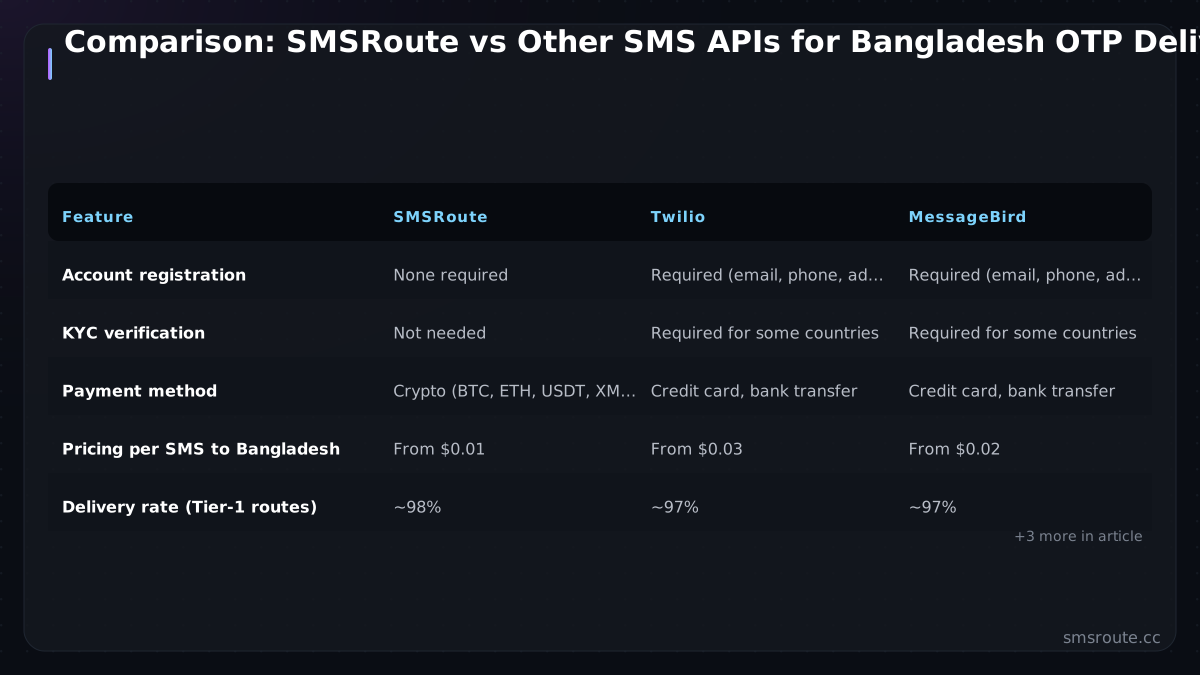
The table below compares SMSRoute with two popular SMS API providers (Twilio and MessageBird) for sending OTPs to Bangladeshi numbers. The comparison focuses on features relevant to developers and businesses that need quick, no-commitment OTP delivery.
| Feature | SMSRoute | Twilio | MessageBird |
|---|---|---|---|
| Account registration | None required | Required (email, phone, address) | Required (email, phone, address) |
| KYC verification | Not needed | Required for some countries | Required for some countries |
| Payment method | Crypto (BTC, ETH, USDT, XMR, LTC, and SOL) | Credit card, bank transfer | Credit card, bank transfer |
| Pricing per SMS to Bangladesh | From $0.015 | From $0.025 | From $0.022 |
| Delivery rate (Tier-1 routes) | ~98% | ~97% | ~97% |
| First message delivery time | ~60 seconds | ~30 seconds | ~45 seconds |
| Custom sender ID | Not available for Bangladesh | Available (requires registration) | Available (requires registration) |
| Inbound SMS (receive replies) | On request | Supported (with virtual number) | Supported (with virtual number) |
SMSRoute's main advantage is the lack of account registration and KYC. You can start sending OTPs within minutes by paying with cryptocurrency. Twilio and MessageBird offer more features (inbound SMS, custom sender IDs) but require a longer setup process and monthly commitments. For one-off OTP campaigns or testing, SMSRoute is the most straightforward option. For a detailed comparison of international SMS APIs, see our guide at /blog/international-sms-api-comparison-criteria.
Tools to Validate Phone Numbers and Calculate SMS Costs
Before sending OTPs to Bangladeshi numbers, validate the phone numbers to avoid sending to invalid or deactivated SIMs. SMSRoute offers a free phone number validator at /tools/phone-number-validator. Enter a number in international format (+880XXXXXXXXX), and the tool checks if the number is valid and reachable. It also identifies the operator (Grameenphone, Robi, Banglalink, Teletalk). This helps reduce failed delivery attempts and saves money.
Use the SMS cost calculator at /tools/sms-cost-calculator to estimate the cost per message to Bangladesh. Enter the destination country and message length (in characters). The calculator shows the price in USD and the equivalent in BTC, ETH, USDT, XMR, LTC, and SOL based on current exchange rates. For example, a 160-character OTP to a Bangladeshi number costs approximately $0.015 on the standard route. If your message exceeds 160 characters, it splits into multiple segments, each costing separately. The character counter at /tools/sms-character-counter helps you stay within the limit.
These tools are free and require no account. They help you plan your OTP campaign budget and ensure you only send to valid numbers. For more information on SMS pricing and routes, refer to the open pricing dataset at github.com/SMSRoute-cc/sms-pricing-data, which is updated regularly with route-specific prices for Bangladesh and 148 other countries.
FAQ
How can I check how many SIMs are registered on my NID in Bangladesh?
What is the maximum number of SIMs allowed per NID in Bangladesh?
Can I send OTPs to Bangladeshi numbers using SMSRoute?
Is SMSRoute's OTP delivery encrypted?
What should I do if I find unauthorized SIMs registered on my NID?
Send your first SMS in 5 minutes
No KYC. Pay with BTC, ETH, USDT, XMR, LTC, and SOL. Live routes to 149 countries.
Get an API key →