What SNA does that a code can't
Silent Network Authentication verifies that the phone number a user claims belongs to the SIM physically in their device. No code, no tap, no message. The app asks the carrier, over the mobile data connection, to cryptographically confirm the SIM's identity. An answer returns in one to four seconds, invisibly. Because there is no passcode anywhere in the flow, there is nothing for a fraudster to phish or intercept. That is the pitch, and it is a real one: SNA closes the exact hole (phishing proxies, SIM-swap-adjacent interception) that got SMS OTP restricted by NIST (see NIST SP 800-63B).
We sell SMS delivery. We will still tell you SNA is genuinely better for what it does. But 'what it does' has hard edges, and the honest comparison is about those edges, not a winner.
The trade-off table
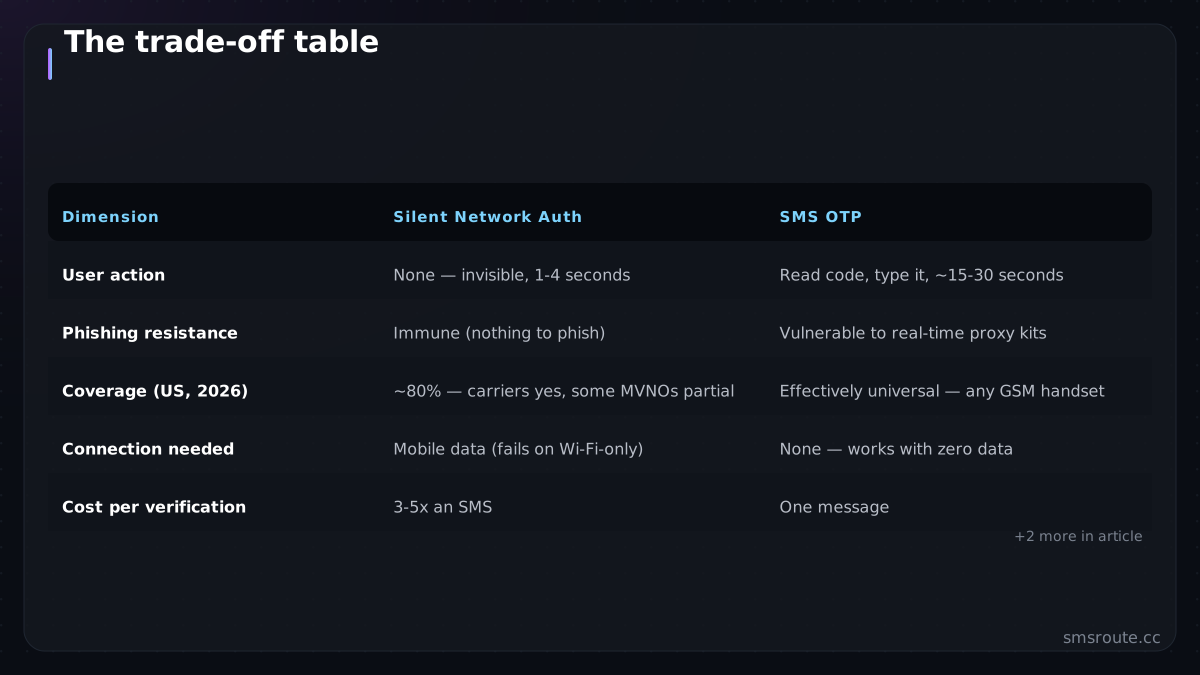
| Dimension | Silent Network Auth | SMS OTP |
|---|---|---|
| User action | None (invisible, 1-4 seconds) | Read code, type it, ~15-30 seconds |
| Phishing resistance | Immune (nothing to phish) | Vulnerable to real-time proxy kits |
| Coverage (US, 2026) | ~80% (carriers yes, some MVNOs partial) | Effectively universal (any GSM handset) |
| Connection needed | Mobile data (fails on Wi-Fi-only) | None (works with zero data) |
| Cost per verification | 3-5x an SMS | One message |
| Standards | GSMA Mobile Connect, CAMARA, Aduna gateway | Ubiquitous, decades old |
| Conversion at the step | 30-40% higher completion (vendor data) | Baseline |
The two edges that decide most deployments: SNA needs an active mobile data connection (a user on Wi-Fi with mobile data off cannot be verified), and it covers ~80% of users, not all. Both gaps have the same fix: fall back to SMS.
Why the honest answer is 'both'
SNA's coverage gap and data requirement are not flaws to wait out. They are structural. A user on hotel Wi-Fi with mobile data off, on an MVNO the carrier gateway doesn't cover, or on a device that just dropped to no signal, cannot complete SNA. For those users something has to catch the request, and the universal catcher is SMS: any handset, no data plan, no coverage gap. So the 2026 pattern is not SNA *or* SMS. It is SNA first, SMS as the fallback that makes SNA deployable at all.
The economics reinforce it. SNA costs 3-5x an SMS but lifts completion 30-40% at the verification step, so it pays off when a verified user is worth more than about fifty cents (high-LTV signups, fintech, marketplaces). For low-value or high-volume verification, paying 3-5x on every attempt is hard to justify, and SMS-first with SNA reserved for step-up may invert the stack. Neither ordering is wrong; it depends on your unit economics.
Designing the pairing
- Try SNA when the value justifies itFor high-LTV flows, attempt silent auth first: best case, the user is verified before they notice. Gate it on having mobile data available.
- Fall back to SMS on any SNA missNo coverage, no data, unsupported carrier, or a timeout → send an SMS OTP immediately. This is the same universal-reach fallback role SMS plays for passkeys and WhatsApp OTP.
- Share one verification stateWhichever channel confirms the number, the outcome lands in one place in your backend. Rate-limit the SMS fallback per number so it does not become an unguarded pumping target.
- Measure completion per pathTrack SNA success rate, fallback rate, and end-to-end completion. If fallback is firing more than ~20% of the time, your audience's coverage or connectivity is telling you SMS is carrying more load than the SNA pitch assumed.
SMSRoute is a no-KYC SMS API with crypto billing (BTC, ETH, USDT, XMR, LTC, and SOL), and our role in the SNA story is the universal-reach layer that catches the 20% and the no-data users SNA structurally cannot — the essential complement that makes any verification flow complete. We are not going to tell you SNA is hype; it is the better front door where it reaches. We are going to deliver the messages for everyone it misses, which is why 'both' beats 'either' for any serious verification flow in 2026. SMSRoute's published route pages list delivery from $0.004/message (premium direct-carrier corridors up to $0.035) with sub-100ms median submission and ~98.6% delivered success (smsroute.cc route pages, 2026).
FAQ
What is Silent Network Authentication?
Is SNA better than SMS OTP?
Why does Silent Network Authentication need mobile data?
Should I replace SMS OTP with SNA?
Send your first SMS in 5 minutes
No KYC. Pay with BTC, ETH, USDT, XMR, LTC, and SOL. Live routes to 149 countries.
Get an API key →