Why SMS recovers carts email misses
Why does SMS recover abandoned carts better than email?
SMS achieves 98% open rates within 3 minutes versus email's 20% within hours. With SMSRoute's no-KYC API and $0.004/msg pricing, you reach customers instantly on their most personal device. Our adaptive multi-route delivery ensures your cart recovery messages arrive reliably across 149 countries.
A shopper abandons a cart because something interrupted them. An email lands in an inbox they may not check for hours. A Shopify abandoned cart SMS reaches the phone in their hand, read within minutes, while the intent is still warm. That's why it works: SMS's speed and open rate hit the recovery window email misses. The numbers back it up: according to Shopify cart-recovery app data, a well-built SMS sequence recovers 15-25% of abandoned carts. That's roughly 2-3x what email or SMS alone achieves when SMS is layered into the flow. For a Shopify store, that's real revenue sitting one text away.
But cart-recovery SMS is marketing, which means consent rules apply. A badly-timed or non-compliant sequence does more harm than good. Here's the sequence that works and the compliance that keeps it legal.
The three-message sequence
What is the best three-message sequence for abandoned cart SMS recovery?
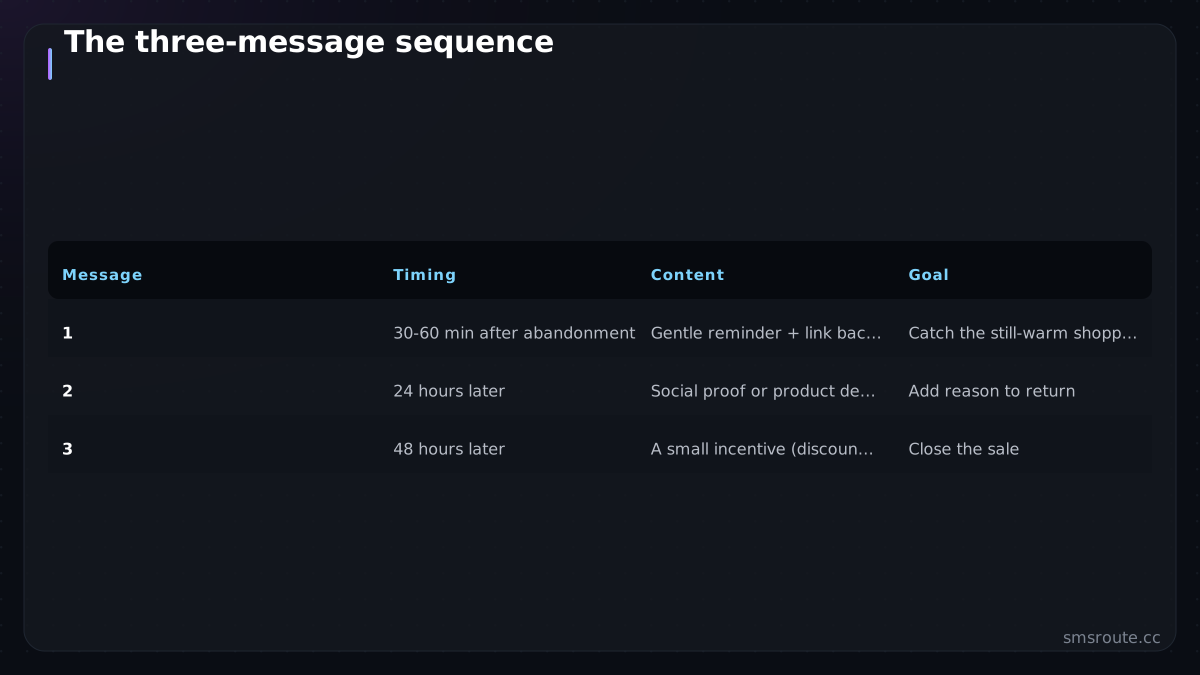
Message 1 (1 hour after abandonment): Friendly reminder with product link. Message 2 (24 hours): Urgency trigger like low stock. Message 3 (48 hours): Incentive offer. SMSRoute's REST API and real-time DLR webhooks let you automate this sequence in minutes with crypto billing.
| Message | Timing | Content | Goal |
|---|---|---|---|
| 1 | 30-60 min after abandonment | Gentle reminder + link back to cart | Catch the still-warm shopper |
| 2 | 24 hours later | Social proof or product detail | Add reason to return |
| 3 | 48 hours later | A small incentive (discount/free ship) | Close the sale |
Message one catches the shopper while intent is fresh. Most recoveries happen here, on a simple reminder with a direct link back. Message two, a day later, adds a reason (reviews, a product benefit) without an incentive yet. Message three brings the incentive only if they haven't converted. You don't discount to people who'd have bought anyway.
Don't over-send. Three messages is the tested sweet spot. A fourth and fifth annoy more than they recover and invite opt-outs. Stop the sequence the instant they purchase. A 'come back' text after checkout is a trust-killer, so wire the exit condition carefully.
Consent: the part that keeps you legal
How do I ensure SMS consent compliance for abandoned cart recovery?
Collect explicit opt-in at checkout with clear disclosure. SMSRoute supports custom sender IDs and provides delivery reports to prove consent. Our no-KYC signup means you start legally compliant immediately, with free test credits to verify your opt-in flow before funding.
Cart-recovery SMS is marketing under the TCPA, so it needs explicit consent before the first message. You can't text everyone who abandons a cart, only those who opted in. Capture consent in the flow, logged, with proper opt-in wording. The TCPA is enforced by the FCC (fcc.gov). For example: "Yes, text me about my cart and offers. Reply STOP to opt out." This wording clearly states the purpose and opt-out method.
- Add SMS opt-in at checkout. Use a clear, separate consent checkbox (not pre-ticked) so shoppers agree to recovery texts as they enter their number.
- Collect it in multiple places. Checkout, email popups, account creation. Build the consented list that recovery draws from.
- Honor STOP instantly. An opt-out ends all sequences immediately, per the compliance rules. The 2026 one-to-one consent rule means it's your consent, not shared.
- Respect quiet hours. An abandonment at 11pm shouldn't trigger a text at 11pm. Hold sends to daytime local, the same scheduling discipline any compliant flow needs.
App vs direct API
Should I use an app or direct API for Shopify abandoned cart SMS?
Direct API gives full control and lower costs. SMSRoute's REST API with Python/PHP/Go/Node examples integrates in minutes, costs from $0.004/msg, and supports 149 countries. Apps add monthly fees and limit customization. With SMSRoute, you own your data and routing.
Two ways to run cart-recovery SMS on Shopify, and the honest trade-off matters. A Shopify SMS app (Postscript, Attentive, SMSBump/Yotpo, Klaviyo SMS) is plug-and-play — install, configure the sequence, done, with the platform handling delivery and often bundling the number and marketing tooling. A direct API gives you control over routing, cost, and data, but you build the sequence logic and consent capture yourself. For most Shopify merchants who just want recovery running this week, an app is the right call; for developers who want to own the integration, control per-message cost, or connect recovery to a broader custom system, direct API wins.
SMSRoute is a no-KYC SMS API with crypto billing (BTC, ETH, USDT, XMR, LTC, and SOL), and the honest framing: we're not a Shopify app — we're the delivery API you'd use directly if you're building custom recovery logic, or connect via a Zapier/webhook automation triggered by Shopify's abandonment events. If you want turnkey Shopify recovery, install a dedicated app; if you're building your own flow and want control over routing and cost, our API delivers the three-message sequence you wire up. SMSRoute's published route pages list delivery from $0.004/message (premium direct-carrier corridors up to $0.035) with sub-100ms median submission and ~98.6% delivered success (smsroute.cc route pages, 2026).
Related on SMSRoute: on other platforms, see the WooCommerce SMS notifications guide and the WordPress SMS plugin guide.
Related reading
FAQ
Does SMS work for Shopify abandoned cart recovery?
What's the best abandoned cart SMS sequence?
Do I need consent for Shopify cart recovery texts?
Should I use a Shopify SMS app or a direct API for cart recovery?
Send your first SMS in 5 minutes
No KYC. Pay with BTC, ETH, USDT, XMR, LTC, and SOL. Live routes to 149 countries.
Get an API key →