Why teams look for a no-KYC OTP route
Why do developers choose a no-KYC SMS API for OTP delivery?
Developers choose no-KYC SMS APIs to avoid submitting identity documents, speed up onboarding, and maintain privacy. SMSRoute lets you sign up with just an email, fund with crypto, and start sending OTPs in minutes — no bureaucracy, no delays, and full control over your authentication flow.
Most mainstream SMS providers gate account activation behind Know-Your-Customer (KYC) checks: a registered business, a verified sender ID, and sometimes a use-case review that takes days. For a solo developer, a pre-launch product, or a privacy-focused team, that friction is a hard stop before a single OTP is sent.
A no-KYC SMS API removes the onboarding review from the critical path. You create an account, fund a balance, and send. The trade-offs are real and worth stating plainly: you are responsible for your own compliance with destination-country rules, and you should still follow OTP best practices (rate limiting, opt-in, message hygiene). What you gain is time-to-first-message measured in minutes, not days. For the authoritative reference, see the TCPA. For example, Twilio can take 24 to 72 hours to approve a sender ID, while a no-KYC API activates the same number in minutes.
No-KYC is about onboarding friction, not about ignoring the law. You remain responsible for lawful use, consent, and per-country sender rules wherever you deliver messages.
Send your first OTP in five steps
How do I send my first OTP SMS without KYC verification?
Sign up at SMSRoute with your email, top up with BTC/ETH/USDT, generate an API key, call the REST endpoint with the recipient number and OTP message, and monitor delivery via real-time webhooks. The entire process takes under five minutes with no document uploads required.
- Create an account and fund a balanceSign up and top up with a card or crypto (BTC, ETH, USDT, XMR, LTC, and SOL). Crypto billing means you can start without linking a bank identity, which is why it pairs naturally with a no-KYC flow.
- Grab your API keyCopy the key from your dashboard. Treat it like a password — put it in an environment variable, never in client-side code or a public repo.
- Generate the code server-sideCreate a 6-digit numeric code, store a hash of it against the user's session with a short TTL (5 minutes is typical), and never send the raw code back to the client.
- Send the SMS via the APIPOST the recipient number in E.164 format and your message body to the send endpoint. Keep the copy short and include your app name so carriers and users trust it.
- Verify and rate-limitOn submission, hash the user's input and compare to the stored hash. Cap attempts (e.g. 5) and re-sends (e.g. 1 per 60s) to control both fraud and spend.
The code (5 lines to send)
What code do I need to send an OTP SMS via API?
With SMSRoute, sending an OTP takes just five lines: set your API key, define the recipient and message, make a POST request to the /send endpoint, and handle the response. Example in Python: `requests.post(url, json={'to':'+1234567890','text':'Your OTP is 123456'}, headers={'X-API-Key':'your_key'})`.
A minimal Python example. Swap in your key and endpoint; the shape is the same in any language that can make an HTTPS POST.
import os, requests
resp = requests.post("https://api.smsroute.cc/sms/send",
    headers={"Authorization": f"Bearer {os.environ['SMSROUTE_KEY']}"},
    json={"to": "+15551234567", "from": "MyApp", "message": "Your MyApp code is 481902"})
print(resp.json())  # generic response object
For production, generate the code and message dynamically, and log the returned message id so you
can reconcile delivery status later.
Delivery, retries, and cost control
How does SMSRoute handle OTP delivery failures and costs?
SMSRoute automatically retries failed deliveries through alternative routes in 149 countries, with real-time DLR webhooks for status updates. Failed messages are credited back, and unused balance is refundable. Pricing starts at $0.004 per message, with transparent per-country rates up to $0.035.
- Use E.164 numbers (
+and country code). Malformed numbers are the top cause of silent OTP failures. - Poll or webhook delivery status. A
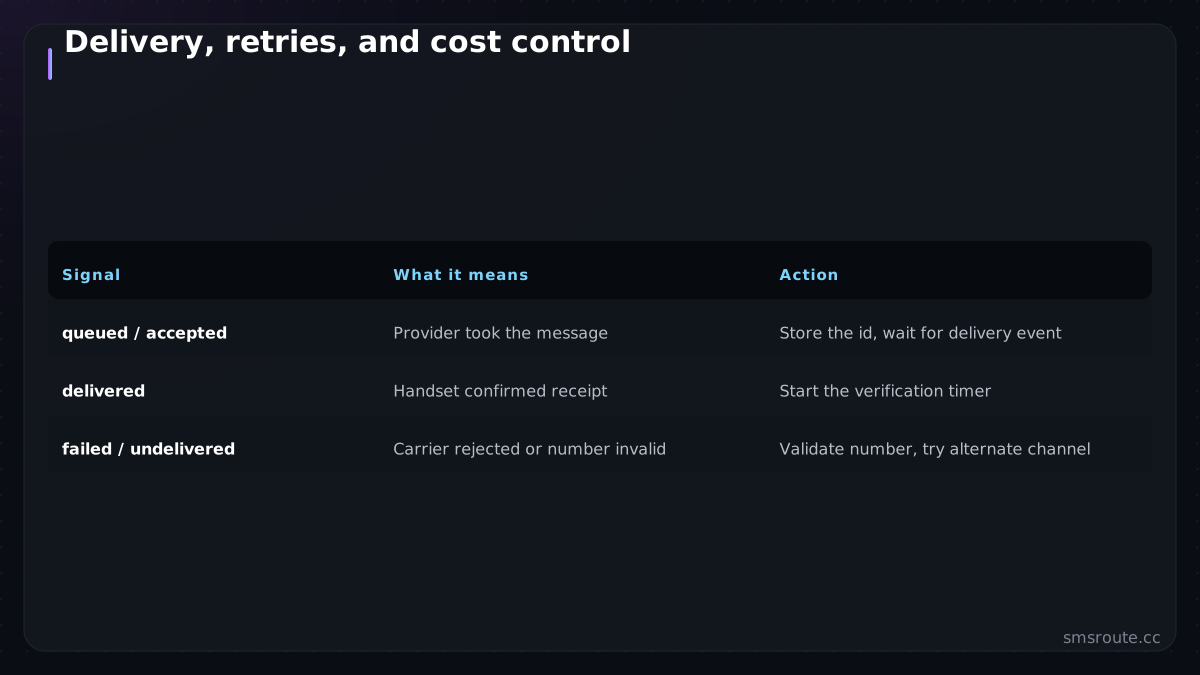
queuedresponse means accepted, not delivered. Reconcile against the message id. - One resend, then escalate. If the first SMS isn't confirmed in 60–90s, offer a resend once, then fall back to voice or email rather than spamming.
- Set a per-number send cap to blunt OTP-pumping fraud, where attackers trigger paid messages to premium ranges.
| Signal | What it means | Action |
|---|---|---|
| queued / accepted | Provider took the message | Store the id, wait for delivery event |
| delivered | Handset confirmed receipt | Start the verification timer |
| failed / undelivered | Carrier rejected or number invalid | Validate number, try alternate channel |
SMSRoute's published route pages list delivery from $0.004/message (premium direct-carrier corridors up to $0.035) with sub-100ms median submission and ~98.6%
FAQ
Is it legal to send OTP SMS without KYC?
How fast can I send my first message?
How do I keep OTP costs down?
Can I pay for OTP SMS with crypto?
Send your first SMS in 5 minutes
No KYC. Pay with BTC, ETH, USDT, XMR, LTC, and SOL. Live routes to 149 countries.
Get an API key →