What self-hosting actually means
A self-hosted SMS gateway versus an API is really a choice between two builds. The hardware route: a GSM modem (or a bank of them) with consumer SIM cards, driven by software like Gammu or an Android bridge app. The software route: Kannel or similar speaking SMPP upstream to a carrier or aggregator. Here you run the gateway but still buy delivery. The second is a legitimate architecture choice. The first is where the trouble lives, and it is what most 'free SMS server' tutorials describe.
The appeal is obvious: no per-message API fees, full control, works offline. All three are real. So are the costs the tutorials skip.
The costs nobody itemizes
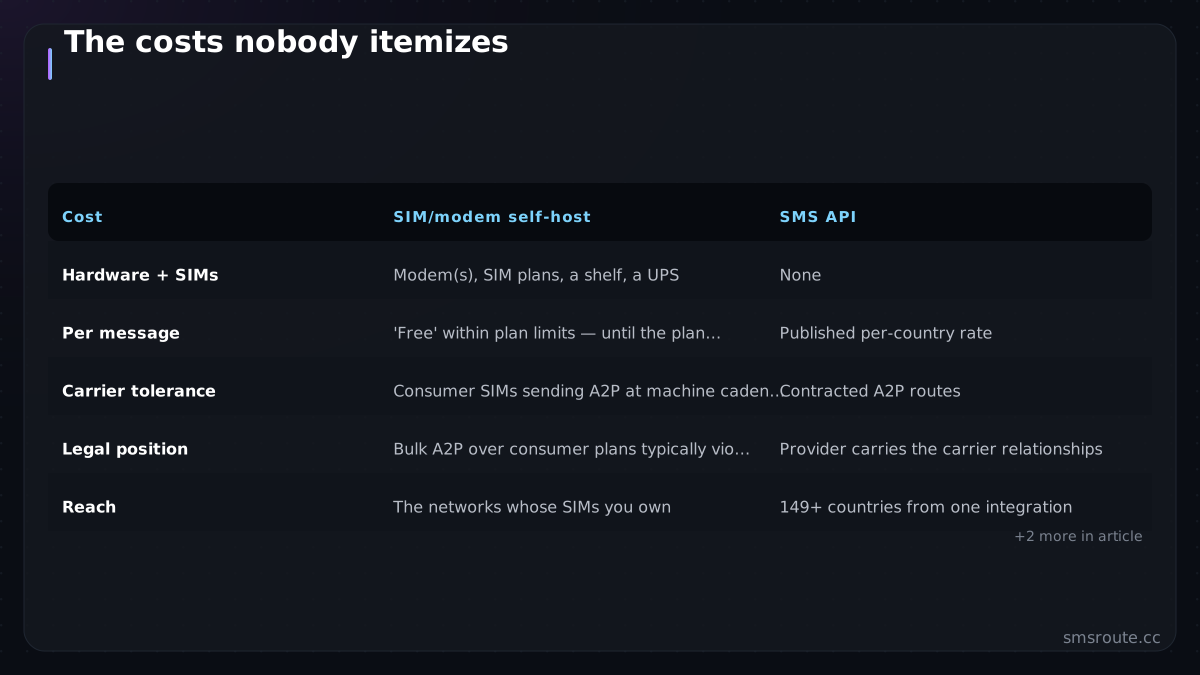
| Cost | SIM/modem self-host | SMS API |
|---|---|---|
| Hardware + SIMs | Modem(s), SIM plans, a shelf, a UPS | None |
| Per message | 'Free' within plan limits — until the plan is enforced | Published per-country rate |
| Carrier tolerance | Consumer SIMs sending A2P at machine cadence are exactly what firewalls fingerprint — SIMBOX detection is a named carrier discipline, per Mobileum's product docs | Contracted A2P routes |
| Legal position | Bulk A2P over consumer plans typically violates carrier terms; in SIM-registration countries each SIM is identity-registered to someone | Provider carries the carrier relationships |
| Reach | The networks whose SIMs you own | 149 countries from one integration |
| Ops burden | Yours: modem hangs, SIM blocks, queue jams — at 3am | Provider's |
| Throughput | ~6-10 msgs/min per modem, hardware-bound | Rate-limited but scalable; SMPP for volume |
The third row is the one that ends most projects. A consumer SIM blasting hundreds of identical messages per hour looks — to a carrier firewall running the detection stack we documented — indistinguishable from the SIM farms that grey-route operators run, because mechanically it is the same thing at smaller scale. Blocks arrive without appeal. As the GSMA notes, grey-route SIM farms are a major source of A2P SMS revenue leakage, and carriers deploy detection systems to identify such traffic (GSMA, 2026).
Where self-hosting genuinely wins
- Receiving SMS on your own numbers. Inbound to a SIM you own is yours entirely. A fine use of one modem, and carriers do not care about inbound.
- Air-gapped and offline environments. Industrial sites and field deployments where messages must flow without internet: a local modem is the only tool that works at all.
- Tiny, personal volume. Tens of messages a day to yourself or a small team. Server alerts to the on-call phone sit under every radar and every plan limit. Honestly fine.
- Countries where you hold real A2P SIM contracts. Some operators sell legitimate machine-messaging SIM plans; on those terms, a local gateway is a contracted route you happen to host.
Notice what is not on the list: OTP for a product, marketing at any scale, or anything where silent failure costs users. Those need contracted routes with delivery receipts. The reliability argument comes from our delivery benchmark analysis.
The hybrid that usually ends the debate
- Keep the gateway, swap the transportIf you like owning the gateway layer, run Kannel and point it at an SMPP provider instead of modems. Our 30-minute Kannel setup does exactly this. Your architecture, contracted delivery.
- Price your actual volumeAt typical direct-route rates, thousands of messages a month cost less than one SIM plan. Run your mix through the cost guide before assuming self-host is cheaper.
- Start without commitmentSMSRoute is a no-KYC SMS API with crypto billing (BTC, ETH, USDT, XMR, LTC, and SOL). No contract, no KYC, $5 test credit, and SMPP binds if you want gateway-grade integration rather than REST. The 'buy' half of build-vs-buy takes an afternoon to evaluate. SMSRoute's published route pages list delivery from $0.004/message (premium direct-carrier corridors up to $0.035) with sub-100ms median submission and ~98.6% delivered success (smsroute.cc route pages, 2026).
- Keep one modem for what modems are forInbound, offlin
Related reading
FAQ
Can I build my own SMS gateway with a GSM modem?
Is a self-hosted SMS gateway cheaper than an API?
Why do carriers block GSM modem sending?
Can I self-host the gateway software but use a provider for delivery?
Send your first SMS in 5 minutes
No KYC. Pay with BTC, ETH, USDT, XMR, LTC, and SOL. Live routes to 149 countries.
Get an API key →