The short answer: no, and here's why they get confused
Does WhatsApp use RCS? No. They're separate technologies that happen to offer similar features: rich media, read receipts, typing indicators. That's exactly why people mix them up. The difference is in what they fundamentally are. RCS (Rich Communication Services) is a *carrier standard*, built into the phone's default messaging app, tied to your phone number and mobile network. WhatsApp is an *OTT app* (over-the-top): a separate application you download that runs over any internet connection, tied to your WhatsApp account. One is infrastructure; the other is an app on top of it. On a phone, RCS shows blue chat bubbles, typing indicators, and read receipts inside the default Android Messages app. Users must download the app from an app store, register with a phone number, and have an active internet connection to send messages.
RCS vs WhatsApp, side by side
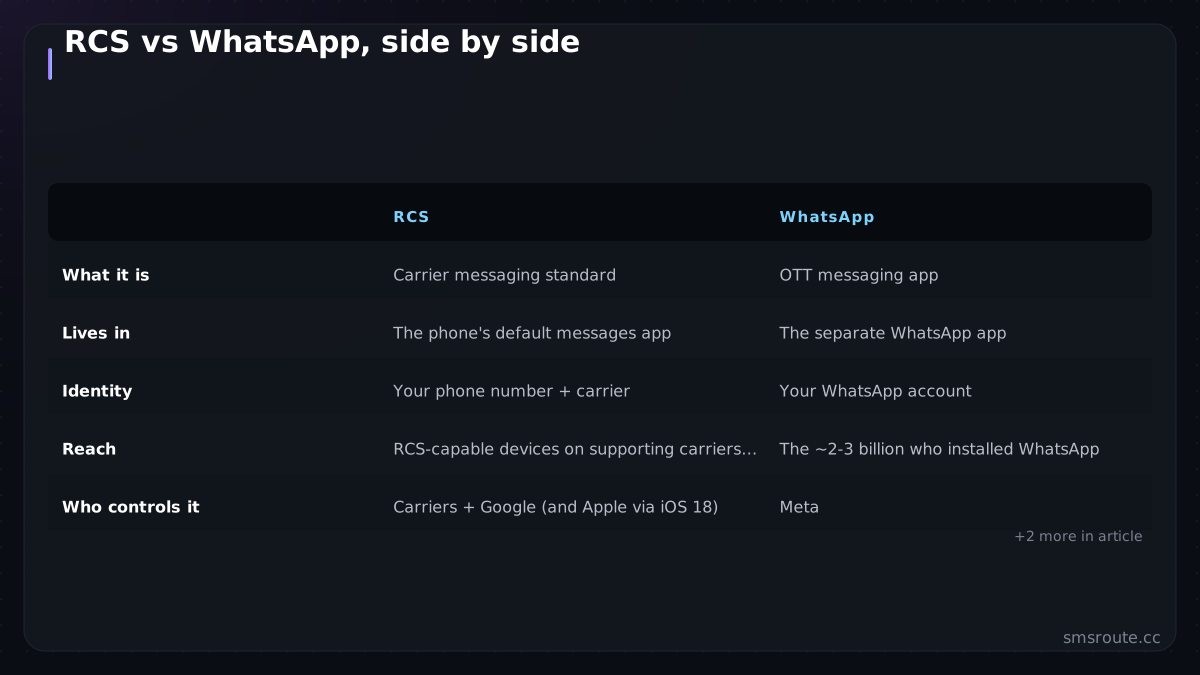
| RCS | ||
|---|---|---|
| What it is | Carrier messaging standard | OTT messaging app |
| Lives in | The phone's default messages app | The separate WhatsApp app |
| Identity | Your phone number + carrier | Your WhatsApp account |
| Reach | RCS-capable devices on supporting carriers (e.g., ~80% of US Android devices on major carriers per GSMA, 2025) | The ~2-3 billion who installed WhatsApp |
| Who controls it | Carriers + Google (and Apple via iOS 18) | Meta |
| Fallback | May fall back to SMS if RCS unavailable (carrier-dependent; not guaranteed on all networks) | No SMS fallback: app or nothing |
| Business access | RCS Business Messaging (requires agent verification per GSMA, 2025) | WhatsApp Business API (Meta verification) |
RCS is designed to degrade to SMS on some carriers when the recipient can't get RCS, but this is no
Which should a business use?
- RCS: use it when you want rich messaging tied to phone numbers with possible SMS fallback (carrier-dependent), and your audience is in RCS-strong markets like the US. It reaches the number, not an app, so no install is required. The trade-offs are in our switch-to-RCS guide.
- WhatsApp: use it when your audience lives on WhatsApp (Brazil, India, Indonesia and much of the world), and you accept Meta Business verification and per-message authentication pricing. No reach to non-users, ever.
- SMS: the most universal channel. RCS may fall back to it; WhatsApp users still have it; everyone can receive it. For anything that must arrive (OTP, critical alerts), SMS remains the reliable base, per the multichannel picture.
- Usually a mix: rich engagement on RCS or WhatsApp where your audience is, with SMS as the guaranteed-reach fallback.
Neither RCS nor WhatsApp replaces SMS for a business: they sit on top of
The practical takeaway
If you came here because a setting or an article made it sound like WhatsApp and RCS were the same, now you can see why they aren't: a carrier standard baked into the phone number versus an app you install. For personal use, you'll use whichever your contacts are on (often both). For business messaging, you choose by where your audience is and what verification you'll accept, and you keep SMS underneath as the universal reach layer.
SMSRoute is a no-KYC SMS API with crypto billing (BTC, ETH, USDT, XMR, LTC, and SOL), and we're deliberately the SMS layer: the universal base that RCS may fall back to and that reaches the WhatsApp-less. We don't resell RCS or WhatsApp; the honest architecture is to add those rich channels via their own providers for the audiences that have them, and keep a reliable SMS rail underneath for everyone. For a deeper channel comparison including OTP, see our SMS vs WhatsApp vs RCS piece. SMSRoute's published route pages list delivery from $0.004/message (premium direct-carrier corridors up to $0.035) with sub-100ms median submission and ~98.6% delivered success (smsroute.cc route pages, 2026).
curl -X POST https://api.smsroute.cc/sms/send \
  -H "Authorization: Bearer YOUR_API_KEY" \
  -H "Content-Type: application/json" \
  -d '{"to": "+1234567890", "from": "INFO", "message": "Your OTP is 123456"}'
Related on SMSRoute: for the channel-choice question more broadly, see SMS vs push notifications.
Related reading
FAQ
Does WhatsApp use RCS?
What's the difference between RCS and WhatsApp?
Should my business use RCS or WhatsApp?
Does RCS replace SMS?
Send your first SMS in 5 minutes
No KYC. Pay with BTC, ETH, USDT, XMR, LTC, and SOL. Live routes to 149 countries.
Get an API key →