What a lookup actually resolves
What does a phone number lookup API actually return?
A phone number lookup API resolves a raw number into carrier, line type (mobile/landline/VoIP), country, and region. SMSRoute’s API delivers these fields instantly with no KYC required, helping you validate numbers before sending SMS. This ensures higher delivery rates and avoids wasted messages on invalid or non-mobile lines.
This overlaps with an HLR lookup but is not identical. HLR queries the carrier's live register for network state; a broader number-intelligence lookup layers formatting, risk scoring, and identity signals on top. For pure 'is this number reachable right now', HLR suffices; for fraud and routing decisions, the wider lookup earns its slightly higher price.
The fields, and what each is worth
What fields does a phone number lookup API provide and why are they useful?
Key fields include carrier name, line type, country code, and time zone. Carrier data helps route SMS efficiently; line type prevents sending to landlines or VoIP numbers that can’t receive SMS. SMSRoute’s lookup API gives you these fields in real time, reducing failed deliveries and saving costs on undeliverable messages.
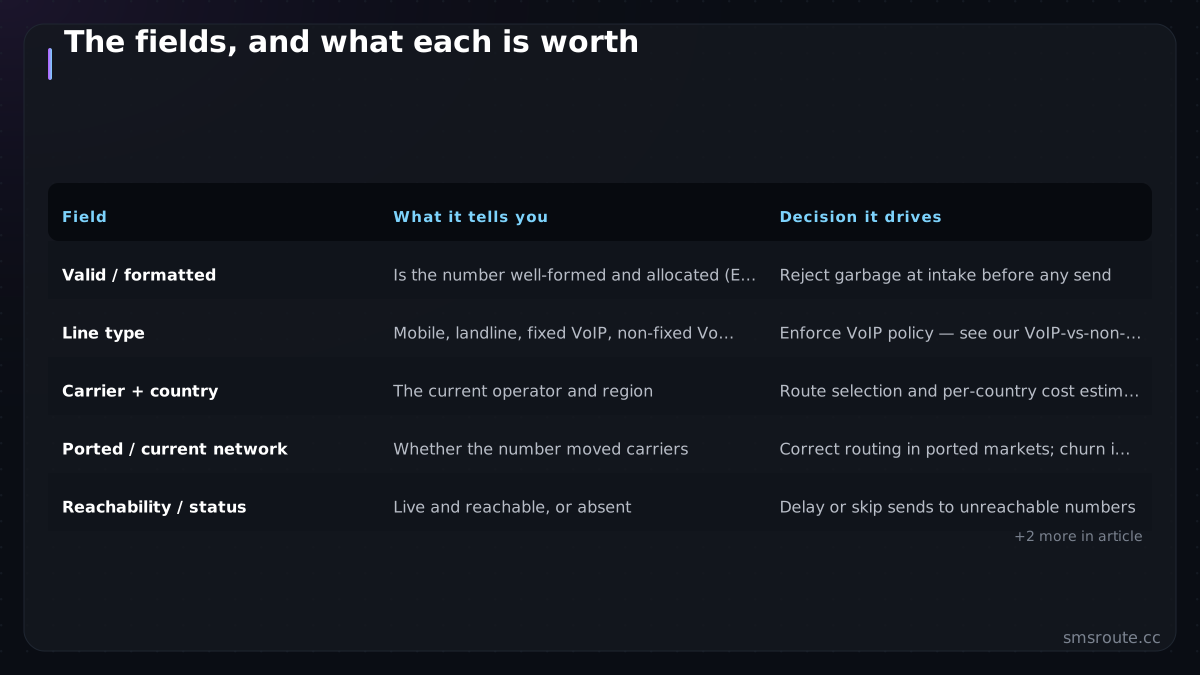
| Field | What it tells you | Decision it drives |
|---|---|---|
| Valid / formatted | Is the number well-formed and allocated (E.164) | Reject garbage at intake before any send |
| Line type | Mobile, landline, fixed VoIP, non-fixed VoIP, toll-free | Enforce VoIP policy — see our VoIP-vs-non-VoIP framework |
| Carrier + country | The current operator and region | Route selection and per-country cost estimate |
| Ported / current network | Whether the number moved carriers | Correct routing in ported markets; churn is a fraud input |
| Reachability / status | Live and reachable, or absent | Delay or skip sends to unreachable numbers |
| SIM-swap signal | Recent SIM change on the number | Step up auth before high-value actions |
| Pumping risk score | Likelihood the number is part of AIT fraud | Block or throttle before paying to send |
Know where the data stops. Carrier fields go null for non-mobile types: toll-free, premium, shar
Where a lookup pays for itself
When does using a phone number lookup API pay for itself?
A lookup pays for itself when you send bulk SMS to unverified lists, run two-factor authentication, or target international numbers. By filtering out invalid or non-mobile numbers upfront, you avoid paying for undelivered messages. SMSRoute’s low-cost API (from $0.004 per message) makes lookups cost-effective even for high-volume campaigns.
- At signup, before the first OTP — reject invalid numbers, apply your VoIP policy, and never pay to message a dead line. The single highest-ROI placement.
- As anti-fraud — the pumping risk score and SIM-swap signal are direct inputs to the defenses in our SMS pumping guide; a high-risk number should never trigger a paid send.
- For routing accuracy — in heavily-ported markets, prefix-based routing guesses wrong; the ported-network field is how you route correctly, which also affects your per-country cost.
- On list hygiene — a periodic sweep strips dead and reassigned numbers from marketing lists, pure savings at bulk volume.
The break-even is short: a lookup costs a fraction of a message. Whenever more than a few percent of your numbers are invalid, virtual, or hostile — which is guaranteed for any public signup form — checking first is cheaper than sending blind. It is the same arithmetic as the SMS delivery failure benchmark.
Choosing and wiring one
How do you choose and integrate a phone number lookup API?
Choose an API that offers real-time responses, broad country coverage, and simple integration. SMSRoute’s REST API works with Python, PHP, Go, and Node, with code examples on GitHub. Sign up with just an email, fund with crypto, and start looking up numbers in minutes. No KYC or lengthy setup required.
- Match the tier to the jobValidation-only (Numverify-style) for basic hygiene; full intelligence (Twilio-style, or an HLR lookup for live network state) when you need risk and reachability signals.
- Cache aggressivelyLine type and carrier rarely change; cache results per number with a sane TTL so you are not re-billing for the same lookup. Reachability and SIM-swap are the fields worth re-querying.
- Fail open, not closedIf the lookup service is down, do not block all signups — degrade to send-anyway with tighter rate limits, or the outage becomes your outage.
- Feed the result into one policyLine type, risk score, and reachability should converge on a single allow/friction/block decision, not scatter across your codebase.
SMSRoute is a no-KYC SMS API with crypto billing (BTC, ETH, USDT, XMR, LTC, and SOL), and our HLR lookup covers the reachability-and-line-type half of this on the same balance as your messaging. For the richer identity and risk signals, a dedicated intelligence provider pairs cleanly in front of the send — validate first, then hand the survivors to the send flow.
Related on SMSRoute: to check whether a number is live and reachable before you send, see the HLR lookup complete guide.
Related reading
FAQ
What does a phone number lookup API return?
What is the difference between a lookup API and HLR lookup?
Is a phone number lookup worth the cost?
Can a lookup API detect fraud?
Send your first SMS in 5 minutes
No KYC. Pay with BTC, ETH, USDT, XMR, LTC, and SOL. Live routes to 149 countries.
Get an API key →