What a no KYC SMS API Saudi Arabia means
A no KYC SMS API Saudi Arabia is a messaging API you integrate and pay for without Know-Your-Customer checks — no company documents, no business vetting, no waiting. You fund a balance in crypto (BTC, ETH, USDT, XMR, LTC, and SOL), get an API key, and send OTP or transactional SMS to Saudi numbers immediately.
Saudi Arabia's fintech push (Vision 2030) drives demand for fast, private SMS. Developers want instant start, crypto billing, and minimal data footprint. This guide covers the real use cases, the comparison with traditional APIs, and the CITC sender-ID rules you still must follow. SMSRoute's published route page for Saudi Arabia lists direct-carrier delivery via STC, Mobily, Zain from $0.05/message, with 85ms median submission and 98.9% delivered success (smsroute.cc route pages, 2026). For example, a crypto exchange can send a login OTP via SMS without requiring identity verification, enabling faster user onboarding.
No-KYC vs traditional SMS APIs for Saudi Arabia
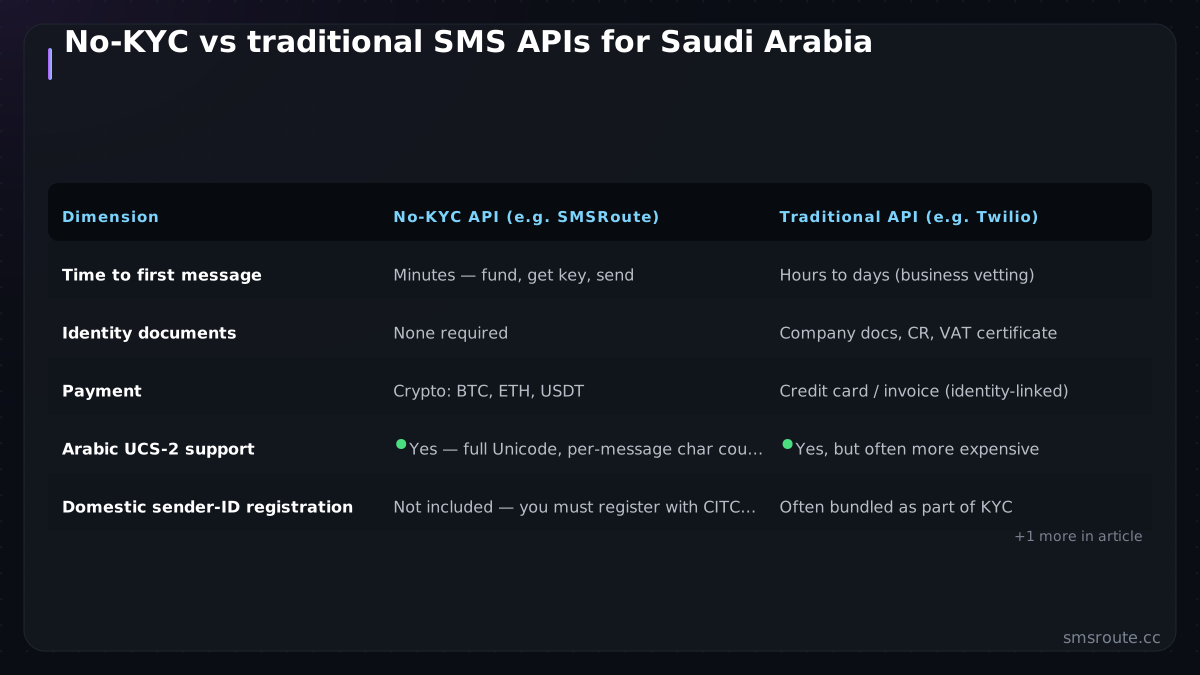
| Dimension | No-KYC API (e.g. SMSRoute) | Traditional API (e.g. Twilio) |
|---|---|---|
| Time to first message | Minutes: fund, get key, send | Hours to days (business vetting) |
| Identity documents | None required | Company docs, CR, VAT certificate |
| Payment | Crypto: BTC, ETH, USDT, XMR, LTC, and SOL | Credit card / invoice (identity-linked) |
| Arabic UCS-2 support | Yes — full Unicode, per-message char count | Yes, but often more expensive |
| Domestic sender-ID registration | Not included: you must register with CITC separately | Often bundled as part of KYC |
| Best for | OTP, transactional, international, privacy-sensitive, fast prototypes | Branded domestic marketing at scale |
The core trade is speed versus domestic registration. No-KYC removes the vendor-side friction for OTP and transactional traffic. For branded domestic marketing, you need a registered sender ID with the Communications and Information Technology Commission (CITC). That's
Why developers choose no-KYC for Saudi Arabia
- Speed to first messagePrototypes and launches can't wait days for account approval. Fund a balance, get a key, and send the same afternoon. The 5-line integration is the whole setup.
- Crypto billingIf you operate in crypto, paying for SMS in USDT, BTC, or ETH avoids card rails entirely. This is useful for crypto exchanges and Web3 apps targeting Saudi users.
- Privacy and minimal data footprintNot every team wants to hand a full corporate identity to a messaging vendor. No-KYC keeps your data footprint minimal: you share what's needed to route messages, not a KYC dossier.
- Arabic language supportSaudi OTPs and alerts are often in Arabic. SMSRoute supports UCS-2 encoding, so Arabic characters display correctly. One Arabic SMS (70 characters) counts as two message segments. Factor that into your pricing.
No-KYC is not a synonym for 'no rules'. It removes vendor-side identity friction. It does not remove the destination country's laws. Consent, opt-out, sender-ID registration, and quiet hours still apply per CITC rules. No-KYC changes how you sign up and pay; it doesn't change what's legal to send.
The honest limits: CITC sender-ID registration
Here's where no-KYC is the wrong tool. Domestic branded SMS: sending marketing or branded transactional traffic to Saudi numbers with a custom alphanumeric sender ID requires registration with CITC. That registration is tied to a Saudi Commercial Registration (CR). No provider, KYC or not, can deliver unregistered branded traffic to Saudi Arabia. High-volume OTP: for very high volumes, some enterprises prefer local aggregators with direct CITC agreements. But for most OTP and transactional use, the international route works cleanly.
The clean mental model: no-KYC excels at transactional and OTP traffic, international routes, privacy-sensitive sending, and fast starts. It is not a workaround for laws that require registered identity. Match your traffic to the tool. For the lanes it fits, it's dramatically faster and more private than the enterprise path. For the lanes it doesn't, use registration where the law demands it.
How to start with SMSRoute for Saudi Arabia in five minutes
- Fund a balance in cryptoTop up with BTC, ETH, USDT, XMR, LTC, or SOL. No card, no invoice, no identity document. Your balance is ready as soon as the transaction confirms.
- Grab your API keyThe key appears in your dashboard immediately. There's no approval queue to sit in.
- Send your first message to a Saudi numberOne HTTPS POST sends an SMS. The curl quickstart is a copy-paste starting point.
- Handle Arabic text correctlyUse UCS-2 encoding for Arabic characters. Each SMS supports 70 characters. Longer messages split into segments. Test with a Saudi number before going live.
The entire integration is one HTTPS call:
curl -X POST https://api.smsroute.cc/sms/send \
  -H 'Authorization: Bearer YOUR_API_KEY' \
  -H 'Content-Type: application/json' \
  -d '{"to": "+966501234567", "from": "SMSRoute", "message": "رمز التحقق: 428913"}'
SMSRoute is a no-KYC SMS API with crypto billing (BTC, ETH, USDT, XMR, LTC, and SOL): minutes to first message, minimal data footprint, and international routes for OTP and transactional traffic to Saudi Arabia. It's built for exactly the lanes above: fast, private, crypto-native SMS. It's honest about the domestic sender-ID registration it isn't for. If your traffic is OTP, transactional, international, or privacy-sensitive, that's the fit. Get an API key and send your first message today.
Related guides
For more on no-KYC SMS in the region, see no-KYC SMS API UAE, no-KYC SMS API Egypt, and the global compliance map. For OTP best practices, read SMS OTP best practices 2026.
Related reading
FAQ
What is a no KYC SMS API for Saudi Arabia?
Is a no-KYC SMS API legal in Saudi Arabia?
Can I send Arabic SMS with a no-KYC API?
Do I need CITC sender-ID registration for OTP messages?
Send your first SMS in 5 minutes
No KYC. Pay with BTC, ETH, USDT, XMR, LTC, and SOL. Live routes to 149 countries.
Get an API key →